
Why Technology Rollouts Fail — and the Operating Model That Fixes Them
July 17, 2026
Technology rollouts are often treated like a software problem: buy the tool, configure the system, train users, and go live. In reality, the software is usually only the visible part of the iceberg. The real reason implementations fail is that organizations launch technology without the operating model needed to absorb it, govern it, and translate it into everyday work. That gap shows up as confusion, slow adoption, duplicated effort, shadow processes, and disappointing business results.
Recent research points to the same conclusion from different angles. McKinsey has found that outcomes depend heavily on operating model design, not just the technology itself, and that organizations with more integrated models are better prepared for digital change. PMI’s 2024 research also highlights that high-performing PMOs are increasingly central to digital transformation and value delivery, while Prosci’s research continues to show that visible sponsorship, role clarity, and manager enablement are major contributors to successful change. (mckinsey.com)
This post breaks down why rollouts stall, what the latest research says, and how to build a practical rollout operating model that works for HR systems, ERP, CRM, and AI-enabled enterprise tools alike.

1. The real problem isn’t the software — it’s the rollout system around it
When a new system underperforms, the instinct is to blame the platform: poor UX, missing features, integration issues, or “bad data.” Those can matter, but they rarely explain the full picture. Most rollout failures happen because the organization has no durable system for introducing change at scale. The tool arrives, but the surrounding operating model is still built for the old way of working. McKinsey’s research on digital strategy and operating models emphasizes that structure alone is not enough; companies need clarity, speed, skills, and commitment across the model to make digital change stick. (mckinsey.com)
A rollout system is bigger than project management. It includes executive sponsorship, process redesign, communications, training, local manager support, data readiness, issue triage, and post-launch reinforcement. If even one of these elements is weak, adoption slows. Users may log in once, then fall back to spreadsheets, email, or legacy workflows. That is not a “technology issue” in the narrow sense — it is an operating failure.
This distinction matters because software can be installed quickly, but behavior cannot. People do not adopt tools because they are available; they adopt them when the new tool makes sense inside a redesigned workflow, when their manager reinforces it, and when the organization measures whether the change is actually being used. Prosci’s change-management research frames this clearly by linking success to leadership sponsorship, project management, and change management working together around shared outcomes. (prosci.com)
In short: the software is the artifact. The rollout system is the real product.
2. Why many implementations stall after go-live: fragmented ownership, weak change capacity, and unclear outcomes
The hardest part of many rollouts begins after go-live. That is when the initial energy fades, the support tickets rise, and the real work of habit change begins. Three patterns show up again and again: fragmented ownership, weak change capacity, and unclear outcomes.
First, fragmented ownership means no one owns the end-to-end experience. IT owns the platform, the PMO owns the timeline, HR or Finance owns the business process, and local leaders own “their people,” but no one is accountable for adoption as a whole. This creates gaps in decision-making and slow escalation. McKinsey’s work on operating models notes that speed in decision-making and clarity of roles are essential to performance, especially in fast-changing environments. (mckinsey.com)
Second, weak change capacity is a capacity problem, not just a communication problem. Many organizations underestimate the effort required to redesign workflows, train managers, support line teams, and respond to resistance in the first 30 to 90 days. Prosci’s research emphasizes that active sponsorship and engaged people managers are critical, and that effective sponsors are far more likely to help projects meet objectives than ineffective ones. (prosci.com)
Third, unclear outcomes create launch-day theater. Teams celebrate go-live, but they never define what “good adoption” looks like. Is success 95% login rate? Reduced cycle time? Fewer manual workarounds? Better data quality? Faster case resolution? Without explicit outcomes, it becomes impossible to tell whether the rollout is actually working. Prosci recommends measuring success using metrics such as speed of adoption, utilization, and proficiency — not just project completion. (prosci.com)
When these three problems combine, the organization experiences the same painful pattern: launch happens, but transformation does not. The fix is not more status reporting. It is a stronger operating model with clear ownership, adequate change capacity, and measurable outcomes from day one.
3. What the latest research says about digital transformation and PMO performance
The latest research is consistent on one point: digital transformation succeeds less because of technology selection and more because of organizational design and execution discipline. McKinsey’s 2025 research on operating models says companies with emergent structures tend to be more prepared for innovation, technology, data, and AI scaling than those with traditional hierarchies. It also notes that structure alone does not determine success; other operating-model factors are critical. (mckinsey.com)
McKinsey’s digital-transformation research also shows that organizations with integrated technology models are less likely to encounter transformation challenges and integration problems. In one study, companies with an integrated or fully digital technology model were 30% less likely to face digital-transformation challenges and less than half as likely to struggle integrating new digital efforts with core architecture. (mckinsey.com)
On the PMO side, PMI’s 2024 report highlights that high-performing PMOs are increasingly associated with customer satisfaction, digital transformation, and innovation. The report also notes that leading PMOs are far more likely to use technology to enable value delivery. (pmi.org) Gartner’s recent PMO research similarly argues that PMOs should prioritize business outcomes and support CIOs in enabling IT capabilities, rather than focusing only on classic project controls. (gartner.com)
Prosci’s research adds the human side of the equation. It shows that active sponsorship remains a leading contributor to success and that projects with extremely effective sponsors are much more likely to meet objectives than those with ineffective sponsors. It also emphasizes role-based training for executives, managers, project teams, and front-line employees. (prosci.com)
Taken together, the research suggests a clear lesson: PMOs and transformation teams should not just track delivery. They should orchestrate adoption. That means managing readiness, capability, behavior, and business outcomes alongside milestones and budgets.
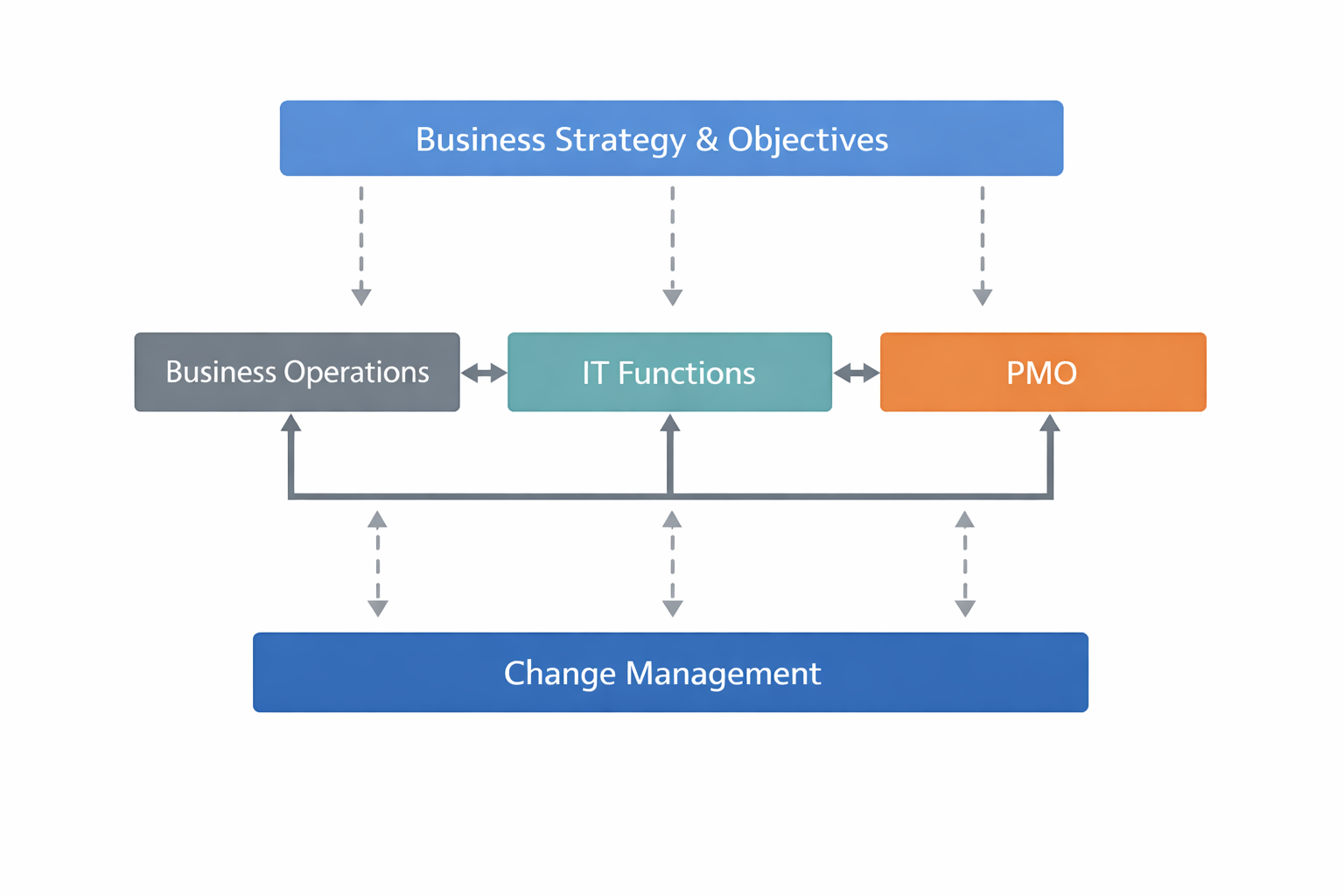
4. A new model for rollout readiness: aligning strategy, process, people, and data before launch
Rollout readiness is not a checkbox at the end of testing. It is a four-part alignment exercise: strategy, process, people, and data. If those elements are not aligned before launch, the rollout may still happen — but it will almost certainly be messy.
Strategy answers why the change exists. What business outcome are we trying to improve? Lower cost? Faster hiring? Better customer response? More accurate forecasting? When the strategy is vague, the rollout becomes feature-centric instead of outcome-centric.
Process answers how work will change. A new tool rarely succeeds if the old workflow is simply copied into the new system. The process must be redesigned so the technology fits the intended way of working.
People answers who must change behavior. This includes executives, managers, super users, service desk staff, and frontline employees. Prosci emphasizes that sponsorship and people-manager enablement are among the strongest drivers of change success. (prosci.com)
Data answers what the system depends on. Poor master data, unclear definitions, and mismatched ownership can sink even the best rollout. If users do not trust the numbers, they will not trust the tool.
A practical readiness model asks four questions before launch:
Do we have a clear business outcome?
Have we redesigned the workflow, not just configured software?
Are managers prepared to reinforce the new behavior?
Is the underlying data usable and governed?
McKinsey’s operating-model research supports this broader view by showing that effective operating models deliver clarity, speed, skills, and commitment — exactly the capabilities rollout teams need before launch. (mckinsey.com)
The key insight is simple: readiness is not about whether the system is turned on. It is about whether the organization is ready to work differently the moment it is turned on.
5. Building an implementation core team that can actually drive decisions fast
A successful rollout needs a small, empowered core team that can make decisions quickly. Large steering committees are useful for oversight, but they are usually too slow for day-to-day implementation. The core team should be the operational engine of the rollout: the group that removes blockers, resolves trade-offs, and keeps adoption moving.
At minimum, the core team should include:
an executive sponsor with authority,
a business owner accountable for outcomes,
a project or program lead,
a change lead,
a process owner,
a data owner,
and a technical lead.
The main job of this team is not to create more slides. It is to make fast decisions on scope, sequencing, training, issue prioritization, and escalation. McKinsey’s operating-model research repeatedly emphasizes speed and clear decision rights as drivers of performance, while Prosci’s research underlines the importance of sponsorship and manager engagement in turning change into results. (mckinsey.com)
What makes a core team effective is not only the right people, but the right cadence. Strong teams meet frequently, review adoption data, identify where users are stuck, and assign actions with owners and due dates. They also know which decisions belong in the room and which decisions should be pushed down to local managers or functional leads.
This team should be built early, not after problems appear. Many rollout issues become expensive because no one is empowered to decide quickly when the system is half-built or just launched. A strong core team prevents that drift by treating the rollout as a managed operating cadence, not a one-time event.
In practice, the best implementation teams act like a control tower: they do not do all the work themselves, but they see where the work is breaking and intervene fast enough to keep the rollout on course.
6. Designing adoption instead of announcement: training, workflow redesign, and manager enablement
Too many organizations announce a new system as if awareness equals adoption. It does not. People can know a tool exists and still not use it correctly, consistently, or at all. Adoption must be designed.
The first element is training, but training should be role-based, not generic. Executives need to understand what success looks like and how to sponsor it. Managers need to know how to reinforce new behaviors and handle exceptions. End users need practical, task-based instruction tied to their actual work. Prosci’s enterprise training materials specifically emphasize role-based change training for sponsors, managers, project teams, and employees. (prosci.com)
The second element is workflow redesign. If a new CRM requires ten extra clicks, users will route around it. If a new ERP step slows purchasing without clear value, people will revert to spreadsheets or side channels. Adoption improves when the new workflow is not just available but obviously better.
The third element is manager enablement. Managers are the translators between strategy and daily behavior. They answer questions, set expectations, reinforce use, and spot resistance early. Prosci’s research highlights people managers as a distinct and important role in change, and its training programs specifically help managers support front-line teams through transition. (prosci.com)
This is where many rollouts fail: they provide training sessions, but not managerial reinforcement. They send announcements, but not job aids. They create dashboards, but not new routines. Effective adoption design includes communications, practice, coaching, and local reinforcement — not just a launch email.
The most successful rollouts treat adoption as a behavior design problem. They ask: what do people need to start doing, stop doing, and do differently on day one, and what support will make that change realistic?
7. Measuring success beyond launch day: leading indicators, user behavior, and business outcomes
If you only measure go-live, you are measuring the beginning of the change, not the success of it. Real rollout measurement includes leading indicators, user behavior, and business outcomes.
Leading indicators tell you whether adoption is building. Examples include training completion, manager briefings delivered, super-user activation, ticket volume trends, data quality improvements, and percentage of critical workflows completed in the new system.
User behavior shows whether the organization is actually changing. Are users logging in? Are they using the right workflow? Are managers reviewing the right reports? Are workarounds declining? Are approvals happening inside the system instead of outside it?
Business outcomes show whether the rollout is delivering value. These can include cycle-time reduction, improved compliance, lower administrative effort, faster hiring, better forecasting, improved customer response, or reduced manual rework.
Prosci’s framework is especially useful here because it distinguishes among speed of adoption, utilization, and proficiency, rather than collapsing everything into one vague “adoption” number. (prosci.com) McKinsey’s operating-model research also reinforces the need for measurable outcomes like speed, clarity, and performance improvement, not just delivery milestones. (mckinsey.com)
A strong measurement model also helps leaders avoid false positives. For example, login rates may look healthy while users still maintain side spreadsheets. Training completion may look strong while managers remain disengaged. That is why measurement should connect behavior to outcomes.
The best question to ask after launch is not “Did we go live?” It is “Did the business actually change?”
8. A sample rollout framework for HR, ERP, CRM, or AI-enabled enterprise tools
A good rollout framework should be flexible enough to work across systems while still being concrete enough to guide action. Here is a practical model that can be adapted for HR, ERP, CRM, or AI-enabled enterprise tools.
Phase 1: Define outcomes
Start with business goals, not features. For HR, that may mean faster hiring or cleaner employee data. For ERP, it may mean better financial visibility or fewer manual reconciliations. For CRM, it may mean improved pipeline quality and forecast accuracy. For AI tools, it may mean faster knowledge retrieval or better decision support.
Phase 2: Assess readiness
Check process maturity, data quality, sponsor commitment, manager capability, and local capacity. Identify likely resistance points early.
Phase 3: Design the future workflow
Map the new process end to end. Remove unnecessary steps. Clarify who does what, when, and in which system.
Phase 4: Build the change plan
Create a role-based plan for executives, managers, super users, and end users. Include communications, training, coaching, and resistance management. Prosci’s research strongly supports role-based sponsorship and people-manager enablement. (prosci.com)
Phase 5: Prepare data and support
Fix master data, create support documentation, define escalation paths, and set up launch support. Assign owners for issue triage.
Phase 6: Launch in waves
Pilot where possible, then scale. Use each wave to learn and improve before the next one.
Phase 7: Stabilize and reinforce
Monitor behavior and outcomes for 30, 60, and 90 days. Adjust training, manager coaching, and process rules based on what users actually need.
This phased framework works because it treats rollout as an operating system for change, not a single event. It is less about one perfect launch and more about repeatable execution.
9. Common failure patterns and how to prevent them early
Most rollout failures are predictable. The challenge is not discovering them after the fact; it is spotting them early enough to intervene.
Failure pattern 1: “IT owns it”
When only IT is seen as responsible, business adoption suffers. Prevention: assign a business owner, sponsor coalition, and functional managers with explicit accountability.
Failure pattern 2: “We trained them, so they should use it”
Training is necessary but not sufficient. Prevention: add workflow redesign, manager reinforcement, coaching, and reinforcement after launch. Prosci’s research shows that training works best when paired with sponsorship and people-manager support. (prosci.com)
Failure pattern 3: “Go-live means done”
This mindset ends support too early. Prevention: define a 30/60/90-day stabilization plan with adoption metrics and issue management.
Failure pattern 4: “We’ll fix data later”
Bad data undermines trust and slows usage. Prevention: include data remediation in rollout planning, not as an afterthought.
Failure pattern 5: “Success is vague”
If the goal is just to “implement the system,” no one knows how to judge whether it worked. Prevention: define clear outcome metrics tied to business value.
Failure pattern 6: “Local managers will figure it out”
They usually won’t unless they are equipped. Prevention: create manager toolkits, talking points, escalation paths, and simple weekly routines.
McKinsey’s and Prosci’s research together reinforce a practical warning: transformation efforts fail when organizations focus on delivery mechanics without changing how the organization is set up to absorb change. (mckinsey.com)
Early prevention is far cheaper than post-launch recovery. The best teams identify these failure modes during design, not after complaints start rolling in.
10. Conclusion: treat technology rollout as an operating capability, not a one-time project
Technology rollouts fail when organizations treat them like events instead of capabilities. The software matters, but it is not the whole story. What determines success is whether the organization has the operating model to align strategy, redesign process, prepare people, govern data, and sustain adoption after launch. Research from McKinsey, PMI, Gartner, and Prosci all points in the same direction: transformation value comes from how organizations work, not just what tools they buy. (mckinsey.com)
The practical takeaway is straightforward. Stop asking only whether the system is ready. Start asking whether the organization is ready to use it well. Build a core team that can decide fast. Design adoption, not announcement. Measure behavior, not just go-live. And make rollout readiness a repeatable operating capability that gets stronger with every implementation.
That is the difference between installing software and changing the business.
References
PMI — High performing PMOs critical to driving business transformation
McKinsey — Products and platforms: Is your technology operating model ready?
McKinsey — Managing the fallout from technology transformations
McKinsey — How to get your operating model transformation back on track
Prosci — Right Change Management Training for Your Organization
Gartner — Improve PMO Impact by Prioritizing IT Operating Model Outcomes
Gartner — Redefine PMO Mandates to Drive Digital Business Transformation