
What Makes an AI Feature Actually Valuable to Users? 2025 Research, Trends, and Stats
June 22, 2026
Artificial intelligence is everywhere in 2025. It shows up in search, writing tools, customer support, office software, design platforms, and consumer apps. But “AI-powered” is not the same thing as “valuable.” Many features can demo well, sound impressive in a product launch, and still fail to create meaningful user value.
The difference is simple: users do not pay, keep using, or recommend a feature because it uses AI. They keep using it because it helps them do something important faster, with less effort, and with enough confidence to trust the result. Recent research shows that adoption is broad, but retention depends on whether AI actually improves outcomes, fits into real workflows, and earns trust. In other words, novelty gets attention; usefulness gets loyalty. Deloitte’s 2025 consumer research found that 53% of surveyed U.S. consumers use or experiment with generative AI, while 69% of users report using gen AI capabilities built into familiar software and services they already know. McKinsey’s 2025 survey found that 88% of respondents say their organizations use AI in at least one business function, but only 39% report any EBIT impact, which is a reminder that adoption alone does not equal value. (deloitte.com)

1. Introduction: why “AI-powered” is not the same as “valuable”
A feature becomes valuable only when it solves a problem users already have. That sounds obvious, but it is where many AI products go wrong. Teams often start with the technology and then look for a place to insert it. Users, however, start with friction: too many steps, too much manual work, too much uncertainty, too much time spent switching tools, or too many decisions that feel risky. If AI does not reduce one of those pains, it is usually decoration.
This matters more in 2025 because users are no longer impressed simply by the existence of AI. As the market matures, expectations rise. Deloitte reports that many consumers are using AI, but they also worry about privacy, security, and misuse; its 2025 Connected Consumer research says 82% of users surveyed think the technology could be misused, and 70% worry about data privacy and security when using digital services. That means the bar is not “Can it generate something?” but “Can I trust it, use it quickly, and know it will help me?” (deloitte.com)
The best AI features behave less like flashy extras and more like a capable assistant embedded into work people are already doing. They lower effort, speed up completion, improve confidence, and make better outcomes more likely. In many products, that means the feature is almost invisible: it feels like the software simply got smarter, not like the user had to “go use AI.” That distinction is the core of product value. Features that force users to learn a new mental model, move to a separate interface, or clean up unreliable outputs often lose value even if the underlying model is powerful. Valuable AI is not about proving intelligence; it is about removing work. (deloitte.com)
2. What users value most: speed, convenience, confidence, and reduced effort
When users say they like an AI feature, what they usually mean is that it helps them get to a result with less friction. Four benefits keep showing up again and again: speed, convenience, confidence, and reduced effort. These are not abstract product ideals; they are direct responses to everyday pain.
Speed matters because time is one of the clearest forms of value. If AI can draft a message, summarize a document, classify a support request, or recommend the next action in seconds rather than minutes, users immediately feel the benefit. Convenience matters because people prefer tools that fit naturally into their routine. Deloitte’s 2025 research found that 69% of users tap AI capabilities built into familiar software and services, which strongly suggests that “already where I work” is part of the value proposition. Confidence matters because users do not just want outputs; they want to trust those outputs enough to act on them. And reduced effort matters because many users are not looking for a magical experience—they are looking for fewer clicks, fewer tabs, fewer decisions, and less cognitive load. (deloitte.com)
The user experience angle is crucial here: an AI feature that technically saves time but adds stress can still fail. For example, if a feature is fast but frequently wrong, users may spend the saved time verifying or correcting it. That means the product has not really saved effort; it has shifted effort into cleanup. Intercom’s 2025 consumer sentiment research on AI support showed that trust and confidence rise after users see modern AI in action, and that transparency, accuracy, and seamless handoffs are key to earning confidence. That pattern reinforces a simple principle: speed alone is not enough. Value appears when speed is paired with reliability and a low-friction experience. (intercom.com)
3. Evidence from recent research: adoption is broad, but trust and usefulness determine retention
Recent research paints a consistent picture: AI adoption is widespread, but durable value depends on usefulness and trust. McKinsey’s 2025 State of AI survey found that 88% of respondents report regular AI use in at least one business function, up from 78% a year earlier. Yet only 39% attribute any EBIT impact to AI. That gap tells an important story: organizations are experimenting, but many are not yet capturing meaningful, repeatable business value. The missing ingredient is usually not model capability; it is how AI is deployed, measured, and integrated into work. (mckinsey.com)
Deloitte’s consumer research shows a similar pattern on the user side. Adoption is real, and AI is increasingly part of everyday digital life, but trust remains fragile. In the 2025 Connected Consumer survey, more than half of U.S. consumers surveyed used or experimented with gen AI, yet most still had concerns about privacy and misuse. That means broad usage does not guarantee long-term retention. People may try a feature because it is novel or because a platform prompts them to, but they continue using it when it earns confidence. (deloitte.com)
The strongest signal that usefulness drives retention is how people respond after experiencing a good AI feature. Intercom’s 2025 study found that before seeing an AI support demo, only 40% of consumers felt positive about AI in support, but that sentiment improved by 20 percentage points after the demo. Trust in AI agents to resolve issues rose 18 percentage points after users saw the system in action, while distrust nearly halved. That is an important lesson for product teams: user skepticism often comes from unclear expectations and poor prior experiences, not from a refusal to use AI in principle. When the product proves it can be accurate, transparent, and helpful, perception changes quickly. (intercom.com)
4. The importance of solving a real job-to-be-done instead of adding AI for novelty
A product feature should be evaluated against the job it is meant to help users complete. The job-to-be-done is usually not “use AI”; it is “write a better email,” “answer a customer faster,” “find the right information,” “make a better decision,” or “complete a workflow without rework.” AI features that are valuable map directly to one of these jobs and make the job easier, faster, or more accurate.
Novelty-based AI features fail because they start from the wrong question. Instead of asking, “Where can we use AI?” teams should ask, “What is the painful part of the user’s task, and can AI reduce that pain in a way users can feel?” That shift is what separates gimmicks from products. A flashy image generator bolted onto a project tool may be interesting, but if users mainly need a cleaner way to track tasks or summarize meeting notes, the image feature does not matter. Value is determined by relevance, not technical sophistication.
This is also why many successful AI deployments focus on narrow, high-frequency tasks. McKinsey’s 2025 survey notes that the companies seeing the most value often use AI not only for efficiency, but also for growth and innovation objectives, and they tend to redesign workflows rather than treat AI as a side feature. That makes sense: the better the fit between AI and the core job, the more likely the feature creates measurable impact. OpenAI’s enterprise report similarly points to outcomes such as revenue growth, improved customer experience, and shorter product-development cycles, which are all linked to specific business jobs rather than generic AI adoption. (mckinsey.com)
In practice, teams should test for job alignment by asking users one question: “Would you still care about this feature if it were not powered by AI?” If the answer is no, the feature may be interesting but not valuable. If the answer is yes because it genuinely saves time, lowers stress, or improves output quality, the AI is serving the user rather than the other way around.
5. Why AI features win when they are embedded in existing workflows and interfaces
One of the clearest trends in 2025 is that embedded AI is outperforming standalone AI. Users gravitate toward features that show up inside the tools they already use, rather than forcing them into separate apps or disconnected chat interfaces. That is not just a convenience preference; it is a workflow preference. People are busy. They want help where the work happens.
Deloitte’s 2025 Connected Consumer survey found that 69% of users rely on AI capabilities built into familiar software and services, such as search engines, social platforms, and office productivity apps. That is a strong signal that embedded experiences reduce adoption friction. Users do not have to learn a new environment or copy-paste data between systems. Instead, the AI shows up as a helpful layer inside an existing habit. (deloitte.com)
This also helps explain why AI can feel more valuable inside enterprise products than in isolated demos. OpenAI’s enterprise report highlights real-world patterns like AI contributing to customer experience improvements, automation of manual processes, and accelerated product development. Those gains typically happen when AI is not a separate destination but a part of a workflow: drafting inside the app, suggesting actions inside the ticketing system, summarizing inside the document, or helping route tasks in the same interface where work is already underway. (openai.com)
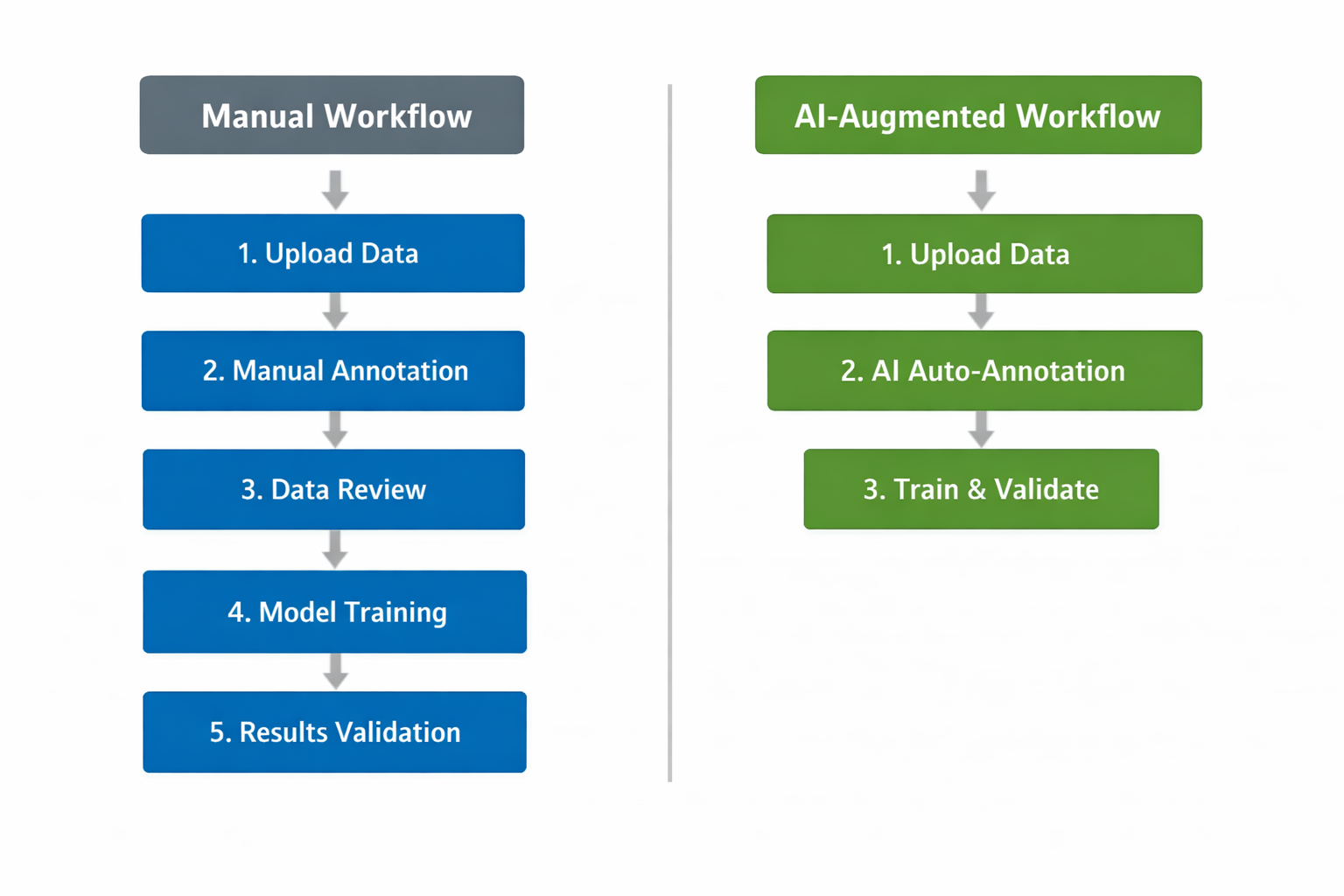
Embedded AI also has a psychological advantage. It reduces the feeling that users are “trying out a machine” and instead makes AI feel like a capability of the product itself. That matters because people are more willing to trust assistance when it is contextual. A good embedded AI feature knows what task the user is doing, uses the surrounding information responsibly, and proposes the next helpful step. When the product is aware of context, the user spends less energy explaining the problem, and more energy getting the job done. In short: AI wins when it disappears into the workflow and makes the workflow better. (deloitte.com)
6. Trust, privacy, and reliability: the hidden requirements behind user value
Users do not experience trust as a bonus feature. They experience it as a requirement. If a system is fast but unreliable, or useful but too invasive with data, its value collapses. This is especially true with AI, because AI often operates in spaces where users are already making decisions, handling sensitive information, or relying on output quality. Without trust, users hesitate. Without privacy, they resist. Without reliability, they verify everything manually.
Deloitte’s 2025 research makes this clear. The company found that 82% of users surveyed believe gen AI could be misused, and 70% worry about data privacy and security when using digital services. It also found that only around one in ten consumers are very willing to share sensitive information such as financial, communication, or biometric data. Those numbers imply that AI products cannot assume unconditional access to user data. They have to earn it through clear controls, transparent policies, and obvious safeguards. (deloitte.com)
Reliability is equally important. Users will tolerate occasional imperfection in a creative assistant, but they are much less forgiving when the feature gives wrong answers, creates hallucinated facts, or causes downstream errors. Intercom’s research shows that trust rises when users see accuracy, transparency, and seamless handoffs in action. That is a useful design lesson: reliability is not only about the model’s raw benchmark score. It is about the end-to-end experience of using the feature in a real workflow, with graceful fallback when the AI is uncertain. (intercom.com)
The practical takeaway is that privacy and reliability need to be designed into the product, not added as legal or support documentation after launch. Clear data handling, visible guardrails, good confidence signaling, source attribution when appropriate, and an easy way to escalate to human help can all increase perceived value. In AI products, trust is often what turns a “cool demo” into a tool people actually rely on. (deloitte.com)
7. Designing for measurable outcomes: time saved, better decisions, and fewer errors
If a team wants to know whether an AI feature is valuable, it should measure outcomes users can feel and businesses can verify. The three most useful categories are time saved, better decisions, and fewer errors.
Time saved is the easiest to understand. If AI reduces the number of manual steps or speeds up a task, users immediately perceive value. OpenAI’s enterprise report notes that across a large sample of workers, time saved is correlated with use of more advanced ChatGPT features. That suggests that richer AI capabilities are not just “more advanced” in a technical sense; they can also be more efficient in practice when they help users complete demanding tasks faster. (openai.com)
Better decisions matter when AI helps users interpret information, compare options, or surface relevant context. In this case, the value is not just speed but quality. For example, summarization can help a manager review a long thread quickly, while recommendation features can help a support agent prioritize the next action. McKinsey’s 2025 survey reported that 64% of respondents say AI is enabling innovation, which suggests that AI is doing more than automating routine work—it is also helping teams think differently and act with more confidence. (mckinsey.com)
Fewer errors may be the most underrated metric. A feature can appear to save time but still create hidden rework if it produces mistakes that users have to catch later. That is why measuring net value matters more than measuring usage alone. A good AI feature should reduce the total cost of the task, including review, correction, and follow-up. Intercom’s reporting and customer service materials repeatedly emphasize customer satisfaction, resolution rate, response time, and AI-specific performance metrics, reflecting the broader point that value should be visible in operational outcomes, not only in adoption counts. (intercom.com)
A strong measurement framework therefore combines behavioral and business signals: task completion time, edit rate, error rate, resolution rate, customer satisfaction, conversion, retention, and escalation rate. If those numbers improve, the AI feature is likely delivering genuine value. If usage is high but outcomes are flat, the feature may be interesting, but not truly helpful.
8. Common reasons AI features fail: hallucinations, unclear benefits, friction, and poor defaults
Many AI features fail for predictable reasons. The first is hallucination or inaccuracy. When a feature confidently produces wrong answers, users quickly learn they cannot rely on it. Once trust is broken, even good outputs become suspect. The second is unclear benefits. If users cannot easily tell what the feature saves, improves, or simplifies, they will ignore it. The third is friction. If AI requires too many prompts, too much setup, or too many context switches, it becomes another task instead of a shortcut. The fourth is poor defaults. If the feature is off by default, too vague, or too easy to misuse, most users will never discover enough value to adopt it. (intercom.com)
There is also a more subtle failure mode: the feature may work, but not for the most important job. Teams sometimes optimize for a demoable use case rather than a painful one. That can lead to impressive screenshots and disappointing retention. For example, a generic AI assistant inside a product may generate excitement, but if users mostly need accurate routing, faster resolution, or simpler reporting, the assistant does not solve the main problem. McKinsey’s data showing large-scale AI use but modest enterprise-level EBIT impact is a reminder that activity and value are not the same thing. (mckinsey.com)
Poor product design can also create hidden abandonment. If users must verify every output, re-enter information manually, or work around inconsistent behavior, they may stop using the feature even if it technically “works.” The same is true if the product fails to explain uncertainty. Good AI products show when they are unsure, when human review is needed, and when a user can trust the output. In other words, the best AI products manage expectations as carefully as they manage models. (intercom.com)
9. How leading products are monetizing AI value with usage-based and tiered models
Monetization is another clue to what the market considers valuable. Leading AI products increasingly use usage-based, tiered, or hybrid pricing models because AI value often scales with consumption and capability. This approach makes sense when the product delivers discrete units of value—such as generated outputs, searches, agent actions, or advanced workflows—rather than a fixed, one-size-fits-all benefit.
OpenAI’s 2025 note on access models for Codex and Sora explains a key tension in pricing: usage-based billing is flexible, but can be a poor fit for early exploration because users start paying from the first token. That is why many products mix free access, included usage, tiered limits, and premium features. The goal is to match payment to perceived value while reducing friction for trial and discovery. (openai.com)
This matters because pricing is part of the value proposition. If users understand that a premium tier includes more capable models, deeper research, automation, or higher limits, the pricing structure itself signals what the product believes is valuable. In enterprise settings, OpenAI’s report shows that AI is associated with revenue growth, improved customer experience, and faster development cycles, all of which support a willingness to pay for measurable outcomes rather than abstract access. (openai.com)
The best monetization models usually follow the value curve. Lightweight convenience features may belong in lower tiers or bundles, while higher-value capabilities—such as agentic workflows, advanced analytics, or high-volume automation—fit better in usage-based or premium plans. The crucial point is that users should feel the price is tied to benefit. If pricing feels disconnected from actual usefulness, adoption drops. If users can see that the AI saves time, reduces errors, or drives revenue, monetization becomes much easier to defend. (openai.com)
10. Practical framework: how teams should evaluate whether an AI feature is truly valuable
Teams can avoid a lot of wasted effort by evaluating AI features with a simple, disciplined framework. The question is not “Can we build this?” but “Will users repeatedly find this worth using?”
Start with the job. What exact task is the feature helping users complete, and how painful is that task today? If the answer is vague, the feature is probably too broad. Next, test the benefit. Does the feature clearly improve speed, convenience, confidence, or effort reduction? If the benefit is hard to explain in one sentence, users may not care enough to adopt it. Then test workflow fit. Can the feature live inside the existing interface and habits users already have, or does it require them to jump to a separate tool? Deloitte’s research suggests embedded experiences are already a strong pattern in consumer behavior. (deloitte.com)
After that, test trust. Can users understand where the AI got its answer, what data it used, when it may be wrong, and how to correct it? This is where privacy, transparency, and reliability matter. Deloitte’s consumer research and Intercom’s sentiment work both show that trust strongly shapes willingness to use AI, especially when data is sensitive or the output affects an important decision. (deloitte.com)
Finally, test outcomes. Define one or two metrics that prove value, such as time saved, completion rate, error reduction, resolution speed, customer satisfaction, or revenue lift. If those metrics improve, the AI feature is likely worth keeping and expanding. If the metrics do not move, the product may still be impressive, but not valuable. McKinsey’s 2025 findings underscore this point: widespread AI use is not enough; value emerges when organizations redesign workflows, scale thoughtfully, and connect AI to measurable outcomes. (mckinsey.com)
Conclusion: what actually makes AI valuable
AI features become valuable when they solve real problems in ways users can immediately feel. The strongest features are fast, convenient, confidence-building, and low-effort. They fit naturally into existing workflows, respect privacy, deliver reliable outputs, and create measurable outcomes such as time saved, better decisions, and fewer errors.
The research from 2025 is consistent: adoption is broad, but retention and monetization depend on usefulness and trust. People may try AI because it is new, but they keep using it because it helps them do important work better. For product teams, that means the path to AI value is not “add intelligence everywhere.” It is “make one important task easier, safer, and more effective than before.” That is what users actually value—and what businesses can ultimately grow from. (deloitte.com)
References
Deloitte: As Generative AI Gains Ground, Consumers Choose the Innovators They Trust
2025 Connected Consumer: Innovation with trust | Deloitte Insights
The state of AI: How organizations are rewiring to capture value | McKinsey
The state of AI in 2025: Agents, innovation, and transformation | McKinsey
AI in Customer Service: The Complete Guide to AI-Powered Support | Intercom
New Deloitte Survey: Increasing Consumer Privacy and Security Concerns in the Generative AI Era
Beyond rate limits: scaling access to Codex and Sora | OpenAI
AI-powered reporting & analytics for customer support teams | Intercom Help