
The Real Cost of Running AI Features in Production: 2026 Guide
July 20, 2026

Introduction
If you’ve built a prototype with AI and then tried to turn it into a real product, you already know the biggest surprise: the bill changes shape completely. A demo often feels cheap because the traffic is tiny, prompts are short, edge cases are rare, and nobody is measuring latency, retries, or human review time. In production, those details become the business model. Every extra token, every long context window, every re-run after a failure, and every second of GPU time shows up somewhere in the monthly spend.
This matters more in 2026 than it did even a year ago. Model prices have continued to fall for many workloads, but usage has grown faster than savings. OpenAI’s current model pricing pages show a wide spread across tiers, with small models designed for high-volume, cost-sensitive workloads and larger models priced much higher per token. At the same time, McKinsey’s 2026 coverage of AI infrastructure points to rapidly rising demand for compute, networking, and data-center capacity, with global data-center demand projected to almost triple from 2025 to 2030 under current adoption scenarios. (developers.openai.com)
The result is a new reality for teams shipping AI features: the model invoice is only one line item. The real cost includes infrastructure, orchestration, evaluation, safety, retries, observability, storage, and the people needed to keep quality high. This guide breaks down what actually drives production AI spend, how to forecast it, and where costs are heading next. (cdn.openai.com)
1. Why production AI costs are different from prototype costs
Prototype costs are deceptive because they’re usually measured in the calmest possible environment. You have a few internal users, limited output requirements, short prompts, and almost no need for monitoring or fallbacks. In other words, the prototype only pays for “happy path” inference. Production pays for everything around inference too.
The first big difference is reliability. In a prototype, a failed request is an annoyance. In production, a failed request may trigger retries, alternative model calls, queue backlogs, support tickets, or manual handling. OpenAI’s agent-building guidance explicitly treats guardrails, human intervention, and failure thresholds as first-class operational concerns, which is a clue that production AI needs more than a single prompt and response cycle. (cdn.openai.com)
The second difference is traffic shape. A demo often runs at a steady, low rate. Production traffic is spiky, user-driven, and highly uneven. Concurrency matters because many requests arrive at once, and systems must reserve enough compute or API headroom to avoid latency blowups. OpenAI’s model docs note rate limits tied to requests and tokens per minute, while Google Cloud’s accelerator pricing shows how expensive high-end GPU instances can be when you need them continuously or at scale. (developers.openai.com)
The third difference is context. In a prototype, you may summarize one document or answer one question. In production, the same feature might retrieve dozens of chunks, preserve conversation history, attach documents, call tools, and include hidden reasoning or tool traces. That causes token usage to balloon. Because pricing is often token-based, context length becomes a direct cost lever rather than just a UX concern. (developers.openai.com)
A good way to think about it is this: prototype cost is “cost per prompt,” while production cost is “cost per successful user outcome.” Those are very different numbers.
2. The main cost drivers: model choice, token usage, context length, latency, and concurrency
The five biggest levers in production AI are usually model choice, token usage, context length, latency, and concurrency. If you understand these, you can explain most of the bill.
Model choice
Different models are priced for different levels of capability. OpenAI’s 2026 model pages show a steep pricing ladder, from GPT-5 nano at very low per-token cost to GPT-5 at much higher input and output rates, with GPT-5 mini in between. That kind of spread means your architecture should match the task, not the brand name. Simple extraction, classification, or routing tasks rarely need the most expensive model. (openai.com)
Token usage
Tokens are the core billing unit in most hosted LLM setups. The more tokens you send and generate, the more you pay. Production systems often underestimate token use because prompts grow over time: system instructions get longer, tool schemas get appended, retrieved passages accumulate, and conversation history keeps expanding. Even a small increase in average tokens per request can dominate budget at scale. OpenAI’s pricing docs and model pages make token-based pricing explicit, including different rates for cached input on some models. (developers.openai.com)
Context length
Context length affects both quality and cost. Longer context can improve grounding, but it also increases input tokens, memory pressure, and latency. Large-context models like GPT-5 mini and GPT-5.4 mini are built for long prompts, but that doesn’t mean you should always use them. Longer context windows are useful when the task needs them; otherwise they can quietly inflate spend. (developers.openai.com)
Latency
Latency has a cost even when it doesn’t appear on the invoice. Slow responses reduce throughput, increase user drop-off, and force teams to overprovision systems. In self-hosted setups, low latency can require more GPUs or more expensive instances to keep queue times down. Google Cloud’s accelerator-optimized pricing shows the scale of this issue: H100-based A3 instances can cost tens of dollars per hour per machine, depending on configuration and pricing model. (cloud.google.com)
Concurrency
Concurrency is often the hidden multiplier. If one model call takes five seconds and your app gets a burst of 1,000 simultaneous requests, the infrastructure required to keep service levels acceptable can jump dramatically. Even if average traffic is modest, concurrency spikes can force you into larger reservations, spot-instance buffering, or request queuing strategies. That means cost is not just about how many requests you get, but how many arrive together. (cloud.google.com)
The practical takeaway is simple: you should model your AI feature as a system, not as a single API call. The bill is the sum of token usage, latency tolerance, concurrency, and the model chosen to handle the job.
3. Inference pricing trends: falling token prices, but growing workload volume
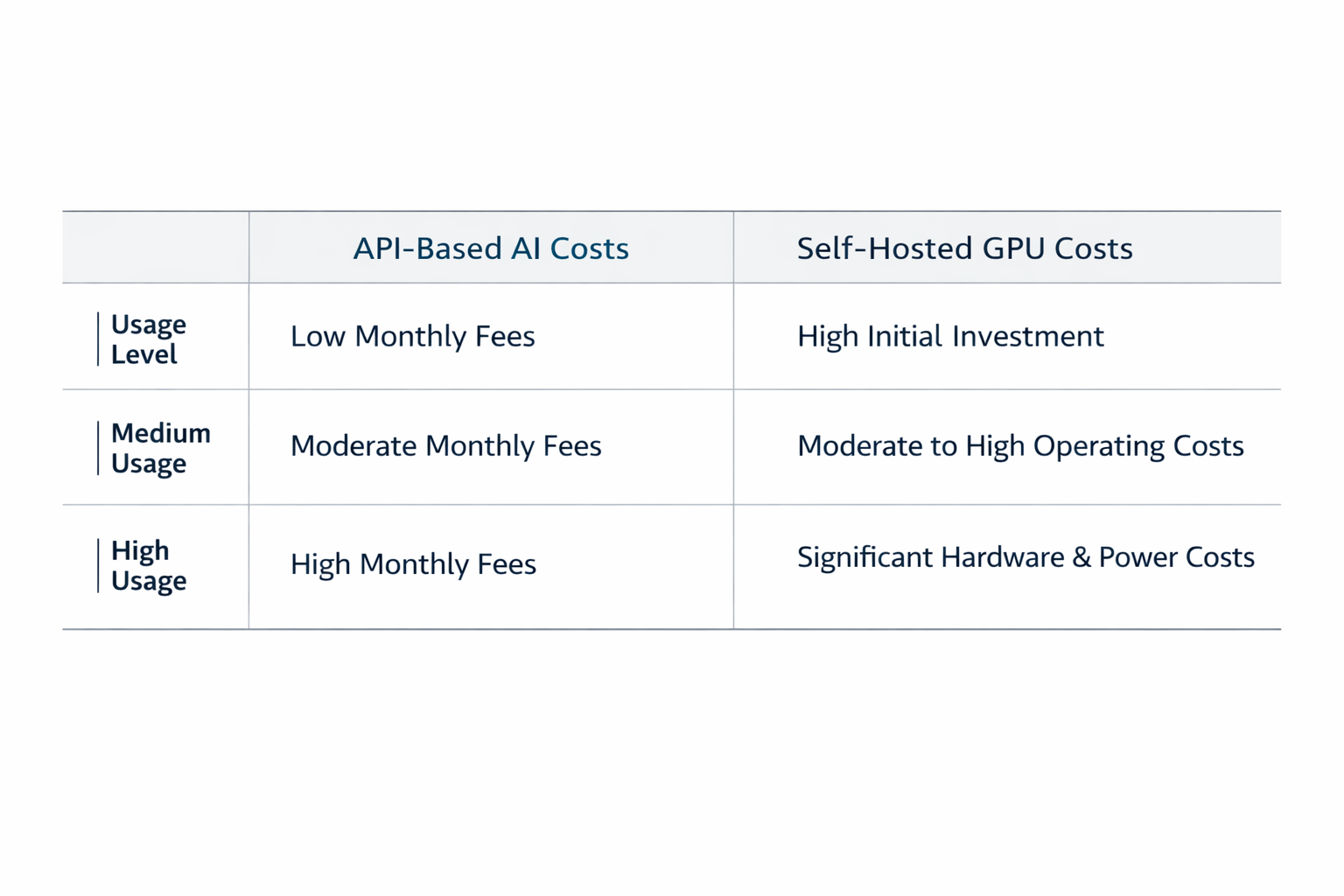
The headline trend in 2026 is that token prices keep getting more competitive, but that doesn’t automatically make AI cheaper overall. In fact, spend can rise even while price per token falls.
OpenAI’s pricing pages illustrate the pattern clearly. GPT-5, GPT-5 mini, GPT-5 nano, GPT-5.4 mini, and GPT-5.4 nano all exist in the same ecosystem but serve different cost-performance tiers. The smaller models are explicitly positioned for high-volume, cost-sensitive workloads, which is a sign that the market is optimizing around price-performance segmentation rather than one universal frontier model. (openai.com)
At the infrastructure layer, the cost curve is also changing. NVIDIA’s H100 page cites benchmark-based inference economics in which H100 can deliver inference around $0.09 per million tokens in one benchmark scenario, while B200 can be roughly $0.02 per million tokens in another, showing how newer hardware can materially cut per-token serving cost. At the same time, Google Cloud’s pricing pages show that H100-backed accelerator-optimized VMs remain expensive in absolute hourly terms, especially when you need full instances rather than fractional usage. (nvidia.com)
This is the paradox many teams face: the unit price goes down, so they expand use cases. A feature that once handled only support drafts may now power search, summarization, agent workflows, multimodal inputs, and internal copilots. McKinsey’s 2026 writing on AI infrastructure and the broader AI race notes continued expansion in data-center demand and AI-related trade flows, which supports the idea that volume growth is absorbing efficiency gains. (mckinsey.com)
So yes, inference pricing is improving. But the true business question is whether your organization is using those savings to lower spend or to ship ten times more AI workload. In most companies, it’s the second one.
4. Infrastructure costs: GPUs, cloud pricing, networking, storage, and orchestration
Hosted API spend is only one part of the story. If you self-host models or run hybrid deployments, infrastructure costs become central very quickly.
GPUs and compute
GPUs are the biggest visible infrastructure expense. Google Cloud’s 2026 pricing shows A3 High with H100s at $88.49 per hour on-demand, while A3 Mega with H100s is $93.40 per hour on-demand. Larger or newer configurations can be even more expensive. These are not small line items, especially if you need multiple replicas for resilience or scale. (cloud.google.com)
Cloud pricing structure
Cloud pricing is not just “GPU price times hours.” You also pay for attached CPUs, memory, SSD, and commitment structure. Google’s pricing pages show that the same accelerator class can have different costs under on-demand, spot, or committed-use terms. That means a workload’s economics can change substantially based on how steady it is and whether you can tolerate preemption. (cloud.google.com)
Networking and egress
AI systems often move large amounts of data: prompts, documents, embeddings, logs, response payloads, and sometimes media. McKinsey’s 2026 AI infrastructure piece highlights that cloud data-transfer fees, or egress costs, are estimated at $70 billion to $80 billion annually. That’s a strong signal that networking is becoming a meaningful cost center, not a rounding error. (mckinsey.com)
Storage
RAG pipelines, multimodal workflows, and logging all increase storage demand. You may need object storage for source documents, vector stores for embeddings, caches for fast retrieval, and archives for compliance or audits. Storage is usually cheaper than GPU time, but at scale it becomes a durable cost that sticks around long after a prototype would have been deleted. (cloud.google.com)
Orchestration
Production AI systems need orchestration layers for routing, retries, queueing, model fallback, tool execution, and safety checks. McKinsey’s 2026 work on agentic infrastructure suggests that AI is changing infrastructure itself, not just the applications on top of it. That implies the orchestration layer is becoming a permanent operating expense, not an optional engineering luxury. (mckinsey.com)
The main lesson: when teams say “self-hosting is cheaper,” they often mean the raw per-token math. They usually haven’t yet priced the full stack.
5. Hidden operational costs: observability, retries, guardrails, evals, caching, and human review
The most expensive AI systems are not always the ones with the highest token price. They’re often the ones with the highest operational complexity.
Observability is the first hidden cost. You need logging, tracing, prompt/version tracking, model-output inspection, latency monitoring, and cost monitoring by endpoint or user segment. Without this, you can’t tell whether a model is getting worse, whether a prompt changed, or why spend spiked. These systems are increasingly standard in production because AI behavior is probabilistic and can drift over time. OpenAI’s guardrails and evals tooling makes that operational reality visible. (guardrails.openai.com)
Retries are another silent bill driver. If your system retries on timeouts, tool failures, JSON parse failures, or safety rejections, you may be paying for multiple model calls to complete one task. In agentic flows, retries can multiply across steps. OpenAI’s agent guidance warns about failure thresholds and the need to bound retries, which is effectively a cost-control measure as much as a reliability measure. (cdn.openai.com)
Guardrails and evals also consume money. If you run model-based checks, policy filters, or offline evaluations on every release, those calls add up. OpenAI’s documentation notes that even grading tokens can be billed separately at standard rates in some workflows. That means “quality assurance” is often an inference workload of its own. (help.openai.com)
Caching can reduce spend dramatically, but cache management itself has complexity. Prompt caching works best when prompts are stable and repeated. If every prompt is unique, cache hit rates stay low. If prompts are slightly different every time because of dynamic metadata or long user histories, the savings may disappoint. OpenAI’s model pages explicitly mention cached input pricing for some models, which shows how important repetition is to economics. (developers.openai.com)
Finally, human review is expensive but often unavoidable. In high-stakes domains, teams route low-confidence outputs to people for approval. That’s a direct labor cost plus a throughput cost, and it can dominate the AI budget in workflows where the model is only partially trusted. OpenAI’s agent guidance emphasizes human intervention as a safeguard, which reflects how common this operating pattern has become. (cdn.openai.com)
In practice, the “real cost” of AI is often the cost of making AI trustworthy enough to ship.
6. Build vs buy: API usage versus self-hosted models and total cost of ownership
Whether to call an API or self-host a model is one of the most important financial decisions in an AI product. The right answer depends on scale, latency, privacy, reliability, and staffing—not just unit price.
API usage
API usage is usually the fastest path to market. You pay per token or per unit of usage, and the provider handles scaling, patching, hardware refresh, and most reliability engineering. OpenAI’s pricing pages show clear per-token pricing across model sizes, making the cost model easy to understand and forecast at the request level. That simplicity is valuable for teams that want to ship quickly and learn from production traffic before making heavy infrastructure commitments. (openai.com)
Self-hosting
Self-hosting can be attractive when you have predictable high volume, strict data control requirements, or specialized latency needs. But the total cost of ownership is broader than GPU rent. You need deployment tooling, autoscaling, model serving, observability, security, patch management, load balancing, data pipelines, and engineering staff. Google Cloud’s and NVIDIA’s pricing data show that GPU-backed serving infrastructure can be expensive, but raw instance cost is only one piece of the real TCO. (cloud.google.com)
The TCO reality
The “buy” option usually wins early because it is operationally light. The “build” option can win later if you have high enough stable load and enough expertise to manage the stack efficiently. But many teams underestimate the inflection point. They compare API tokens against GPU hours and ignore labor, retries, evaluation harnesses, and downtime risk. McKinsey’s 2026 infrastructure analysis suggests that AI infrastructure is becoming more distributed and more specialized, which means the underlying operational burden is growing, not shrinking. (mckinsey.com)
A sensible rule: buy until you have a very clear reason to build. The “clear reason” usually means sustained volume, strict constraints, or measurable strategic advantage.
7. How usage patterns change the bill: chat, agents, RAG, multimodal, and batch workloads
Different AI product patterns create very different cost profiles. Two apps can use the same model and still have wildly different bills.
Chat
Chat is usually the simplest pattern, but it can become costly as conversation history grows. Long-running chats accumulate context, and every turn may resend large histories or summaries. That means the cost rises over time even if each message is small. OpenAI’s long-context models make this easier to support, but they don’t make it free. (developers.openai.com)
Agents
Agents are more expensive because they often chain multiple model calls, use tools, and retry steps. A single user action may trigger planning, retrieval, tool execution, verification, and a final response. OpenAI’s agent-building materials explicitly emphasize guardrails, human intervention, and retry limits, which tells you the cost is architectural, not incidental. (cdn.openai.com)
RAG
Retrieval-augmented generation can save cost relative to stuffing everything into context, but it introduces new expenses: embeddings, vector storage, retrieval infrastructure, reranking, and larger prompt assembly. If your retrieval is noisy, you may also need extra model calls to clean up the answer. So RAG often trades one kind of cost for another. (cdn.openai.com)
Multimodal
Image, audio, and video inputs make the billing surface larger and more variable. OpenAI’s current model pages show support for image input across the latest models and separate realtime or multimodal offerings. That flexibility is useful, but it also means teams need to watch non-text usage carefully because media workloads can be much heavier than plain text. (developers.openai.com)
Batch workloads
Batch is often the cheapest way to process large volumes when you do not need immediate responses. OpenAI’s model pages and API docs highlight batch pricing and rate-limit structure, which is a strong hint that asynchronous work should be separated from real-time traffic wherever possible. Batch can lower infrastructure pressure and improve throughput economics. (developers.openai.com)
The big idea is that product design drives bill design. If you change the workflow, you change the economics.
8. Cost optimization strategies: routing, caching, batching, smaller models, and prompt compression
There is no single magic trick for controlling AI spend. Real savings usually come from several small improvements that compound.
Routing
Route easy tasks to cheaper models and reserve expensive models for hard cases. OpenAI’s model lineup makes this strategy practical because the price gap between a frontier model and a mini or nano model is large. A router can classify intent, confidence, or complexity and choose the lowest-cost model that can still succeed. (openai.com)
Caching
If many requests repeat similar prompts or shared system instructions, caching can reduce input cost. OpenAI explicitly offers cached input pricing on some models, which encourages architectures that keep stable prefixes and repeated context reusable. (developers.openai.com)
Batching
Batching reduces overhead by grouping non-urgent requests. That can lower cost and improve throughput, especially for classification, labeling, enrichment, or offline summarization. If the user does not need an answer in under a second, batch may be the better economic choice. (developers.openai.com)
Smaller models
Smaller models have become much more capable. OpenAI’s 2026 releases position GPT-5.4 mini and GPT-5.4 nano as improved, cheaper options for coding subagents, extraction, ranking, and other high-volume tasks. This matters because many production systems do not need frontier reasoning for every step. (openai.com)
Prompt compression
Shorter prompts cost less and often perform better because they reduce noise. You can compress instructions, remove repeated boilerplate, summarize conversation history, and replace long examples with structured rules. This is one of the most durable optimizations because it lowers cost and often improves quality at the same time.
Use the cheapest acceptable model
This sounds obvious, but many teams skip it. The right metric is not “best model.” It is “best model that meets the product requirement.” Since OpenAI’s pricing spans multiple order-of-magnitude tiers, the difference matters materially. (openai.com)
The best optimization mindset is not austerity. It is precision: spend only where the user experience or business outcome benefits.
9. Forecasting and budgeting AI spend with real production metrics
Forecasting AI spend from API examples is a recipe for surprises. You need production metrics.
Start with the basics: requests per day, input tokens per request, output tokens per request, cache-hit rate, model mix, retry rate, and escalation rate to humans or fallback models. From there, add latency SLOs, concurrency peaks, tool-call counts, and batch-versus-online split. Without these metrics, you cannot tell whether costs are rising because of traffic, prompt growth, or system inefficiency.
A good budgeting model treats each AI workflow separately. A support chatbot has different economics than an agent that performs tool calls, and both differ from a document-processing pipeline. For example, a RAG support assistant may have moderate input token usage but high retrieval and observability costs. An agentic workflow may have fewer users but more retries and tool calls. Multimodal workflows can have lower volume but much larger per-request payloads. OpenAI’s current model pricing and batch/rate-limit structure make it clear that usage patterns drive cost as much as model choice does. (developers.openai.com)
It also helps to forecast by percentile, not just average. Average traffic hides the spikes that force overprovisioning. If your 95th or 99th percentile concurrency is much higher than your median, your infrastructure and API rate limits must be sized for the spike, not the average. This matters especially when self-hosting on expensive GPU instances or when depending on quotas that constrain burst throughput. (cloud.google.com)
The most reliable budgeting process is quarterly and scenario-based:
baseline volume
high-growth volume
heavy-usage feature rollout
model upgrade scenario
cost optimization scenario
That structure helps teams answer the question executives actually care about: “What happens to spend if adoption doubles?”
10. What the latest data says about adoption, infrastructure spend, and where costs are heading
The latest data points in 2026 point in the same direction: adoption is broad, infrastructure investment is rising, and the economics are becoming more segmented.
McKinsey’s April 2026 analysis says that almost nine out of ten companies had deployed AI in at least one business function by the end of 2025, yet 94 percent of respondents reported not seeing significant value from those investments. That gap matters because it suggests many organizations are still spending on AI faster than they are realizing durable returns. (mckinsey.com)
On the infrastructure side, McKinsey’s AI infrastructure and data-center research describes a market pulling heavily on compute, power, real estate, networking, and colocation. It also projects global data-center demand could almost triple from 2025 to 2030 under current adoption scenarios. That kind of growth is a strong signal that infrastructure costs will remain material, even if per-token inference prices keep falling. (mckinsey.com)
OpenAI’s 2026 model releases tell a similar story from the software side. The company continues to add smaller, faster, cheaper variants like GPT-5.4 mini and nano while maintaining higher-capability models for more demanding tasks. That suggests the market is settling into a tiered architecture: cheap models for routine work, stronger models for hard cases, and orchestration layers to connect them. (openai.com)
Meanwhile, cloud GPU pricing remains high enough that self-hosting is still a serious commitment. Google Cloud’s H100-backed A3 instances and accelerator pricing make it clear that production-grade AI infrastructure still consumes meaningful budget, especially when uptime, scale, and latency are non-negotiable. (cloud.google.com)
So where are costs heading? In short:
unit inference prices should keep improving,
workload volume will keep rising,
infrastructure will stay expensive for serious production systems,
and the biggest savings will come from architecture, not just model choice. (nvidia.com)
Conclusion
The real cost of running AI features in production is much bigger than the model invoice. Prototype economics are simple; production economics are layered. You pay for model selection, token usage, context growth, concurrency, retries, observability, guardrails, evaluation, storage, networking, and sometimes human review. If you self-host, you also pay for GPUs, orchestration, patching, and staffing.
The most important shift in 2026 is that AI has become a portfolio problem. Not every task deserves the most capable model. Not every request needs real-time handling. Not every prompt should carry the full conversation history. Teams that separate cheap work from expensive work, batch from online, and routine from high-stakes can often cut spend dramatically without hurting quality.
The key takeaways are straightforward:
Production AI cost is mostly a systems problem, not just a model pricing problem.
Token prices may fall, but total spend can still rise because usage grows faster.
Infrastructure and operational overhead matter as much as inference.
The best cost controls are routing, caching, batching, smaller models, and tighter prompts.
Forecasting should be based on real production metrics, not prototype assumptions.
If you understand those five points, you’ll be far less likely to be surprised by the next AI bill.