
Secrets Management for Modern Teams: Best Practices, Trends, and Tools in 2026
June 2, 2026
Secrets management has moved from a niche security concern to a core engineering discipline. In modern software delivery, teams rely on API keys, database passwords, certificates, OAuth tokens, signing keys, and cloud credentials to keep systems connected and automated. The problem is that the more distributed your architecture becomes, the easier it is for secrets to leak into source code, CI/CD pipelines, logs, containers, and configuration files. OWASP’s Secrets Management Cheat Sheet highlights exactly this challenge: secrets are now embedded across DevOps workflows, and organizations need centralized storage, auditing, rotation, and governance to reduce risk. (cheatsheetseries.owasp.org)
At the same time, the way teams authenticate is changing. Cloud providers and platform vendors increasingly recommend moving away from long-lived static credentials and toward managed identities and workload identity federation. Microsoft recommends managed identities for Azure services, Google recommends Workload Identity Federation for GKE, and AWS continues to emphasize secrets centralization, rotation, monitoring, and minimizing direct exposure. (learn.microsoft.com)
For modern teams, secrets management is no longer just “where do we store passwords?” It is about how credentials are created, accessed, rotated, audited, revoked, and prevented from leaking in the first place. This post walks through the risks, principles, architecture patterns, automation strategies, compliance needs, Kubernetes and multi-cloud realities, and the biggest trends shaping secrets management in 2025–2026.

1. What secrets management is and why modern teams need it
Secrets management is the practice of securely handling sensitive credentials and cryptographic material throughout their lifecycle: creation, storage, access, distribution, rotation, revocation, and deletion. Common examples include API keys, database passwords, SSH keys, signing keys, OAuth tokens, and cloud access credentials. OWASP’s guidance frames secrets management as a way to centralize storage, provisioning, auditing, and rotation so that teams can control access and reduce the chance of leaks or compromise. (cheatsheetseries.owasp.org)
Modern teams need a strong secrets management strategy because software environments are now much more dynamic than they were even a few years ago. Applications are deployed across multiple clouds, ephemeral containers, serverless functions, and third-party SaaS platforms. Developers rely on CI/CD systems, infrastructure as code, and automated deployment pipelines. Each of these layers can become a secret exposure point if credentials are handled manually or stored in plaintext. OWASP’s DevSecOps guidance explicitly calls out the need to scan repositories and commits for sensitive data, while CISA guidance warns against hardcoded credentials and recommends secret managers for CI/CD pipelines and applications. (owasp.org)
There is also a business reason to care: credential compromise can turn a small mistake into a large incident. A leaked database password, cloud token, or signing key can enable lateral movement, data theft, service impersonation, or supply-chain abuse. Once a secret has been exposed, the damage often spreads beyond the original repository or workload because the same credential may be reused by multiple services. OWASP specifically notes that shared secrets make it harder to identify the source of compromise. (cheatsheetseries.owasp.org)
In practice, good secrets management gives teams three things: fewer long-lived credentials, smaller blast radius when something goes wrong, and a clear operational record of who accessed what and when. That makes it both a security control and an engineering reliability tool. Teams that treat secrets as first-class infrastructure are generally better positioned to support least privilege, compliance, faster incident response, and safer automation. (cheatsheetseries.owasp.org)
2. The biggest risks: hardcoded credentials, secret sprawl, and pipeline leakage
The most obvious secret-management failure is hardcoding credentials in source code. That can happen in application code, shell scripts, CI definitions, Dockerfiles, Terraform, test fixtures, or even documentation. CISA’s product-security guidance explicitly flags hardcoded secrets in source code and recommends using a secret manager instead. OWASP similarly notes that many organizations still have secrets stored in plaintext across source code and configuration files. (cisa.gov)
A second major problem is secret sprawl. Secret sprawl happens when too many systems store sensitive values independently, creating duplication, inconsistent rotation, and unclear ownership. A team may keep passwords in a vault, a cloud secrets manager, a Kubernetes Secret, a password manager, and a CI system all at once. That increases operational overhead and makes it difficult to know which value is current, which one should be revoked, and where a compromised secret may have propagated. OWASP’s guidance recommends standardization and centralization, but also warns that many organizations still end up using multiple solutions and need strong documentation to keep them manageable. (cheatsheetseries.owasp.org)
The third high-risk area is pipeline leakage. CI/CD pipelines are attractive targets because they often have access to build credentials, deployment tokens, signing keys, and infrastructure permissions. If secrets are echoed in logs, exposed in environment variables, inherited by child jobs, or copied into artifacts, they can leak outside the intended trust boundary. CISA guidance on securing the software supply chain recommends protecting any secrets associated with the build pipeline and avoiding plaintext secrets in automation code and logs. OWASP’s CI/CD guidance also emphasizes scanning repositories and commits for secrets. (cisa.gov)
The danger is not limited to malicious insiders. Misconfigured log redaction, verbose debug settings, repository forks, cached build layers, or debugging output can expose secrets accidentally. AWS’s rotation guidance specifically warns that debug or logging statements in rotation functions can write sensitive information into CloudWatch Logs. That’s a good example of how even a security feature can become a leak if logging is not handled carefully. (docs.aws.amazon.com)
A useful mental model is this: every place a secret touches is a place it can leak. Hardcoded values, copied values, pipeline logs, and duplicated storage all widen the attack surface. The goal of modern secrets management is to reduce the number of places a secret exists, reduce the number of humans who can see it, and reduce the lifetime of each credential. (cheatsheetseries.owasp.org)
3. Core principles: least privilege, separation of environments, and zero trust
Three principles matter more than almost anything else in secrets management: least privilege, environment separation, and zero trust.
Least privilege means each workload, person, and system gets only the permissions needed to do its job. OWASP’s Secrets Management Cheat Sheet explicitly recommends fine-grained access controls on each secret and warns against broad access. Microsoft’s Azure guidance similarly recommends using Azure Policy and managed identities to enforce secure configurations and avoid legacy access patterns. (cheatsheetseries.owasp.org)
Separation of environments means production secrets should not be accessible from development or test systems unless there is a clear, tightly controlled reason. This matters because lower environments tend to be less protected, more heavily shared, and more likely to include debugging access. If a non-production system can read production credentials, then a compromise in dev becomes a compromise in prod. Separating secrets by environment also makes it easier to rotate and revoke credentials without disrupting every stage of the delivery chain. OWASP recommends standardization and documentation so it is obvious what each secret is used for and where it lives. (cheatsheetseries.owasp.org)
Zero trust in secrets management means no component is trusted simply because it is “inside” the network or “part of” the platform. Instead, each request for a secret should be authenticated, authorized, and ideally constrained by workload identity, token audience, scope, and policy. This is why cloud providers increasingly recommend managed identities and workload identity federation instead of static key files. Azure recommends managed identities for app and service connections to Key Vault, Google recommends Workload Identity Federation for GKE workloads, and Azure Kubernetes Service now centers its guidance on Microsoft Entra Workload ID. (learn.microsoft.com)
Zero trust also changes the way teams think about human access. Engineers should not routinely inspect production secrets to debug issues. Instead, they should rely on logs, metrics, traces, and controlled break-glass procedures. The fewer people who can view raw credentials, the smaller the exposure window when an account or workstation is compromised. That aligns with OWASP’s recommendation to avoid broad engineer access and apply least privilege to the secret management system itself. (cheatsheetseries.owasp.org)
In short, the core principles are not abstract policy language. They are practical controls that limit blast radius, support compliance, and make automation safer. The best secrets systems are designed so that “who can fetch what, from where, and under which identity” is explicit and enforced by default. (cheatsheetseries.owasp.org)
4. Modern architecture patterns: centralized vaults, cloud-native secret managers, and workload identity
Modern secrets architectures usually fall into one of three patterns: centralized vaults, cloud-native secret managers, or workload identity-first designs.
A centralized vault is a dedicated platform, often used across teams and environments, that stores secrets in a hardened location and provides policy-based access, auditing, and rotation. OWASP mentions that organizations may use multiple solutions but should standardize how teams interact with them. Central vaults are useful when you need a common control plane across many systems, a consistent audit trail, or advanced workflows like dynamic secrets and policy templating. They are especially appealing for organizations that need to span multiple clouds or support many business units with different needs. (cheatsheetseries.owasp.org)
A cloud-native secret manager is a managed service from a cloud provider, such as AWS Secrets Manager, Azure Key Vault, or Google Cloud Secret Manager. These services integrate naturally with the surrounding platform, making them easier to adopt for cloud-first teams. AWS documents automatic rotation options, including managed rotation and Lambda-based rotation. Microsoft recommends using Key Vault to store secrets and managed identities to eliminate hardcoded credentials. Google’s GKE guidance shows workloads accessing Secret Manager through Workload Identity Federation rather than static service account keys. (docs.aws.amazon.com)
A workload identity pattern reduces or removes the need for long-lived credentials entirely. Instead of putting a secret file in a pod or VM, the workload authenticates with a federated identity and fetches only the secrets it is allowed to use. This is increasingly the preferred approach for Kubernetes and cloud-native systems because it reduces manual secret handling and avoids distributing key material to workloads. Microsoft’s AKS Workload ID documentation, for example, maps Kubernetes service accounts to Microsoft Entra identities, while Google’s GKE documentation explicitly recommends avoiding less secure static service account key files. (learn.microsoft.com)
Many modern teams combine these patterns. For example, a team may use cloud-native secret managers for operational simplicity, while using a centralized vault for multi-cloud governance or dynamic database credentials. The architecture choice depends on the team’s scale, regulatory requirements, cloud mix, and how much identity federation the platform already supports. What matters most is not the brand of secret store, but the quality of the identity model and the discipline of lifecycle management around it. (cheatsheetseries.owasp.org)
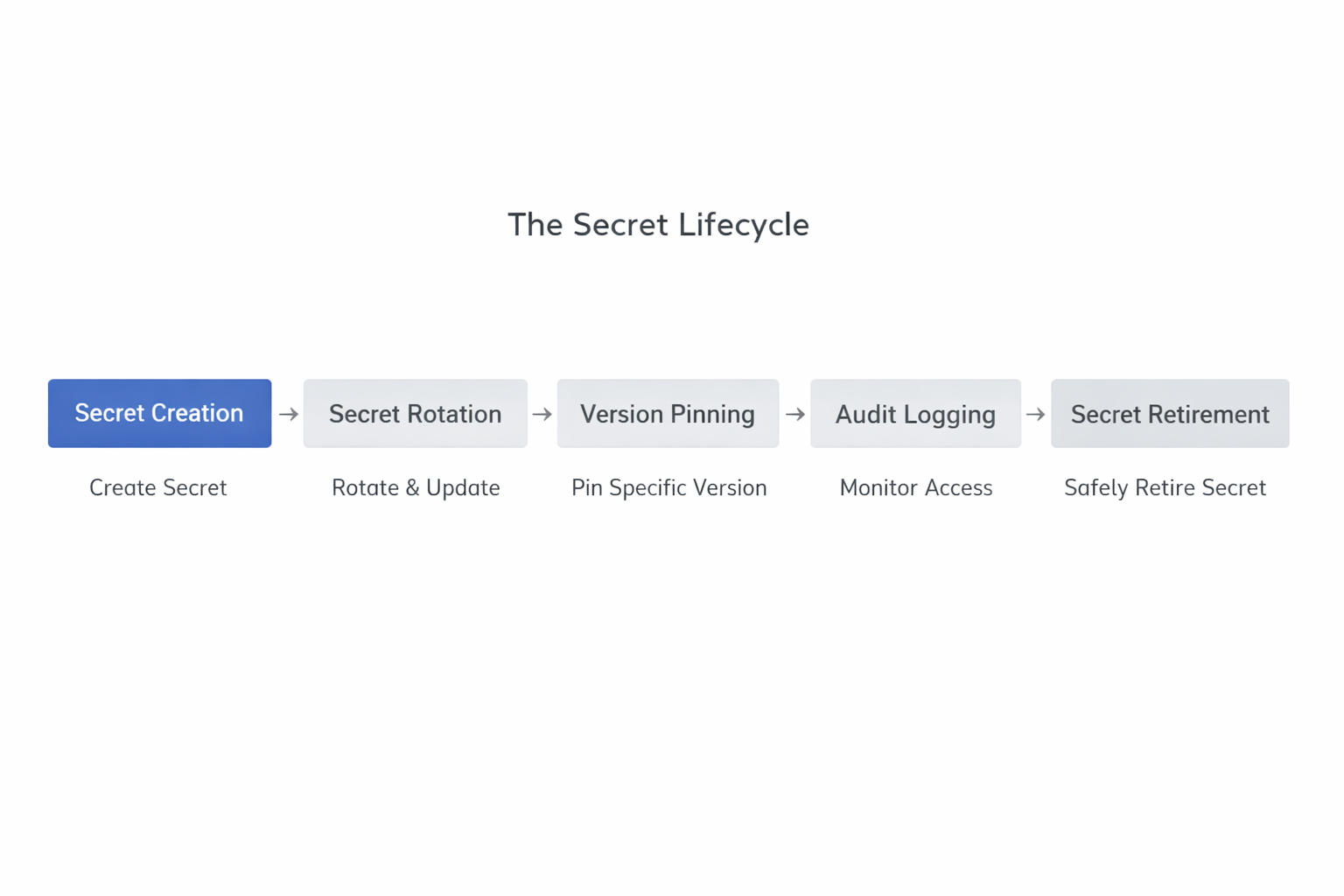
5. Lifecycle management: creation, versioning, rotation, rollback, and safe deletion
A mature secrets program treats every secret as a lifecycle object, not a static value. Creation, versioning, rotation, rollback, and deletion should all be part of the design from the start.
Creation should be secure and deliberate. Secrets should be generated with strong randomness and assigned the minimum privileges needed for their use. OWASP recommends secure generation and clear ownership, and notes that dynamic secrets can reduce reuse and shorten the exposure window. In other words, a secret should be born with purpose and scope, not copied around and reused indefinitely. (cheatsheetseries.owasp.org)
Versioning matters because secrets change. New versions are often needed during rotation or incident response. AWS Secrets Manager, for example, uses staging labels to distinguish versions during Lambda-based rotation, which helps distinguish current, pending, and previous values. That kind of versioning is essential for smooth transitions, especially when dependencies may take time to pick up a new credential. (docs.aws.amazon.com)
Rotation is the heart of lifecycle management. AWS notes that rotation is the process of periodically updating a secret and can be managed automatically. Azure Key Vault supports automated rotation policies for keys and tutorials for rotating secrets used by resources with a single set of credentials. Microsoft also notes that the best authentication method is managed identity when available, which can reduce how often secrets need to exist at all. (docs.aws.amazon.com)
Rollback is often overlooked. If a new secret breaks a workload, you need a safe way to revert or re-enable the previous version temporarily. Good rotation systems keep the old credential available long enough to test, validate, and cut over safely. AWS’s use of current, previous, and pending labels is one example of a rotation model that supports transition and recovery. (docs.aws.amazon.com)
Safe deletion is the final stage, but it should not be casual. Once a secret is no longer needed, it should be revoked, removed from the store, and eventually purged according to retention and compliance policy. In some environments, deleting a secret too quickly can create outages if a stale workload still depends on it. In others, retaining secrets too long increases risk. The right balance depends on audit requirements, data classification, and recovery objectives. OWASP’s lifecycle guidance emphasizes revocation and expiration as distinct stages, which is a good reminder that removal should be intentional, not ad hoc. (cheatsheetseries.owasp.org)
A strong lifecycle process usually includes ownership, SLAs for rotation, alerts for overdue rotation, and tested recovery steps. Without those elements, “rotation” becomes a one-time project instead of a reliable operational habit. (docs.aws.amazon.com)
6. Automation in CI/CD and infrastructure as code: reducing manual handling of secrets
If secrets are handled manually, they will eventually be exposed manually. That is why automation is one of the most important controls in a modern secrets program.
In CI/CD, the goal is to keep secrets out of code, build logs, and long-lived environment variables. CISA recommends protecting secrets in build pipelines and avoiding plaintext secrets in automation code. OWASP’s DevSecOps guidance similarly urges teams to scan commits and repositories for sensitive information. Many organizations now combine secret scanning, policy checks, and runtime retrieval from a secret manager to reduce the need for humans to copy credentials between systems. (cisa.gov)
A common pattern is for the pipeline to authenticate to a secret manager using short-lived identity credentials, retrieve only the secrets needed for the current stage, and then discard them immediately after use. That is much safer than storing static deployment keys in a CI platform indefinitely. OWASP recommends limiting human interaction and using a “secrets pipeline” to manage creation, rotation, and distribution. (cheatsheetseries.owasp.org)
Infrastructure as code can help too. Rather than injecting secret values directly into Terraform, CloudFormation, Bicep, or Kubernetes manifests, teams can reference secret IDs, secret names, or identity bindings. That way, the infrastructure definition describes what the workload needs, not what the secret value is. This makes code reviews safer and simplifies rotation because the secret backing the reference can change without rewriting the infrastructure itself. (cheatsheetseries.owasp.org)
It is also important to protect automation credentials themselves. If a pipeline uses a token to read secrets, that token should be short-lived, scoped narrowly, and ideally bound to the job or workload identity. OWASP notes that credentials used by CI/CD tooling should be rotated frequently and expire after a job completes. That principle is central to modern delivery pipelines, especially in multi-tenant build systems. (cheatsheetseries.owasp.org)
Finally, automated detection should be paired with automated response. If a secret is detected in a commit or build log, the right response is not just to alert someone; it is to revoke the exposed credential, rotate it, and trace its downstream usage. GitHub’s secret scanning exists to automatically scan code and other data sources for sensitive information, but scanning alone is not enough if response processes are slow. (github.com)
7. Governance, auditability, and compliance: logging, monitoring, residency, and policy enforcement
Secrets management is not only about storage and rotation; it is also about governance. Teams need to know who accessed a secret, when it was changed, where it is replicated, and whether its handling meets policy and regulatory expectations.
Logging and monitoring are foundational. AWS recommends monitoring secrets and integrates Secrets Manager with AWS logging, monitoring, and notification services. AWS Config can evaluate whether secrets are rotating on schedule and can aggregate compliance data across accounts and Regions. Azure similarly recommends using Azure Policy to audit and enforce secure Key Vault configurations and set up alerts for deviations. (docs.aws.amazon.com)
Auditability should cover more than simple access logs. Good governance includes change history, rotation events, failed access attempts, policy violations, and secret metadata changes such as encryption key changes or tags. AWS Config explicitly mentions tracking changes to secret metadata, rotation configuration, the KMS key used for encryption, the Lambda rotation function, and tags associated with a secret. That level of detail is useful not just for compliance but also for incident investigation. (docs.aws.amazon.com)
Residency has become increasingly important for distributed teams. Some organizations need certain secrets to remain in specific cloud regions or jurisdictions due to legal, contractual, or internal policy constraints. Multi-region replication can improve availability, but it also raises questions about where the secret exists and which environments can read each copy. Teams should align secret replication with data-residency rules and document those boundaries clearly. AWS documents secret replication as part of its best practices, and Azure’s guidance stresses secure, auditable storage rather than ad hoc distribution. (docs.aws.amazon.com)
Policy enforcement is the glue that keeps governance real. Azure recommends policy-based enforcement for Key Vault security settings, while AWS Config provides rule-based compliance checks for rotation. These mechanisms matter because teams cannot rely on memory or documentation alone. Policy must be machine-enforced where possible, especially in large environments with many service owners. (docs.aws.amazon.com)
For compliance teams, the key question is not simply “Are secrets encrypted?” but “Can we prove which secrets exist, who used them, whether they rotated on time, and whether any exceptions were approved?” Modern governance makes those answers observable and defensible. (docs.aws.amazon.com)
8. Kubernetes, cloud, and multi-cloud considerations for distributed teams
Kubernetes makes secrets both easier and harder. Easier, because platform-native mechanisms can distribute sensitive values to pods. Harder, because distributed workloads make it easy to overexpose credentials if the underlying identity model is weak.
Kubernetes-specific guidance increasingly favors workload identity over static secret injection. Azure’s AKS Workload ID documentation maps service accounts to Microsoft Entra identities, and Google’s GKE guidance recommends Workload Identity Federation to access Cloud Secret Manager without static service account key files. Kubernetes itself continues to evolve its support for token handling and CSI integrations, including recent work to pass service account tokens to CSI drivers through the appropriate secrets field. (learn.microsoft.com)
One important best practice is to avoid treating Kubernetes Secrets as a universal answer. Kubernetes Secrets can be part of a solution, but they are not automatically a full-fledged secret management program. OWASP’s Kubernetes guidance treats secrets management as a distinct concern and emphasizes securing data properly rather than assuming the orchestrator solves the problem by itself. If Kubernetes Secrets are used, the storage backend must be encrypted and managed carefully. (owasp.org)
Cloud-native teams should also pay attention to service account credentials, token lifetimes, and pod identity mapping. Azure’s guidance notes that workload identity can be configured with service account annotations and pod labels, and that token expiration settings matter for stable authentication behavior. That is a reminder that identity integration is not just a policy issue; it is an operational one. (learn.microsoft.com)
Multi-cloud teams face a different challenge: consistency. Each cloud has its own secret manager, identity model, logging layer, and rotation tooling. OWASP advises standardization even when multiple solutions are used, because organizations often need different tools for different environments. In practice, that means defining common policy, naming, tagging, rotation SLAs, and audit expectations across clouds, even if the underlying service differs. (cheatsheetseries.owasp.org)
For distributed teams, the best pattern is usually the one that minimizes static secrets at the workload edge and centralizes governance at the identity and policy layer. Whether a team uses AWS, Azure, Google Cloud, or all three, workload identity and federated access are becoming the default direction of travel. (learn.microsoft.com)
9. Emerging trends and statistics shaping secrets management in 2025-2026
Several trends are shaping how teams think about secrets in 2025 and 2026. The first is the continued shift from static credentials to identity-based access. Cloud vendors are making that direction increasingly explicit: Azure recommends managed identities for app-to-service connections, Google recommends Workload Identity Federation for GKE, and AWS is expanding automation and managed rotation options for its secret services. (learn.microsoft.com)
The second trend is stronger supply-chain awareness. CISA’s guidance on hardcoded credentials and pipeline protection reflects a broader industry shift toward treating secrets exposure as a software-supply-chain problem, not just an application problem. That matters because secrets can leak at build time, during code review, through artifacts, or in deployment tooling long before a workload ever goes live. (cisa.gov)
The third trend is greater automation around rotation and compliance. AWS Config can check whether secrets have rotated within the required interval, while Azure Key Vault supports scheduled rotation policies for keys. Organizations are increasingly using policy engines and compliance checks to make rotation measurable rather than optional. (docs.aws.amazon.com)
The fourth trend is the rise of short-lived, federated workload credentials in Kubernetes and cloud-native platforms. AKS Workload ID, GKE Workload Identity Federation, and CSI improvements around token handling all point toward a future where applications prove who they are at runtime instead of carrying long-lived secrets everywhere. (learn.microsoft.com)
As for statistics, public reporting continues to reinforce the scale of the exposure problem. GitHub describes secret scanning as an automated way to detect sensitive information in code and other data sources, reflecting how common the issue has become in repositories and development workflows. OWASP also notes that many organizations still have secrets embedded in plaintext across code and configuration. While different reports use different measurement methods, the overall direction is consistent: secret exposure remains common enough to require continuous detection and response. (github.com)
The biggest strategic takeaway for 2025–2026 is that secrets management is becoming inseparable from identity management, policy-as-code, and supply-chain security. The best teams are no longer asking how to store a password more safely; they are asking how to eliminate the password entirely whenever possible. (learn.microsoft.com)
10. A practical implementation checklist for modern teams
Here is a practical checklist that modern teams can use to improve secrets management without boiling the ocean.
Inventory all secrets and classify them by application, owner, environment, and sensitivity. OWASP recommends standardization so it is clear what each secret is for and where it lives. (cheatsheetseries.owasp.org)
Remove hardcoded credentials from source code, pipeline definitions, and configuration files. CISA and OWASP both strongly warn against plaintext secrets in code and automation. (cisa.gov)
Adopt least privilege for every secret, human role, and workload. Fine-grained access control should be the default. (cheatsheetseries.owasp.org)
Separate production, staging, and development secrets. Prevent lower environments from reading production credentials. (cheatsheetseries.owasp.org)
Prefer workload identity and managed identities over static key files. Azure, AWS, and Google all steer teams in that direction. (learn.microsoft.com)
Centralize secrets in a hardened manager or standardized secret platform. Use policy, logging, and access controls consistently. (cheatsheetseries.owasp.org)
Automate rotation, and test it. Use scheduled rotation where available and confirm that old credentials are revoked safely. (docs.aws.amazon.com)
Build rollback and recovery into every rotation plan. Label versions and document cutover procedures. (docs.aws.amazon.com)
Scan repositories, commits, and build outputs for leaked secrets. Pair scanning with automated revocation and rotation. (github.com)
Enforce governance with policy-as-code, audit logs, and alerting. Use cloud policy tools and compliance checks to verify that rotation and access rules are actually followed. (docs.aws.amazon.com)
Review residency and replication rules for multi-cloud and multi-region environments. Make sure secret placement matches legal and business requirements. (docs.aws.amazon.com)
Practice incident response for secret exposure. Know how to revoke, rotate, and validate dependencies quickly when a leak is detected. This is the only way to make “least exposure time” a real outcome rather than a slogan. (cheatsheetseries.owasp.org)
Conclusion
Secrets management in 2026 is about much more than storing passwords safely. It is about minimizing static credentials, reducing secret sprawl, protecting CI/CD pipelines, enforcing least privilege, and moving toward identity-based access wherever possible. Cloud providers and security frameworks are converging on the same core direction: use managed identities, automate rotation, centralize governance, and make secrets observable throughout their lifecycle. (learn.microsoft.com)
For modern teams, the winning strategy is to treat secrets as a living operational system, not a collection of values hidden in a vault. The more you can replace manual handling with identity, policy, and automation, the less likely a small mistake is to become a major incident. If you want stronger security, better compliance, and smoother delivery, secrets management is one of the highest-leverage places to invest. (cheatsheetseries.owasp.org)