
Scaling Read Traffic in 2026: Caching, Replicas, and Query Optimization
July 29, 2026
Modern applications rarely fail because they cannot write fast enough. Far more often, they struggle when read traffic surges: home feeds, search results, dashboards, product pages, API lookups, and AI-powered experiences all generate constant read demand. As traffic grows, the same database query may be executed thousands or millions of times per minute, and even “small” inefficiencies can turn into real user pain. Latency rises, infrastructure costs climb, and teams end up firefighting incidents instead of shipping features.
The good news is that read scaling is usually a multi-layer problem with multiple practical solutions. You do not have to choose only one path. In many systems, the best outcome comes from combining caching, read replicas, and query tuning in a way that matches the shape of your traffic. Caching can eliminate repeated work entirely for hot data. Read replicas can offload the primary database and absorb broader read volume. Query optimization can reduce the work every request causes, making every other layer more effective.
This post walks through the full read-scaling toolkit in 2026: where caching helps most, when replicas are the right lever, how to mitigate cold caches, and how to keep queries efficient as data grows. Along the way, we will look at operational tradeoffs, consistency concerns, observability, and architecture patterns that work in real systems. The goal is not to make every request “faster” in the abstract, but to build a system that stays fast, stable, and cost-aware as traffic increases.
1. Why read scaling matters now: latency, cost, and user experience at higher traffic levels
Read traffic matters because it is often the dominant form of load in product systems. Most users spend their time viewing data, not changing it: browsing catalogs, checking order status, loading dashboards, searching records, or refreshing feeds. As a result, the same small set of read paths can become bottlenecks long before write throughput becomes a problem. AWS’s Well-Architected guidance explicitly calls out caching and read replicas as common performance strategies for reducing repeated database work and improving read rates. (docs.aws.amazon.com)
Latency is the first visible symptom. A query that is “fast enough” at low volume may become slow when run concurrently by thousands of users. Even if average latency still looks acceptable, the tail often degrades first. That matters because users remember the slowest interactions: pages that stall, APIs that time out, and dashboards that feel “sticky.” In practice, p95 and p99 latency are often more important than the average because they reflect the experience of real customers under load.
Cost is the second pressure. Scaling a primary database vertically is expensive, and doing so may still not solve the core issue if the workload is dominated by repeated reads. A better design often shifts the repeated work to cheaper layers: memory caches, replicas, and query plans that touch fewer rows. Google Cloud SQL documentation notes that read replicas can offload read requests or analytics traffic from the primary instance, which is the basic economic logic of read scaling: preserve the primary for writes and critical consistency-sensitive reads, then place cheaper, more scalable read capacity behind it. (docs.cloud.google.com)
User experience is the third and most important reason. At scale, read performance is product performance. A search box that returns instantly feels reliable; a profile page that lags feels broken. And once traffic spikes, poor read design can create cascading failures: slow reads increase queue depth, timeouts trigger retries, retries amplify load, and the system gets slower still. Good read scaling reduces that feedback loop. It creates headroom, smooths spikes, and lets teams keep latency predictable even when traffic is uneven.
2. Caching fundamentals: application cache, distributed cache, and database cache hits
Caching is the first lever many teams reach for because it can remove repeated work before it reaches the database. At a high level, a cache stores data closer to the application so future requests can be served faster. Redis’s documentation describes caching as a way to keep data in memory and support invalidation and TTL-based freshness controls, while cache invalidation guidance emphasizes that caching works by synchronizing multiple copies across layers with the source of truth. (redis.io)
There are three practical cache layers to understand.
Application cache
An application cache lives inside the app process or runtime. It is extremely fast because it avoids network calls, but it is also limited. Each instance has its own copy, so data may not be shared across servers. That makes it ideal for very hot, small, and short-lived values: feature flags, config snapshots, expensive computed values, or request-scoped lookups. The tradeoff is consistency: when one instance updates a value, other instances may still hold stale copies unless you actively invalidate them.
Distributed cache
A distributed cache is shared across app servers, usually through a system like Redis or Memcached. Redis documents client-side caching and invalidation strategies, including TTL handling and invalidation messages for cached keys. (redis.io) This layer is the workhorse for shared hot data because it reduces database load across the fleet. Common uses include user sessions, product metadata, computed feed fragments, rate limits, and query result caching.
Database cache hits
Databases also cache data internally. Even without an external cache, a database may serve a request from memory if the page or row is already warm. That means “database cache hit” is not a separate product feature so much as a property of how often your working set fits in memory. It matters because a warm database can be much faster than a cold one, but relying on the database as the only cache is risky: once working set size outgrows memory or traffic spikes, performance can fall sharply.
The main point is that caching is not one thing. It is a stack of opportunities, each with different speed, sharing, and invalidation characteristics. The closer the cache is to the app, the faster it is and the narrower its scope. The farther it is, the more useful it becomes across the system. In practice, the best caching strategy is usually layered: local memory for ultra-hot values, distributed cache for shared state, and database memory as the final fallback.
3. When caching is the best first move: hot data, cold starts, TTLs, and invalidation tradeoffs
Caching is most effective when the same data is requested repeatedly and changes relatively slowly. Redis explicitly recommends caching keys that are requested often and change at a reasonable rate, while discouraging caching data that changes continuously or is rarely used. (redis.io) That advice is easy to forget when teams try to cache everything. The best candidates are usually “hot” reads: homepage content, account summaries, popular product records, permission checks, or any expensive query that many users repeat.
Hot data usually has a clear access pattern. A small number of keys account for a large share of reads, so even modest cache coverage yields large wins. This is why caching is often the best first move. If 90% of requests are for 1% of your data, you do not need to optimize the whole database to see a major impact. You need the hot path to stay fast.
But caching has tradeoffs.
Cold starts
A cold cache means the system has little or no useful data in memory yet. This can happen after a deploy, a restart, a scaling event, a failover, or a key eviction. During a cold start, a burst of fallback traffic. If the fallback load is high enough, the system can experience a stampede. Good cache design anticipates this by warming keys, staggering rollouts, or allowing short-lived stale reads.
TTLs
Time-to-live is the simplest freshness mechanism. Redis supports TTL-based expiration, and its key eviction guidance notes that key expiration helps reduce memory pressure because keys may expire before needing eviction. (redis.io) TTLs are attractive because they are easy to reason about: the cache is “fresh enough” for a bounded time. The downside is that TTLs are blunt. If the data changes right after it is cached, users may see stale results until expiry. If TTLs are too short, the cache misses too often and the benefit shrinks.
Invalidation
Invalidation is more precise but more operationally complex. If a write changes a record, you can evict the corresponding cache key immediately. That improves freshness, but now your system must reliably find and remove all derived cache entries that depend on that record. Redis’s cache invalidation material highlights exactly this challenge: multiple copies of data must stay synchronized with the source of truth. (redis.io)
The rule of thumb is simple: cache when the same result is read often, the cost of recomputing it is meaningful, and the acceptable staleness window is known. If the data is highly volatile or correctness-sensitive, caching may still help, but you will need tighter invalidation and more careful user-facing consistency design.
4. Read replicas explained: primary-offload patterns, lag, consistency, and failover considerations
Read replicas copy data from the primary database to one or more secondary instances so read traffic can be distributed. Google Cloud SQL’s documentation says a read replica reflects changes from the primary “in almost real time, in normal circumstances,” and can be used to offload read requests or analytics traffic from the primary. AWS similarly describes read replicas as a way to improve performance and isolate read-heavy workloads. (docs.cloud.google.com)
The main value of replicas is simple: keep writes centralized, but move many reads elsewhere. That helps in several ways. It reduces contention on the primary, improves isolation between reads and writes, and allows read capacity to scale more flexibly. Some database and managed-service offerings also let replicas be sized independently, which is useful when read demand exceeds write demand by a wide margin. (aws.amazon.com)
Still, replicas are not a free lunch.
Replication lag
Replicas are typically asynchronous or near-real-time rather than perfectly synchronized. That means a read from a replica may not reflect the latest write. Lag might be tiny, but under load, network issues, or large transactions, it can grow. This creates read-after-write inconsistency: a user updates a profile, then immediately refreshes the page, and the replica still shows the old value.
Consistency
Because of lag, you need routing rules. Some reads must go to the primary: immediately after writes, during transactional workflows, or for user actions that require strong freshness. Other reads can safely go to replicas: browsing, analytics, dashboards, and other tolerance-based views. A common pattern is to route consistency-sensitive reads to primary for a short period after writes, then allow replica reads once the data is expected to propagate.
Failover
Replicas are also part of availability planning. If a primary fails, a replica may be promoted to a new primary. Cloud SQL notes that a cross-region replica can be promoted to standalone during failover scenarios. (docs.cloud.google.com) This is valuable, but promotion changes behavior: the new primary may have a cold cache, a different performance profile, or a slightly stale state at the moment of failover. A robust design plans for routing changes, connection re-establishment, and application-level retry behavior.
In short, replicas are best when reads are heavy, freshness can be slightly relaxed, and you want to keep the primary focused on writes and critical transactions. They are powerful, but they are not a substitute for correctness-aware read routing.
5. Replica cache warming and cold-cache mitigation for autoscaled or newly promoted replicas
A read replica can be technically “online” and still perform poorly if its cache is cold. This matters especially in autoscaled environments, after failover, or when a newly promoted replica suddenly becomes the primary. The data is there, but the memory pages, execution paths, and query-related caches may not be.
A cold replica suffers in three ways. First, it must fetch data from storage more often because nothing is resident in memory yet. Second, it may need to rebuild internal access patterns as queries begin arriving. Third, the application may send a burst of traffic immediately after the replica joins the pool, which can amplify the problem.
The mitigation strategy is to warm gradually rather than all at once.
Traffic ramp-up
Do not send full production traffic to a new replica immediately. Start with a small percentage of reads, monitor latency and error rates, then ramp up. This gives the cache time to warm naturally and allows you to catch plan regressions or storage bottlenecks before they affect everyone.
Synthetic warming
For critical endpoints, synthetic warmers can preload common queries, top keys, or recently hot rows. This is especially useful for dashboards or homepages with predictable access patterns. The point is not to “fake” real demand, but to seed the cache with the entries most likely to be needed first.
Keyset-aware warming
Warm what is actually hot, not everything. A common mistake is replaying huge volumes of historical traffic. That wastes resources and may not help current demand. Instead, prioritize popular entities, recent windows, and aggregate query paths. That usually gives better ROI than brute-force warming.
Replica-aware routing
Some systems route a newly promoted replica differently from stable replicas until its caches settle. This is especially important after failover. If the application does not distinguish between warm and cold replicas, users may experience the worst possible combination: a newly promoted node taking over leadership while still serving cold queries.
Cache cooperation
Replica warming should not be isolated from application cache strategy. If the application cache is healthy, it can absorb a lot of the first wave of requests and reduce pressure on the replica itself. Redis’s client-side caching docs reinforce the value of tracking hot keys and handling TTLs carefully, which fits naturally with warming strategies that preserve commonly used data across read paths. (redis.io)
The practical takeaway: treat replica warm-up as part of deployment and failover design, not as an afterthought. A replica that is cold at the wrong moment can undo many of the benefits of scaling reads horizontally.
6. Query optimization basics: indexes, selective predicates, joins, execution plans, and avoiding scans
Caching and replicas are force multipliers, but they do not fix inefficient queries. If a query is poorly written, every cache miss and every replica read becomes more expensive than it needs to be. Query optimization is often the cheapest long-term performance win because it reduces work at the source.
Indexes
Indexes help the database find data without scanning entire tables. They are especially valuable when queries filter by selective columns, join on keys, or sort by commonly requested fields. The key word is selective: if a predicate matches a large fraction of the table, an index may help less than expected. Good indexing is not about adding many indexes; it is about adding the right ones.
Selective predicates
A selective predicate narrows the result set early. That means the database has fewer rows to examine, fewer pages to read, and less data to sort or join. Queries that filter by user ID, account ID, status plus time window, or tenant plus entity type often benefit significantly from well-chosen indexes.
Joins
Joins are powerful, but they can become expensive if the join keys are not indexed or if the query pulls in far more rows than necessary. In read-heavy systems, it is often better to pre-shape data or store a derived read model for common access patterns than to force the database to reconstruct a complex object graph on every request.
Execution plans
Execution plans show how the database intends to run a query. They reveal whether the engine expects an index scan, a sequential scan, a nested loop, a hash join, or some other path. For performance work, the plan matters as much as the SQL text. A query that looks elegant can still be slow if the planner chooses a bad strategy.
Avoiding scans
Table scans are not always bad, but they become a problem when they happen often on large tables for highly targeted reads. The goal is not to eliminate every scan; it is to prevent unnecessary ones on hot paths. That often means better indexes, more selective predicates, partition pruning, or rewriting a query so the planner can use a narrower access path.
The shortest version: if your reads are slow, do not assume you need more infrastructure. First ask whether the database is doing unnecessary work. Often, fixing the query is the most durable performance improvement of all.
7. Database-specific tuning: statistics, planner settings, partitioning, and query plan stability
Once the fundamentals are in place, database-specific tuning can make a major difference. The details vary by engine, but the themes are consistent: give the planner accurate information, keep execution paths predictable, and reduce the amount of data any one query has to touch.
Statistics
Planners depend on statistics to estimate row counts, selectivity, and join costs. If statistics are stale, the planner may pick a bad plan. That can turn a good query into a slow one without any code change. Regular maintenance and analyze operations are therefore important, especially on tables with frequent updates or skewed distributions.
Planner settings
Sometimes the optimizer needs guidance. Engine-specific settings can affect join choices, memory usage, parallelism, or how aggressively certain access paths are favored. These settings should be used carefully and usually only after confirming with benchmarks. A global knob that helps one query can hurt another.
Partitioning
Partitioning can dramatically reduce read cost when queries usually touch a small slice of the dataset. For example, time-based partitions work well for event logs, usage history, and append-heavy records. If the query filters on the partition key, the database can skip irrelevant partitions entirely. That helps both latency and operational manageability.
Query plan stability
A query that performs well today can regress tomorrow if the planner changes its decision because data distribution shifted. Plan instability is especially dangerous in high-traffic systems because the slow path can suddenly become the dominant one. To reduce this risk, teams often standardize query shapes, keep statistics fresh, and test changes against production-like data before rollout.
Practical tuning workflow
The workflow is straightforward:
Identify the slowest read paths.
Inspect their execution plans.
Confirm whether the planner has accurate statistics.
Test whether an index, partition, or query rewrite changes the plan.
Re-benchmark under realistic load.
Database tuning is less glamorous than adding a cache, but it often has the best compound effect. If each query becomes cheaper, your cache lasts longer, your replicas carry less load, and your primary stays healthier.
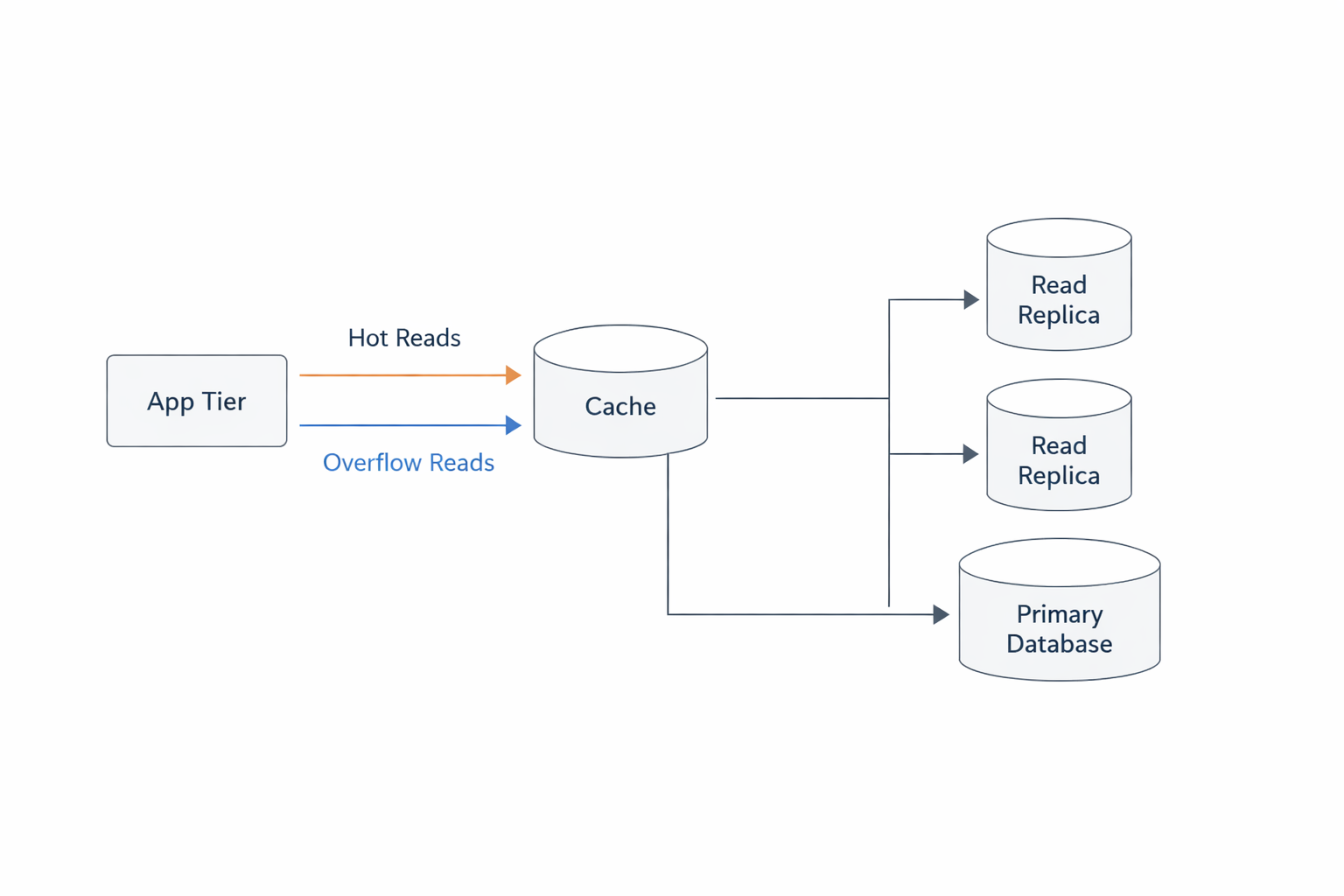
8. Architecture patterns that combine caching and replicas: cache-aside, read-through, replica fan-out, and hybrid designs
In real systems, the best answer is rarely “cache only” or “replicas only.” It is usually a hybrid design that combines layers based on data freshness, traffic shape, and consistency requirements.
Cache-aside
In cache-aside, the application checks the cache first. On a miss, it queries the database, stores the result, then returns it. This is the most common pattern because it is simple and flexible. Redis’s client-side caching and cache invalidation docs reinforce the general logic: cache what is read often, keep TTLs under control, and invalidate or refresh when the source of truth changes. (redis.io)
Cache-aside works especially well with replicas. The application can try the cache, then query a replica if needed, and only fall back to primary for freshness-sensitive cases. That reduces both cache misses and primary load.
Read-through
In read-through, the cache layer itself fetches missing data from the database. This can simplify application code, especially for standardized access patterns. The tradeoff is less flexibility. The cache now becomes more than a storage layer; it becomes part of the data access contract.
Replica fan-out
Replica fan-out means distributing reads across multiple replicas to increase throughput and resilience. This is useful when the read workload is broad and each replica can comfortably serve a share of traffic. AWS and Google Cloud both describe replicas as a way to offload read traffic from the primary, which is the essence of fan-out design. (aws.amazon.com)
Hybrid designs
The most effective systems often combine all of the above:
cache hot, low-volatility data in Redis or in-process memory
route freshness-sensitive reads to the primary
route tolerant reads to replicas
keep derived or aggregated results in cache with TTLs
warm critical keys on deploy or failover

This layered approach works because each component handles a different part of the problem. The cache removes repeated work, replicas expand read capacity, and query optimization ensures every layer is doing as little unnecessary work as possible.
9. Observability and benchmarking: measuring hit ratio, p95 latency, replication lag, and query bottlenecks
You cannot improve what you cannot measure. Read scaling succeeds when the team can see which layer is helping and which one is hiding a problem.
Cache hit ratio
Hit ratio tells you how often requests are served from cache instead of falling through to the database. A high hit ratio is usually good, but it is not the only measure that matters. A cache can have a high hit ratio and still be ineffective if it stores cheap data or if misses are disproportionately expensive. Track hit ratio alongside request volume, miss latency, and cache size pressure.
p95 latency
Average latency hides pain. p95 is a better indicator of user experience because it captures the slow tail. If p95 improves after adding caching or replicas, that is meaningful. If only the median improves, your users may not feel much difference.
Replication lag
Lag is a key safety metric for read replicas. If lag rises, reads may become stale and failover behavior may become riskier. Lag should be part of dashboards, alerts, and routing decisions. Cloud SQL’s documentation emphasizes that replicas reflect the primary almost in real time under normal circumstances, which means you still need to watch for the abnormal cases where they do not. (docs.cloud.google.com)
Query bottlenecks
Slow query logs, execution plans, and sampled traces help identify the true bottlenecks. You want to know whether the slow request is slow because of a missing index, a cache miss, a replica hotspot, a bad plan, or a downstream dependency. Without that breakdown, teams tend to add more infrastructure when the real fix is a simpler query rewrite.
Benchmarking discipline
Benchmark changes under realistic conditions: realistic data volume, realistic concurrency, realistic cache warmth, and realistic replica lag. A design that looks great on a laptop can fail badly in production if it was never tested with the right shape of traffic.
The practical observability goal is simple: see the full path from request to cache to replica to primary to storage. Once you can measure that path, the right optimization almost becomes obvious.
10. Cost and operational tradeoffs: when to add cache, when to add replicas, and when to redesign queries
Every scaling lever has a cost. The right choice depends on whether your main problem is repetition, capacity, or query inefficiency.
Add cache when:
the same data is requested frequently
staleness is acceptable for a short period
database compute is being wasted on repeated reads
response time matters more than perfect freshness
This is usually the fastest and cheapest win when the workload has obvious hot keys or repetitive queries. But caching does require invalidation strategy, memory planning, and cold-start mitigation.
Add replicas when:
read load is high across many different queries
the primary is becoming a bottleneck for mixed read/write traffic
you need read isolation for reporting or analytics
some staleness is acceptable for non-critical reads
Replicas are powerful when the issue is capacity rather than repetition. They are especially useful when many queries are too diverse to cache efficiently. Still, replicas add operational complexity: lag monitoring, routing logic, promotion planning, and cold-cache behavior.
Redesign queries when:
the same endpoint is expensive even after caching
the database is scanning too much data
joins are broader than needed
execution plans are unstable or inefficient
Query redesign is the right move when the system is doing unnecessary work. It may not feel as dramatic as adding another layer, but it often produces the most durable improvements. Better queries make every cache miss cheaper and every replica more efficient.
How to choose
A good decision sequence is:
Fix obviously inefficient queries first.
Cache clearly hot and reusable results.
Add replicas when read volume still exceeds comfortable capacity.
Revisit schema, indexes, and partitioning when growth continues.
The important strategic point is that these levers are complementary. Caching lowers request volume, replicas raise read capacity, and query optimization lowers per-request cost. In a healthy architecture, they reinforce each other instead of competing.
Conclusion
Scaling read traffic in 2026 is less about one silver bullet and more about choosing the right combination of techniques for your workload. Caching is best when the same data is requested repeatedly and can tolerate some staleness. Read replicas are best when you need to distribute large volumes of reads away from the primary. Query optimization is best when the database is doing too much work per request, which is often the root cause of slow reads in the first place. AWS and Google Cloud both emphasize read replicas as a way to offload primary workloads, while Redis documentation highlights the importance of TTLs, invalidation, and selecting the right data to cache. (docs.aws.amazon.com)
The strongest systems treat read scaling as a layered design problem. They cache hot data, route tolerant reads to replicas, warm new nodes carefully, and keep queries lean. They also observe the right metrics: cache hit ratio, p95 latency, replication lag, and slow query behavior. If you build those habits early, read growth becomes something you can manage deliberately rather than something that surprises you.