
Managed PostgreSQL vs Self-Hosted: Which Hosting Model Is Right for You?
May 21, 2026
PostgreSQL has become one of the default database choices for modern software teams, but the bigger question in 2026 is not whether to use PostgreSQL — it is how to run it. The hosting model you choose affects uptime, security, compliance, cost, team workload, and how quickly you can ship features. Managed PostgreSQL can dramatically reduce operational burden by automating patching, backups, monitoring, and failover, while self-hosted PostgreSQL gives you maximum control and flexibility at the cost of taking on all the work yourself. Major cloud providers position managed PostgreSQL as a way to reduce database administration, and PostgreSQL’s own documentation shows why this matters: backups, high availability, replication, and disaster recovery are real operational responsibilities, not optional extras. (cloud.google.com)

1) Introduction: Why PostgreSQL hosting choice matters in 2026
The database is often the hardest part of an application to replace later. If you pick the wrong hosting model, the cost shows up slowly: database downtime, brittle upgrades, backup gaps, slow incident response, compliance headaches, and engineering time that gets pulled away from product work. In 2026, that tradeoff matters even more because teams are moving faster, infrastructure is more distributed, and expectations for resilience are higher than ever. PostgreSQL itself continues to evolve, with current documentation and release notes showing active development and ongoing minor releases, which means version management is not a one-time task. (postgresql.org)
At the same time, PostgreSQL’s popularity keeps rising. DB-Engines’ March 2026 ranking places PostgreSQL at number 4 overall, behind Oracle, MySQL, and Microsoft SQL Server, and the ranking page shows PostgreSQL’s score continuing to rise year over year. That kind of momentum signals something important: more teams are standardizing on PostgreSQL, which in turn increases the ecosystem of tools, talent, and deployment patterns around it. (db-engines.com)
The practical question is no longer “Is PostgreSQL good enough?” It is “Which operating model matches our team’s risk tolerance and growth stage?” A startup with two engineers may value speed and simplicity above all else, while an enterprise with regulated workloads may need deep control over networking, failover design, and residency. Self-hosting can absolutely work, but it requires you to own the entire lifecycle: installation, tuning, upgrades, replication, and recovery. Managed services reduce that burden by wrapping the same database engine in operational automation. (aws.amazon.com)
2) What managed PostgreSQL means: automation, SLAs, patching, backups, and scaling
Managed PostgreSQL is a service model in which a cloud provider runs the database platform for you. The provider typically handles provisioning, patching, maintenance windows, storage management, automated backups, replication, and many of the knobs needed for high availability. AWS describes Amazon RDS for PostgreSQL as managing time-consuming administrative tasks such as software installation and upgrades, storage management, replication for high availability and read throughput, and backups for disaster recovery. Google Cloud says Cloud SQL for PostgreSQL offers fast automated maintenance, encryption, observability, and availability SLAs up to 99.99%, with planned maintenance designed to have near-zero downtime in many cases. (aws.amazon.com)
The biggest benefit of managed PostgreSQL is that it removes the “database babysitting” work from your team. Instead of manually applying operating system updates, restarting services, testing backup jobs, or building your own failover orchestration, you rely on a platform that already productizes those tasks. That matters because PostgreSQL’s own documentation makes clear that backups, continuous archiving, point-in-time recovery, and high availability are core administrative disciplines. Managed services package those disciplines into a product with operational guardrails, support channels, and documented SLAs. (postgresql.org)
Managed services also make scaling simpler. Most let you choose instance sizes, storage tiers, read replicas, or tier-based editions instead of redesigning your own cluster automation. Google Cloud’s Cloud SQL editions, for example, explicitly differentiate between baseline and higher-performance/availability tiers. AWS similarly offers resizable hardware capacity and deployment options designed for easier production use. This does not mean scaling is unlimited or free, but it does mean the provider takes responsibility for a large part of the scaling workflow. (cloud.google.com)
For many teams, this is the decisive benefit: you trade some control for predictability. You know who patches the engine, where the backups live, how failover is handled, and what support and uptime commitments exist. That can be a very rational trade if database operations are not a strategic differentiator for your product. (cloud.google.com)
3) What self-hosted PostgreSQL means: full control, customization, and operational ownership
Self-hosted PostgreSQL means you run the database yourself, usually on virtual machines, bare metal, containers, or Kubernetes. You install PostgreSQL, configure storage and networking, set up backups, create replication and failover, monitor health, apply security policies, and handle every upgrade and recovery drill. The upside is control: you can tune every layer, choose exactly how replication works, and adopt architecture patterns that a managed provider may not expose. The downside is that you also own every failure mode. PostgreSQL documentation shows that high availability, logical replication, failover coordination, backups, and recovery are all administrative tasks that require planning and validation. (postgresql.org)
For some organizations, that ownership is a feature. If you need highly specific extensions, custom kernel-level tuning, unusual storage layouts, strict network topology, or a portability strategy across clouds and on-premises, self-hosting can be the better fit. Some teams also prefer self-hosting because they want to avoid provider-specific behavior, hidden service limits, or managed-service pricing that becomes expensive at scale. In those cases, the database becomes part of the platform engineering stack, not just an application dependency. (aws.amazon.com)
But operational ownership is real. If a backup fails, you must notice it. If a replica lags, you must diagnose it. If a major PostgreSQL release changes behavior, you must plan and test the upgrade path. If a failover happens during an incident, you must know how to promote a standby and restore service safely. PostgreSQL’s docs are explicit that PostgreSQL provides the mechanisms, but not the whole operational environment. For example, the failover documentation notes that PostgreSQL does not provide the system software needed to detect a primary failure and notify the standby server. That responsibility sits with you. (postgresql.org)
Self-hosting is therefore not just “cheaper PostgreSQL.” It is “you are now the database platform team.” For organizations with strong infrastructure talent, that can be acceptable or even desirable. For small teams, it can become a hidden tax that grows every quarter. (postgresql.org)
4) Current adoption and market signals: PostgreSQL’s growing popularity and why teams are standardizing on it
PostgreSQL’s market signal is strong. DB-Engines’ March 2026 ranking places PostgreSQL among the top four database systems overall, and its score continues to rise. That matters because popularity is not just vanity; it usually correlates with ecosystem maturity, hiring availability, tooling support, community knowledge, and the odds that your future vendors will support it well. (db-engines.com)
Cloud providers also frame PostgreSQL as a strategic default. AWS says PostgreSQL has become the preferred open-source relational database for many enterprise developers and startups. Google Cloud describes Cloud SQL for PostgreSQL as an enterprise-ready, developer-friendly service and emphasizes compatibility with major versions, extensions, and common tools. These are not neutral statements; they are market signals that PostgreSQL is now a mainstream foundation for production systems rather than a niche choice. (aws.amazon.com)
The broader implication is standardization. Teams increasingly want one relational database family they can use across product services, analytics-adjacent workloads, geospatial features, and even vector-enabled applications. PostgreSQL’s extensibility helps here, because the same engine can support common transactional workloads while also offering extensions and features that reduce the need to introduce a separate database for every problem. The ecosystem momentum makes this easier: more managed options, more migration tooling, and more operational know-how are available than ever before. (cloud.google.com)
There is also a talent angle. When a database becomes broadly adopted, hiring gets easier and institutional knowledge spreads faster. That reduces the risk of choosing PostgreSQL in either hosting model. The real decision shifts from “Can we find people who know it?” to “Do we want to spend our people on operations or on product?” In 2026, that is often the better question. (db-engines.com)
5) Operational comparison: provisioning, maintenance, upgrades, observability, failover, and disaster recovery
Operationally, managed and self-hosted PostgreSQL differ most in how much work happens before and after launch. Provisioning in a managed service is usually a few clicks or API calls. AWS says RDS for PostgreSQL can be deployed in minutes, and Google Cloud emphasizes that Cloud SQL helps teams spend less time on database operations and more time on applications. By contrast, self-hosting requires you to provision compute, storage, security groups, backups, monitoring, and often an automation framework before the database is truly production-ready. (aws.amazon.com)
Maintenance and upgrades are where the gap widens. Managed services typically automate engine patching and OS-level maintenance, often with maintenance windows and provider-managed scheduling. Google Cloud says Cloud SQL offers fast automated maintenance and lets customers control timing through postponement or deny periods; AWS highlights safer, simpler upgrades via Blue/Green Deployments. In self-hosted environments, you need your own maintenance playbooks, test environments, rollback strategy, and on-call discipline. (cloud.google.com)
Observability is another major difference. Cloud SQL explicitly advertises database observability with dashboards, query plans, and OpenTelemetry integration. If you self-host, you can absolutely build strong observability, but you must integrate and maintain the tooling yourself. That means metric collection, log shipping, slow query analysis, alert tuning, and incident correlation are all your responsibility. (cloud.google.com)
Failover and disaster recovery are perhaps the most important operational distinctions. PostgreSQL’s documentation explains that high availability is achieved through replication and standby servers, and that logical replication failover requires careful slot synchronization. Backup documentation also emphasizes regular backups and describes SQL dump, file-system-level backup, and continuous archiving/PITR as fundamental approaches. Managed providers abstract much of this complexity, but self-hosters must design and test every piece, including how promotion works during a failure. (postgresql.org)
The short version: managed PostgreSQL gives you operational primitives as a service, while self-hosted PostgreSQL gives you those same primitives as responsibilities. That distinction is easy to underestimate until the first serious outage. (postgresql.org)
6) Cost comparison: predictable managed pricing vs infrastructure, labor, and hidden self-hosted overhead
At first glance, self-hosted PostgreSQL can look cheaper because the infrastructure bill may be lower than a managed service invoice. But the true cost comparison includes labor, reliability work, and the opportunity cost of asking engineers to manage infrastructure instead of building product features. Managed services often look more expensive on paper because the invoice bundles infrastructure and operations together. What you are really buying is predictability. Google Cloud says Cloud SQL uses pay-as-you-go pricing, and AWS provides pricing calculators and deployment choices that make costs easier to estimate. (cloud.google.com)
Self-hosted costs are more variable and more hidden. You pay for compute, storage, backups, replication nodes, monitoring tools, and disaster recovery infrastructure. But you also pay in staff time: patching, tuning, re-running failed backups, managing certificate renewals, testing upgrades, and responding to incidents. Those costs are easy to ignore because they often land in engineering time rather than a line item in finance. Yet they are very real. PostgreSQL’s own docs show that these operational tasks are not trivial add-ons; they are core parts of running the system safely. (postgresql.org)
Managed pricing can also be easier to budget. Providers often structure pricing by instance size, storage, and availability tier, which helps teams forecast expenses as they scale. The tradeoff is that high availability, larger storage footprints, or premium observability can become expensive, especially for always-on, latency-sensitive workloads. So managed PostgreSQL is not “cheap”; it is often “clearer.” (cloud.google.com)
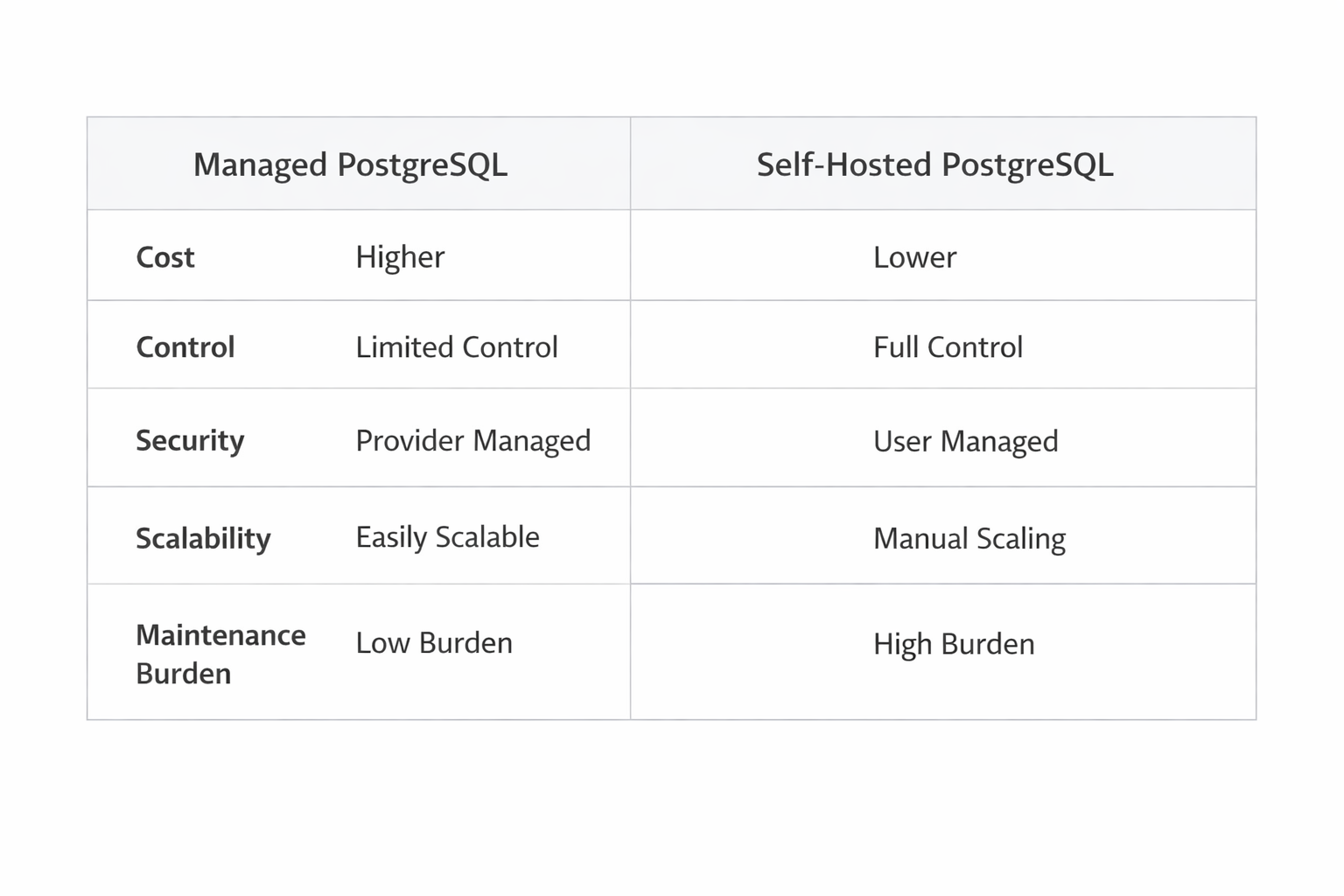
A useful mental model is this: if your team already has strong database/SRE coverage and you run large enough workloads, self-hosting may reduce raw infrastructure spend. If your team is small or your uptime demands are high, managed services often win on total cost of ownership because they reduce the labor and risk burden. In many organizations, the most expensive database is not the one with the biggest cloud bill — it is the one that keeps pulling senior engineers off roadmap work. (postgresql.org)
7) Performance and scalability: when managed services are enough and when self-hosting or hybrid architectures help
Performance is not simply “managed is slower” or “self-hosted is faster.” In practice, most applications hit bottlenecks because of schema design, query patterns, connection management, storage layout, or operational misconfiguration, not because the database is managed. Managed services are enough for a very large number of workloads, especially when your needs fit standard instance sizes, common extensions, and ordinary read/write patterns. Google Cloud and AWS both position their PostgreSQL services as suitable for production applications with scalability, replication, and read throughput support. (cloud.google.com)
Managed services also keep getting better. Cloud SQL highlights performance-oriented machine series, built-in software optimizations, and support for popular extensions. AWS emphasizes resizable capacity and replication for read throughput. That means many teams can reach strong performance without owning the storage stack or building custom cluster automation. For new applications, that is usually the best default. (cloud.google.com)
Self-hosting starts to matter when you need nonstandard tuning or architecture. Examples include very tight latency control, specialized storage hardware, extreme write volumes, custom replication topologies, deep extension experimentation, or environments where you want to control every component from kernel to query planner. Hybrid architectures can also help: a managed primary with self-managed analytics, or a self-hosted core with managed replicas, depending on the application. PostgreSQL’s support for both physical and logical replication gives teams room to build these patterns. (postgresql.org)
The key is to avoid premature complexity. Many teams assume they will “outgrow” managed PostgreSQL before they actually do. In reality, the database often scales farther than the app team expects. If you can meet your latency, throughput, and failover goals with a managed platform, that is usually the smarter move until proven otherwise. Choose self-hosting when you have a specific, measurable reason — not just a vague feeling that more control must mean better performance. (cloud.google.com)
8) Security, compliance, and governance: encryption, access control, isolation, and data residency considerations
Security is one of the clearest reasons organizations choose managed PostgreSQL, but it is also one of the clearest reasons some choose self-hosting. PostgreSQL supports multiple authentication methods, encryption options, and row-level security policies, giving administrators a strong feature set to build on. Its documentation also notes that encryption can be applied at multiple levels, including file-system or block-level storage encryption, and that SCRAM is preferred over MD5-based authentication. Row-level security lets access be constrained by policy so that users can only see rows they are allowed to access. (postgresql.org)
Managed services simplify many security tasks by default. Google Cloud states that Cloud SQL includes automatic encryption at rest and in transit, with support for customer-managed encryption keys, IAM database authentication, VPC integration, and firewall-based network controls. AWS RDS likewise exposes a managed environment with standard PostgreSQL compatibility and operational controls. This is valuable because many teams do not want to design encryption, patching, and network isolation from first principles. (cloud.google.com)
Compliance and governance complicate the decision. Regulated organizations may need audit trails, region-specific deployment, custom key management, strict separation of duties, and explicit data residency guarantees. Managed services often provide these capabilities, but not always in the exact form or region you need. Self-hosting gives you the most control over physical placement and network boundaries, but it also makes you responsible for proving that your controls work. That includes documenting backups, testing restore procedures, and showing who has privileged access. PostgreSQL’s core documentation underscores that security and recovery are not incidental features; they are part of running the database correctly. (postgresql.org)
A simple rule helps here: if your compliance needs are standard and the provider offers the required certifications and controls, managed PostgreSQL is usually sufficient. If your requirements are highly specific, or if your auditors care deeply about infrastructure provenance, self-hosting may be necessary — but only if your team can support that burden consistently. (cloud.google.com)
9) Decision framework: startup, SMB, enterprise, regulated, high-availability, and cost-sensitive use cases
The right hosting model depends on who you are and what failure costs you can tolerate.
Startups: Managed PostgreSQL is usually the best choice. Early-stage teams need speed, simplicity, and fewer operational surprises. Unless database infrastructure is part of your core product, self-hosting usually slows you down more than it saves money. Managed services let small teams focus on shipping while still getting backups, patching, and replication support. (cloud.google.com)
SMBs and growing product teams: Managed PostgreSQL still tends to win, especially if the team has limited SRE coverage. At this stage, the cost of one serious incident can outweigh the annual price difference. If you need more control, choose a managed service with strong configuration options, read replicas, and maintenance controls before jumping to full self-hosting. (cloud.google.com)
Enterprises: The decision becomes more nuanced. Managed services can meet many enterprise requirements, especially when you need multi-region options, support contracts, observability, and standardized operational procedures. But enterprises with large platform teams may also self-host certain clusters for strategic reasons, such as custom architecture, strict integration patterns, or internal platform consistency. (aws.amazon.com)
Regulated industries: Start with managed PostgreSQL only if the provider can satisfy your regulatory, residency, encryption, and access-control requirements. If the provider cannot, or if your governance model requires direct control over every layer, self-hosting may be justified. That said, the operational maturity required is much higher, so do not underestimate the organizational overhead. (postgresql.org)
High-availability workloads: Managed PostgreSQL is often the easiest path to strong HA. Providers package replication, failover, backups, and maintenance into a managed system. Self-hosting is possible, but it demands carefully engineered standby management and practiced recovery procedures. PostgreSQL’s docs make clear that failover and standby design are nontrivial. (postgresql.org)
Cost-sensitive teams: Self-hosting can appear cheaper, but only if your labor cost is low, your operations are mature, and your failure risk is acceptable. If the team is tiny, managed is often the lower-risk, lower-total-cost option because it avoids the hidden cost of bespoke database operations. (postgresql.org)
10) Practical recommendation and conclusion: how to choose the right PostgreSQL hosting model
For most teams in 2026, the default recommendation is managed PostgreSQL. It is the fastest route to production, the easiest way to get backups and failover right, and the least distracting option for teams whose core business is not database operations. The market signals point in the same direction: PostgreSQL remains one of the most popular database systems in the world, and the major cloud vendors continue investing heavily in managed PostgreSQL products. That combination usually means better tooling, more talent, and lower operational friction over time. (db-engines.com)
Choose self-hosted PostgreSQL only when you have a clear reason that managed services cannot satisfy: specialized performance tuning, strict control over the full stack, unusual extension or topology needs, or compliance constraints that a provider cannot meet. Even then, commit to the fact that self-hosting is a platform engineering responsibility, not just a cost-saving move. You will need strong practices for backups, high availability, upgrades, observability, and failover testing. PostgreSQL’s own documentation shows exactly how much discipline those areas require. (postgresql.org)
The most practical decision rule is this:
Pick managed PostgreSQL if you want speed, simplicity, and reliable operations with minimal database staffing.
Pick self-hosted PostgreSQL if you need maximum control and are prepared to run a serious database operations program.
Consider hybrid designs if one part of your stack needs strict control while the rest benefits from managed convenience. (cloud.google.com)
In other words, the “right” model is not the one with the most features — it is the one that fits your team’s capacity and risk profile. For many organizations, managed PostgreSQL is the sensible default. For a smaller set of mature, specialized teams, self-hosting is still worth it. The best choice is the one that keeps your database boring in the ways that matter.