How to Modernize a Legacy System Incrementally: A Practical Roadmap
July 8, 2026
Legacy systems often power the most important parts of a business: customer workflows, billing, operations, reporting, and compliance. That is exactly why modernization is so difficult. A “rewrite everything” approach can look clean on paper, but in practice it creates enormous risk, pauses feature delivery, and makes it harder to learn what really matters in the old system. Incremental modernization offers a safer alternative: keep the business running, modernize in slices, and replace the riskiest or most valuable parts first. The strangler fig pattern is a well-known way to do this gradually, reducing transformation risk and business disruption while allowing new capabilities to come online piece by piece. (docs.aws.amazon.com)
The goal of this roadmap is not to “fix” every legacy issue immediately. It is to create a practical path that balances continuity, delivery speed, and controlled change. That means understanding the current estate, defining a clear target state, introducing an integration layer, modernizing data carefully, and building strong operational guardrails such as CI/CD, observability, and automated testing. When done well, incremental modernization turns a once-fragile legacy system into a platform that can evolve without constant fear of breaking the business. (docs.aws.amazon.com)

1. Why incremental modernization is the safer path for legacy systems
Incremental modernization is safer because it limits blast radius. Instead of changing an entire system at once, you modernize one business capability, one endpoint, or one workflow at a time. That means failures are smaller, rollbacks are simpler, and teams can validate real outcomes before expanding the effort. AWS describes the strangler fig pattern as an incremental migration approach that reduces transformation risk and business disruption, while Martin Fowler’s updated writing emphasizes gradual replacement rather than a big-bang rewrite. (docs.aws.amazon.com)
A full rewrite usually assumes the team understands the system well enough to reproduce every important behavior. In reality, legacy systems often contain undocumented rules, hidden integrations, and edge cases that only surface under production load. Incremental modernization creates room for discovery. As you peel away parts of the old system, you learn where the true complexity lives and can respond with better design choices instead of guesses. That learning loop is especially important in systems that have evolved over many years or through multiple mergers, vendor changes, and business pivots. (docs.aws.amazon.com)
There is also a people and operating-model benefit. Smaller releases are easier to review, test, and deploy. Teams can keep shipping value while modernization work is underway, which reduces organizational resistance. Instead of asking stakeholders to wait months or years for a “finished” platform, incremental modernization delivers visible progress early. That momentum matters because modernization projects often fail when they become invisible, abstract, or disconnected from immediate business needs. (docs.aws.amazon.com)
2. Assess the legacy estate: business value, technical debt, and risk hotspots
Before changing anything, map the estate in business terms. Not every legacy component deserves equal attention. Some systems are critical revenue engines; others are operationally important but low-volume; and some are expensive to maintain but used rarely. Start by identifying the workflows that create revenue, support customers, or satisfy regulatory obligations. Then connect those workflows to the applications, services, data stores, batch jobs, and third-party dependencies that make them work. This gives you a modernization map anchored in business value rather than in code structure alone. (docs.aws.amazon.com)
Next, assess technical debt. Technical debt is not just “old code.” It shows up as duplicated logic, brittle interfaces, hard-coded business rules, deployment friction, and systems that cannot be tested in isolation. Martin Fowler’s refactoring guidance emphasizes making small behavior-preserving changes so the system can evolve safely over time instead of collapsing under one huge restructuring effort. That same logic applies to modernization: you want to locate the parts of the estate where small changes are most dangerous or most expensive. (martinfowler.com)
Risk hotspots are the places most likely to cause outages, delays, or scope creep. These include tightly coupled modules, shared databases, batch processes with unclear ownership, authentication and authorization paths, and integrations that depend on older protocols or undocumented assumptions. A practical way to surface these hotspots is to interview operators, support teams, and long-tenured developers alongside architecture reviews and system logs. The objective is to identify where the system is fragile, where failures are most visible to users, and where changes are most likely to block future modernization work. (docs.aws.amazon.com)
3. Define the target state and modernization principles before touching code
Modernization becomes much easier when the team agrees on the destination before changing the journey. The target state does not need to be a perfectly detailed blueprint, but it should define the operating principles that guide decisions. For example: new functionality should be built in modular services, old and new systems should coexist during transition, data ownership should be explicit, and every modernized slice should be independently testable and deployable. Clear principles prevent the team from improvising architecture in the middle of a migration, when pressure is highest and context is changing quickly. (docs.aws.amazon.com)
A good target state also includes nonfunctional goals. Decide what “better” means in concrete terms: lower incident rate, faster lead time for changes, shorter recovery time, lower infrastructure spend, or improved user latency. Google’s SRE guidance on SLOs is useful here because it emphasizes starting with what users care about and then choosing metrics that reflect those needs. In other words, modernization should be driven by outcomes, not just technology preferences. (sre.google)
This is also the moment to set boundaries. Which parts of the legacy estate will remain stable for now? Which new platform standards are mandatory? How will teams decide whether a component should be replaced, wrapped, or left alone? Without these principles, modernization projects can drift into architecture-by-committee, where every service is redesigned differently and the result is more complexity, not less. A disciplined target state keeps modernization practical and makes trade-offs explicit. (docs.aws.amazon.com)
4. Use the strangler fig pattern to replace functionality slice by slice
The strangler fig pattern is the backbone of incremental modernization. The idea is simple: place a new layer around the old system, route selected requests to new components, and gradually move functionality out of the legacy core until the old system can be retired. AWS describes this as gradually replacing features with new services while users transition progressively, rather than all at once. Martin Fowler’s writing likewise frames the pattern as gradual replacement of a legacy system with a new one. (docs.aws.amazon.com)
In practice, this usually starts with a routing or façade layer. That layer decides whether a request should be served by the legacy system or by a new service. Over time, more routes move to the new implementation. The original system remains available for the parts that have not yet been migrated. This approach is especially useful when the legacy system is too important to stop, too risky to rewrite, or too entangled to split immediately. (aws.amazon.com)
The trick is to slice by business capability, not by technical convenience alone. Migrating “login,” “order status,” or “invoice lookup” makes more sense than extracting a random helper module. Each slice should be independently meaningful, testable, and measurable. That makes it possible to prove the new implementation works before expanding its scope. The more each slice can be verified in production-like conditions, the less likely the migration is to stall because of uncertainty or fear. (docs.aws.amazon.com)
5. Prioritize high-value, low-risk components to build early momentum
Early modernization wins matter. They build credibility, reduce skepticism, and create reusable patterns for the harder parts later. A strong rule of thumb is to prioritize components that deliver visible business value but have relatively low coupling and manageable data complexity. This could be a read-only feature, a reporting endpoint, a configuration workflow, or a customer-facing screen with limited side effects. (docs.aws.amazon.com)
Why start here? Because these slices are easier to deliver successfully, and success creates a template. Teams learn how to route traffic, how to test old-versus-new behavior, how to monitor the new path, and how to handle fallback. Once those practices exist, more complex migrations become less intimidating. This is one reason incremental modernization tends to outperform rewrite programs: the team gets better at modernization as it modernizes. (docs.aws.amazon.com)
High-value, low-risk components are also useful politically. They produce visible improvements without requiring the organization to bet everything on a massive first release. That matters when stakeholders are cautious, budgets are limited, or the legacy system is still performing critical work. In many programs, the first slice is less about technical difficulty and more about proving that the modernization path is credible. Once people trust the approach, it becomes easier to tackle the tougher integrations and data changes later. (docs.aws.amazon.com)

6. Create an API and integration layer to decouple old and new systems
An API and integration layer is what lets old and new systems coexist without becoming tangled. Rather than having the new code reach directly into legacy internals, expose well-defined interfaces that represent business actions or data needs. This creates a stable boundary and gives the team a place to introduce routing, security, logging, and versioning consistently. AWS notes that a uniform point of access can also help with security and workload management during gradual migration. (aws.amazon.com)
This layer can take many forms: an API gateway, a façade service, an event bridge, or an adapter that translates between old protocols and new ones. The exact technology matters less than the design principle: callers should depend on the contract, not on the legacy implementation details. That reduces coupling and makes it easier to swap out the back end later. It also gives you a clean place to handle cross-cutting concerns such as authentication, rate limiting, and request tracing. (aws.amazon.com)
A well-designed integration layer is also how you manage the transition period. Some requests may still need the legacy path while others move to the new service. The layer becomes the switchboard. It can direct traffic, collect metrics, and allow gradual cutover by customer segment, region, or feature flag. Without this decoupling layer, modernization tends to leak into every caller, making the migration harder to control and harder to reverse if something goes wrong. (docs.aws.amazon.com)
7. Modernize data incrementally: synchronization, migration, and coexistence
Data is usually the hardest part of modernization because application code can be rewritten faster than data ownership can be safely transferred. Incremental data modernization starts with understanding what data exists, who uses it, and which system is the source of truth for each domain. In many programs, data cannot move all at once; instead, you need synchronization, coexistence, and staged migration. That requires careful planning around consistency, latency, and fallback. (docs.aws.amazon.com)
A practical model is to begin with read coexistence. The new system may read from replicated or synchronized data while the old system remains authoritative. Later, specific write paths can be redirected to the new service, with the legacy system still supported until confidence is high. This staged approach helps avoid the classic trap of migrating the application while leaving all the data assumptions untouched. That trap often creates hidden coupling that only appears under real load. (docs.aws.amazon.com)
Data migration also needs strong validation. Reconciliation jobs, checksum comparisons, dual writes where appropriate, and audit logs can help verify that the new and old systems agree during transition. The goal is not just to “move data,” but to preserve business correctness while the source of truth changes. Because data issues can be subtle and expensive, many teams benefit from migrating one domain at a time rather than attempting a broad database conversion. (aws.amazon.com)
8. Adopt CI/CD, observability, and automated testing to control change
Modernization without operational discipline quickly becomes chaotic. CI/CD, observability, and automated testing are the mechanisms that keep incremental change safe. Continuous integration ensures that each small change is built and validated early. Continuous delivery or deployment reduces friction in releasing slices as they are ready. Automated tests provide confidence that new behavior matches expectations and that legacy behavior has not regressed. (martinfowler.com)
Observability is equally important. During modernization, you need to know how requests flow through old and new paths, where failures occur, and whether the user experience is improving. Google’s SRE guidance stresses defining service-level indicators and objectives that reflect what users actually care about, rather than just what is easiest to measure. That principle is ideal for modernization: track latency, error rates, throughput, and user journeys across the migration boundary. (sre.google)
Testing should be layered. Unit tests catch logic errors early, integration tests validate contracts across boundaries, and end-to-end tests confirm business-critical flows still work. For modernization specifically, regression tests around legacy behavior are especially valuable because they document the behavior you are replacing. In many cases, the test suite becomes part of the modernization effort itself, helping reveal assumptions that were never written down. Over time, better test coverage and better telemetry make it easier to change the system with confidence. (martinfowler.com)
9. Measure progress with business, reliability, and cost metrics
If you cannot measure modernization progress, you cannot manage it. The right metrics should show whether the program is creating business value, improving reliability, and reducing cost or complexity. Business metrics might include conversion rates, completion times, abandonment rates, support ticket volume, or revenue from the migrated flow. Reliability metrics might include incident counts, error rates, latency, and recovery time. Cost metrics might include infrastructure spend, support effort, licensing, or time spent maintaining legacy code. (sre.google)
Choose metrics that tell a story about outcomes, not just activity. It is easy to count how many services were created or how many endpoints were refactored, but those numbers can be misleading. A modernization program that produces lots of new code but no measurable improvement is still failing. SRE-style objectives are helpful because they force teams to define what “good” looks like in terms of user-visible service quality and operational performance. (sre.google)
It also helps to establish baseline measurements before modernization begins. Without a baseline, it is hard to prove progress or detect regressions. For example, if the legacy process takes 12 minutes end to end, and the new path takes 4 minutes with fewer errors, that is a concrete win. If the new path is faster but more expensive to operate, the organization can have an informed discussion about trade-offs instead of relying on intuition. Good metrics turn modernization from a vague aspiration into a managed portfolio of improvements. (sre.google)
10. Avoid common failure modes: overengineering, hidden dependencies, and weak governance
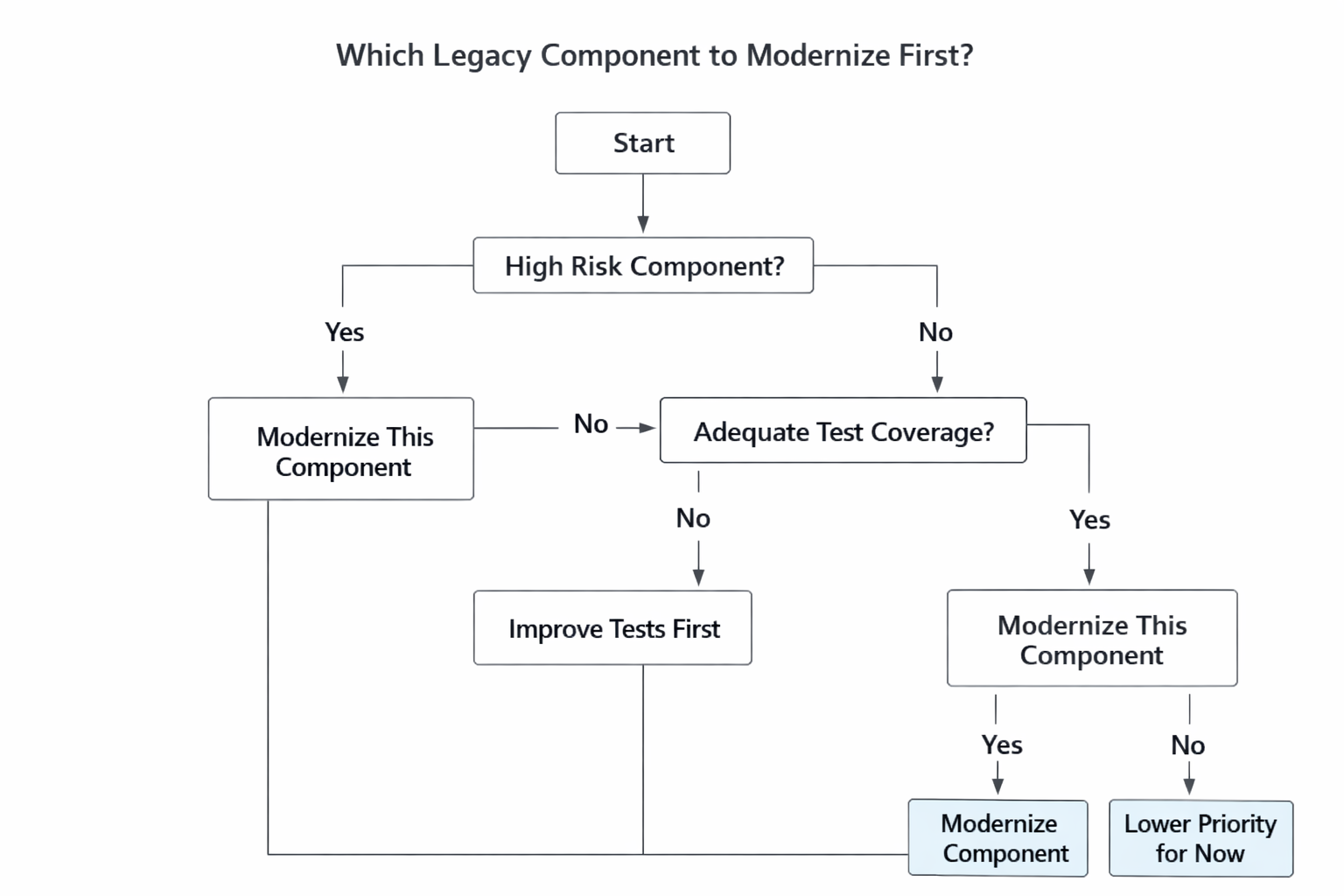
Incremental modernization can still go wrong. One common failure mode is overengineering: teams design a perfect future platform before proving the first slice works. That slows delivery and often creates more complexity than the legacy system had. The point of incremental modernization is to make change safer, not to produce an elaborate architecture diagram that nobody can implement in the time available. (docs.aws.amazon.com)
Hidden dependencies are another major risk. Legacy systems often depend on file drops, timing assumptions, shared tables, batch windows, or side effects that are not obvious from the code. If these dependencies are not discovered early, they can break during migration in ways that are hard to debug. This is why assessment work, observability, and cross-team interviews matter so much: they reveal the real shape of the system before you start cutting pieces out of it. (docs.aws.amazon.com)
Weak governance can quietly undermine everything. If no one owns the migration boundaries, data contracts, testing standards, or release gates, modernization becomes inconsistent and fragile. Governance does not have to be bureaucratic; it can be lightweight and practical. The key is to define decision rights, migration readiness criteria, rollback expectations, and architectural principles so teams can move quickly without creating chaos. Strong governance gives teams the freedom to modernize in parallel while still maintaining coherence across the program. (learn.microsoft.com)
Conclusion
Incremental modernization is not the fastest-looking option at the start, but it is often the fastest path to durable progress. It lets you keep the business running while systematically replacing the most valuable or risky parts of the legacy estate. The safest programs begin with a clear assessment, define a target state and principles, route traffic through a modern façade, migrate data carefully, and surround every change with testing, observability, and meaningful metrics. (docs.aws.amazon.com)
The big lesson is simple: modernize the system the business depends on without forcing the business to stop. By replacing functionality slice by slice, you reduce risk, build confidence, and create a platform that can keep evolving long after the original legacy constraints are gone. That is the real promise of incremental modernization: not just new technology, but a better way to change. (docs.aws.amazon.com)