
How to Introduce AI into Your Architecture Without Creating Chaos
May 13, 2026
AI can create real business value, but it can also create architectural sprawl, security gaps, duplicated tools, and a growing pile of “temporary” experiments that never get cleaned up. The difference between a useful AI rollout and a chaotic one usually isn’t the model itself. It’s the architecture, operating model, governance, and discipline around how AI enters the organization. Recent research shows that adoption is rising quickly, yet enterprise scaling remains uneven: McKinsey’s 2025 global survey says most organizations are still early in scaling and that only 23% are scaling agentic AI somewhere in the enterprise, while Deloitte’s 2026 reporting highlights expanding adoption alongside the need for stronger governance and a more disciplined path to scale. (mckinsey.com)
For architecture teams, the challenge is not “should we use AI?” but “how do we introduce AI without breaking the systems we already depend on?” That means starting with business value, not hype; establishing guardrails before broad rollout; standardizing the platform; and treating AI as a new capability layer that must fit into identity, security, observability, data management, and change control. When teams do that well, AI becomes an accelerator. When they don’t, it becomes another source of technical debt. (mckinsey.com)
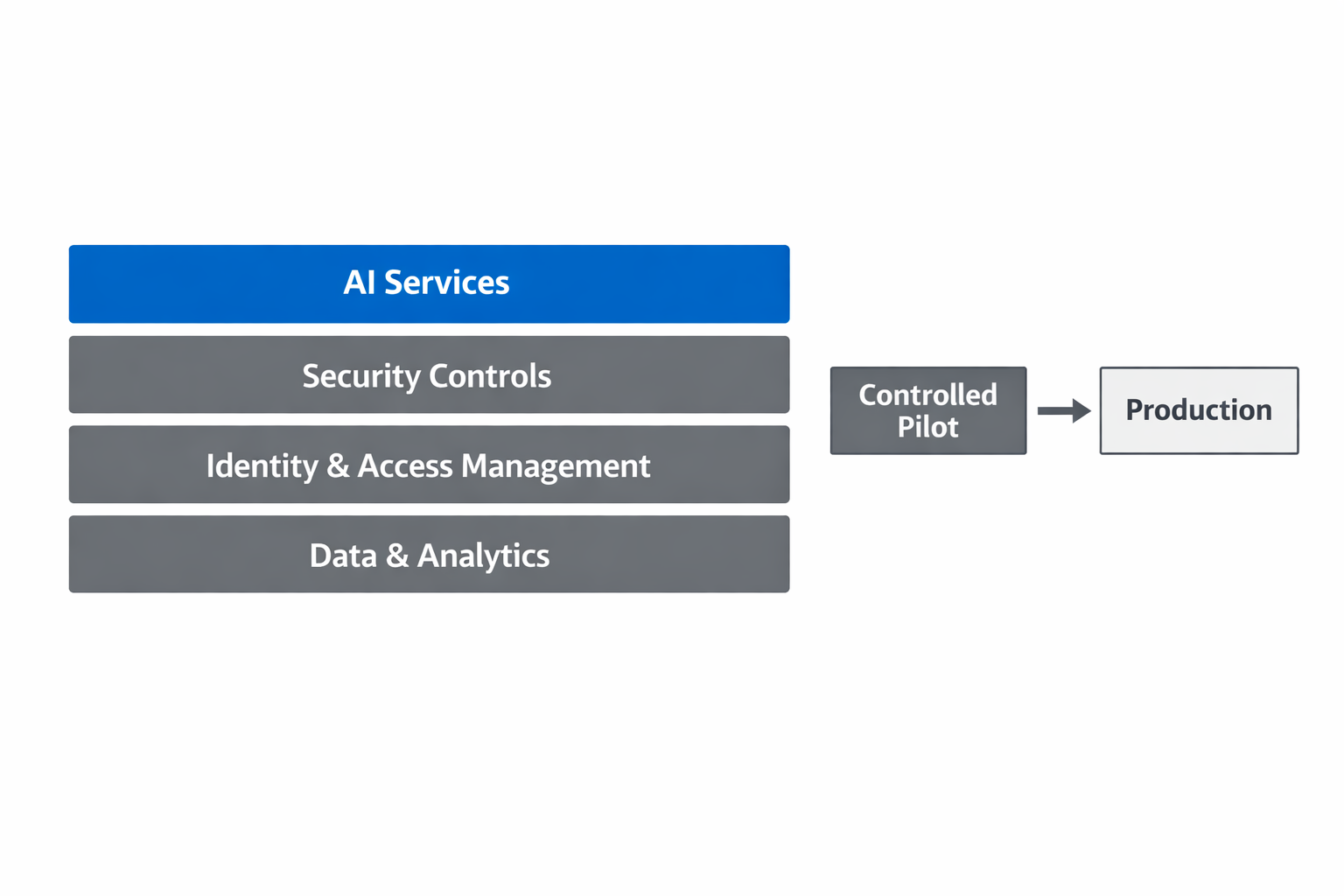
1. Why AI rollouts create chaos in architecture teams
AI rollouts often start with enthusiasm and end with confusion because they bypass the architectural disciplines that keep core platforms stable. A common failure mode is “shadow AI”: individuals or teams adopt consumer tools, browser extensions, or unofficial copilots to solve immediate problems, often without security review, data classification controls, or procurement oversight. That creates hidden data exposure risk and makes it impossible for enterprise architecture to know what is actually in use. Recent security commentary has warned that shadow AI is not hypothetical; it is already showing up in organizations that did not create a sanctioned path fast enough. (itpro.com)
Another source of chaos is duplicated tooling. One team experiments with a chatbot, another builds a separate RAG search layer, and a third buys a point solution for the same use case. Each version has its own prompts, connectors, permissions, and logging model. Over time, this leads to fragmented data access patterns, inconsistent controls, and a support burden that architecture teams cannot sustainably absorb. McKinsey’s 2025 survey suggests many organizations are still in the early stages of adoption and scaling, which means duplication risk is high because multiple teams are moving fast at once. (mckinsey.com)
Unclear ownership makes the problem worse. AI touches application teams, platform engineering, data engineering, security, legal, compliance, and business operations. If no one owns the full lifecycle—from use-case approval to model risk review to monitoring—then incidents get deferred, exceptions pile up, and teams fall back on ad hoc decisions. The architecture lesson is simple: AI needs named owners, explicit boundaries, and reusable patterns. Without those, the organization gets pilots, not platforms. (mckinsey.com)
2. What the latest research says about AI adoption in 2025–2026
The latest research paints a consistent picture: AI adoption is rising, but value capture is uneven. McKinsey’s 2025 State of AI survey found that organizations are expanding use, including agentic AI experimentation, but most are still in the early stages of scaling and capturing enterprise-level value. It also reported that 23% of respondents are scaling an agentic AI system somewhere in the enterprise, while 39% have begun experimenting with AI agents. That is meaningful progress, but it is not yet broad operational maturity. (mckinsey.com)
Research from McKinsey also highlights that a small group of organizations—its “high performers”—are getting significantly more value because they redesign workflows, invest more deliberately, and apply adoption and scaling best practices. In other words, ROI does not come from simply turning AI on; it comes from changing the work around it. McKinsey’s earlier survey-based research likewise emphasizes governance, role-based training, clear roadmaps, and KPI tracking as part of the value-capture formula. (mckinsey.com)
Deloitte’s 2026 AI reporting likewise points to stronger adoption and higher expectations for scale, but it also shows that governance and organizational readiness still matter more than model novelty. IBM’s 2025 research found that nearly 74% of surveyed organizations reported only moderate or limited coverage in AI risk and governance frameworks for technology, third-party, and model risks. That is a big clue for architecture teams: the bottleneck is increasingly governance, operating model, and integration—not access to the latest model. (deloitte.com)

3. Start with business value, not models
The safest way to introduce AI is to start with business outcomes, not model capabilities. Teams that begin with “we need AI everywhere” usually end up with a loose collection of demos, each optimized for novelty rather than operational value. A better approach is to look for high-impact, low-risk use cases where AI can remove friction without taking over critical decisions. Examples include internal knowledge retrieval, document summarization, drafting support, triage assistance, code review support, and customer-service augmentation with human oversight. McKinsey’s research on high performers suggests that organizations see more value when they redesign workflows and focus on enterprise outcomes rather than isolated technical pilots. (mckinsey.com)
Architecture teams should rank use cases by business value, risk, and implementation complexity. A use case with moderate productivity impact and low regulatory exposure is usually a better first candidate than a flashy automation scenario that touches sensitive decisions. This is especially important in architecture because early choices shape long-term platform standards. If the first rollout is too ambitious, it can force shortcuts in data access, identity, monitoring, and escalation paths. (mckinsey.com)
It also helps to be explicit about what AI is not for. AI should not be used to justify process chaos, poor data quality, or unclear ownership. If a workflow is already brittle, adding AI may simply make the brittleness faster and harder to diagnose. Start by identifying where AI reduces cycle time, improves quality, or expands team capacity with manageable risk. That approach produces a better business case and a cleaner architecture. (mckinsey.com)
4. Build an AI-ready architecture foundation
Before AI scales, the underlying architecture needs to be ready for it. The first requirement is data quality. AI systems are only as reliable as the data they can access, and poor metadata, stale content, inconsistent schemas, and unclear lineage quickly become visible once AI starts generating answers or recommendations. This is especially true for retrieval-based systems, where incomplete or duplicated documents can produce misleading outputs even when the model itself is sound. (mckinsey.com)
The next foundation is integration. AI should connect through well-defined APIs, event streams, or controlled retrieval layers—not by granting broad, unlogged access to production systems. Integration patterns should make it easy to understand what the AI can read, what it can write, and what human approval is required before an action is taken. For higher-risk workflows, environment isolation matters too: keep development, testing, and production separate, and make sure AI experiments cannot accidentally interact with sensitive live systems. (mckinsey.com)
Identity and access management are equally important. AI needs the same rigor that other enterprise services require: least privilege, role-based access, service identities, secrets management, and auditability. Observability is also non-negotiable. Teams should be able to trace requests, prompts, retrieval sources, model outputs, tool calls, human approvals, and downstream actions. NIST’s AI RMF emphasizes trustworthiness considerations across the AI lifecycle, which aligns well with standard architecture practices around control, monitoring, and continuous improvement. (nist.gov)
5. Create governance before scaling
Governance is not a brake on AI. It is what makes AI safe enough to scale. The best time to define governance is before the first pilot becomes popular, not after the first incident. That governance should cover approved use cases, acceptable data types, human oversight requirements, model risk review, audit logging, escalation paths, and exception handling. McKinsey’s adoption research explicitly identifies governance-related best practices such as dedicated transformation teams, role-based training, clearly defined roadmaps, and KPI tracking. (mckinsey.com)
A practical governance model starts with a use-case intake process. Each new AI idea should be evaluated for business value, data sensitivity, decision impact, compliance obligations, and operational support needs. Low-risk use cases may only need light review and standard controls, while high-risk use cases may require legal, security, privacy, and model-risk signoff. The point is not to slow every request; it is to calibrate oversight to the actual level of risk. (nist.gov)
Governance should also define what humans must do. For some workflows, AI can draft or recommend, but only a person can approve, release, or act. For others, AI may be allowed to take bounded actions, but only within strict thresholds and with full logging. NIST’s AI RMF provides a useful trust framework here, while OWASP’s LLM guidance highlights the need to account for prompt injection, data leakage, and excessive agency in AI-enabled systems. (nist.gov)
6. Choose the right deployment pattern
Not every AI use case should be deployed the same way. A copilot pattern is the safest starting point for many organizations: AI assists a user, but the human remains in control. This works well for drafting, summarization, search, analysis, and suggestion generation. It is typically the lowest-risk pattern because the AI improves productivity without directly changing systems of record. (mckinsey.com)
An embedded workflow AI pattern goes a step further by placing AI inside the business process itself. For example, AI can assist claims handling, case management, service desk triage, or developer workflows. This pattern is more valuable than a standalone chatbot because it meets users where they already work, but it also requires better integration, clearer controls, and stronger observability. McKinsey’s research suggests that embedding AI into business processes is one of the adoption best practices associated with scaling value. (mckinsey.com)
Retrieval-augmented generation, or RAG, is useful when accuracy depends on enterprise knowledge. It can reduce hallucination risk by grounding responses in approved sources, but it does not remove security or governance concerns. Agentic automation is the most advanced pattern: the AI can plan, call tools, and take multi-step actions. That can unlock real efficiency, but it also introduces the highest risk because it expands the consequences of mistakes or malicious inputs. OWASP’s 2025 LLM guidance and related security work make it clear that prompt injection, excessive agency, and supply-chain risks become more serious as autonomy increases. (owasp.org)
7. Reduce technical and organizational sprawl
AI sprawl is what happens when every team builds its own stack, naming convention, connector set, and evaluation method. The antidote is standardization. Architecture teams should publish reference architectures for common AI patterns, including approved model access paths, data retrieval methods, logging standards, and human-in-the-loop requirements. When teams have a clear default path, they are less likely to invent one-off solutions that later become permanent support obligations. (mckinsey.com)
Platform guardrails matter just as much. A shared AI platform can provide approved model endpoints, secret handling, prompt templates, retrieval services, and monitoring hooks. That makes it easier for delivery teams to move quickly without negotiating every control from scratch. It also improves governance because controls live in one place rather than being reimplemented inconsistently across projects. (deloitte.com)
Organizations should also actively prevent duplicate experiments. That does not mean banning exploration; it means making experiments visible, reusable, and time-boxed. A central registry of AI use cases, pilots, and approved vendors helps teams avoid repeating work. It also makes it easier to identify which pilots deserve to graduate into shared services. The goal is a portfolio, not a pile of disconnected demos. (mckinsey.com)
8. Secure the stack end to end
AI security has to be treated as an architecture concern, not just a model concern. Sensitive data needs classification, access control, masking where appropriate, and clear rules for what can enter prompts, retrieval indexes, logs, and training datasets. If teams can paste anything into any tool, then AI becomes an uncontrolled data exfiltration channel. NIST’s AI RMF supports a trust-based approach, while IBM’s research shows governance coverage is still lagging in many organizations. (nist.gov)
Prompt injection is one of the most visible risks in modern AI systems. OWASP’s 2025 guidance explicitly lists prompt injection as a top issue for LLM applications, and Microsoft’s security guidance also highlights indirect prompt injection as a real operational threat. In practice, that means AI systems need input filtering, tool restriction, source validation, output checking, and careful separation between user content and system instructions. (owasp.org)
Supply-chain risks matter too. AI systems depend on models, libraries, agents, connectors, vector databases, and external services, any of which can introduce vulnerabilities or hidden behavior. That is why architecture teams should align AI controls with existing security architecture: secure software supply-chain practices, secrets management, runtime monitoring, segmentation, and least privilege. The more agentic the system becomes, the more important it is to constrain tool access and log every action. (docs.aws.amazon.com)
9. Measure what matters
If you measure the wrong things, you will optimize the wrong behaviors. Vanity metrics such as number of prompts, number of users, or number of demos launched do not tell you whether AI is improving the business. Better measures include adoption in the right workflows, cycle-time reduction, quality improvement, cost savings, incident rate, and business outcomes tied to the original use case. McKinsey’s research specifically points to tracking well-defined KPIs for AI solutions as part of the adoption and scaling playbook. (mckinsey.com)
Measurement should be layered. At the product level, track usage and satisfaction. At the workflow level, track throughput, rework, escalation rate, and time saved. At the risk level, track policy violations, hallucination escapes, data exposure incidents, and human override frequency. At the business level, track revenue impact, cost reduction, customer satisfaction, or service quality—whatever the original use case was meant to improve. (mckinsey.com)
It is also useful to distinguish between activity and value. A pilot may have high engagement but low value if it does not actually change the work. Conversely, a tool may have modest usage but outsized business value if it is used in a high-friction process. Architecture teams should help leadership interpret AI metrics in context, because a healthy AI program is not the one with the most demos. It is the one that reliably improves outcomes without increasing risk. (mckinsey.com)
10. A phased roadmap for implementation
The safest path to AI at scale is phased, not explosive. Start with a pilot that is narrow, measurable, and low risk. The pilot should validate business value, user behavior, data requirements, and control points. At this stage, the goal is not to prove that AI can do everything; it is to prove that it can do one valuable thing reliably. (mckinsey.com)
Once the pilot is promising, validate it against real operational conditions. That means testing with realistic data, checking for security and privacy issues, documenting failure modes, and confirming who is responsible when things go wrong. Next comes governance: define policies, approvals, logging, and human oversight before expanding access. Then integrate the solution into core workflows and supported platforms so it becomes part of the operating model rather than a side experiment. (nist.gov)
After integration, expand deliberately. Reuse reference architectures, standardize controls, and add use cases only when the foundation is ready. Finally, continuously improve by monitoring outcomes, reviewing incidents, retraining users, and adjusting policies as the technology and the risk landscape evolve. Deloitte and McKinsey both point toward the same broad lesson: organizations that scale AI successfully pair adoption with governance, workflow redesign, and disciplined iteration. (deloitte.com)
Conclusion
Introducing AI into your architecture does not have to create chaos. The organizations that succeed treat AI as an enterprise capability, not a novelty feature. They start with business value, build on a solid data and integration foundation, establish governance early, choose the right deployment pattern for the risk level, and keep security and observability in the design from day one. That approach reduces duplication, prevents shadow AI, and gives teams a safer path from pilot to scale. (mckinsey.com)
The key takeaway is simple: AI should fit into your architecture discipline, not replace it. If you create a clear roadmap, standardized patterns, and responsible controls, AI can improve productivity and decision-making without destabilizing the systems your organization depends on. If you skip those steps, AI will amplify the chaos you already have. (mckinsey.com)
References
McKinsey — The state of AI: How organizations are rewiring to capture value
Deloitte — The State of AI in the Enterprise - 2026 AI report
IBM — CIOs Face A Critical Gap As AI Risk Governance Falls Behind
Microsoft Learn — Defend against indirect prompt injection attacks
Microsoft Learn — Protect enterprise generative AI apps with prompt injection protection