
How to Decide if You Really Need Microservices in 2026
August 26, 2026
Microservices are still one of the most debated architecture choices in software development. For some teams, they unlock faster releases, better team autonomy, and cleaner scaling. For others, they introduce operational complexity that slows everyone down. In 2026, the question is not “Are microservices good?” It is “Are microservices the right answer for this organization, this product, and this stage of maturity?”
That distinction matters more than ever. Cloud-native adoption is now mainstream, with CNCF reporting that 98% of surveyed organizations use cloud-native techniques and 82% of container users run Kubernetes in production. But the same reports also suggest that the hardest part is no longer just technology—it is organizational change, process, and managing complexity at scale. (cncf.io)
This post walks through how to decide, realistically, whether your system needs microservices in 2026. We will look at the business triggers that justify the move, the signs your monolith is struggling, the hidden costs people underestimate, and the cases where a modular monolith is the better choice. If you are trying to avoid both architecture dogma and expensive mistakes, this guide is for you.
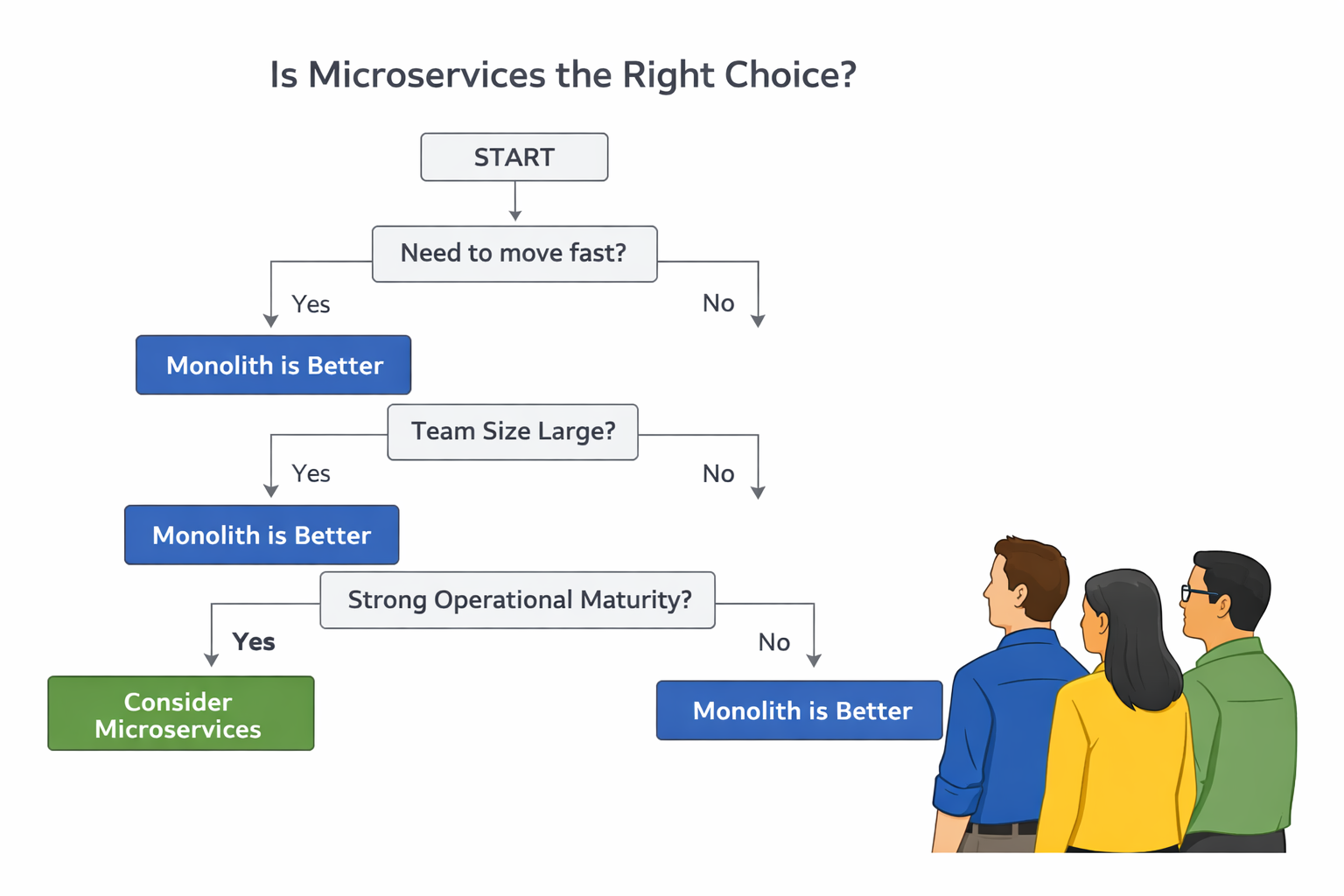
1. What microservices are—and why teams still debate them
Microservices are an architectural style in which a single application is built as a set of small services, each running in its own process and communicating through lightweight mechanisms such as HTTP APIs. Martin Fowler’s definition also emphasizes that services should be organized around business capabilities and deployed independently. (martinfowler.com)
So why do teams still argue about them? Because microservices solve real problems, but they do so by introducing a new class of problems. A monolith can become difficult to understand and deploy as it grows. Microservices can reduce coupling between teams and make it easier to release parts of a system independently. Fowler notes that microservices can help larger teams maintain strong module boundaries and avoid the coordination pain that often comes with a large monolith. (martinfowler.com)
But the trade-off is obvious: once you split a system into many networked services, you inherit distributed-systems complexity. That means more failure modes, more deployment surfaces, more data consistency challenges, and more tooling requirements. In practice, some teams adopt microservices because they genuinely need them; others adopt them because they want to feel “modern.” Those are very different motivations.
The strongest advice from the microservices literature is still the most practical one: start with a monolith, keep it modular, and split it only when the monolith becomes a real problem. That guidance remains relevant in 2026 because it frames architecture as an answer to pressure, not as an identity choice. (martinfowler.com)
2. Current adoption trends and what recent surveys suggest about cloud-native complexity
Recent surveys suggest that cloud native is no longer experimental. CNCF’s 2026 Annual Cloud Native Survey says cloud-native adoption reaches 98% across surveyed organizations, and 82% of container users run Kubernetes in production. It also reports that 66% of organizations hosting generative AI workloads use Kubernetes in production. (cncf.io)
That sounds like a strong case for microservices, but the nuance matters. The same survey results suggest that the challenge has shifted from “Can we adopt this?” to “Can we operate it sustainably?” CNCF highlighted that cultural change with development teams ranked as the number one challenge at 47%, overtaking traditional technical blockers. (cncf.io)
This is important because microservices tend to appear in organizations that have already embraced cloud-native tooling, containers, and Kubernetes. But broad cloud-native adoption does not automatically mean a company is ready for a complex distributed architecture. In fact, a 2024 CNCF survey summary showed that complexity, scaling deployments, testing, logging, networking, and service mesh concerns remain significant pain points across maturity levels. (cncf.io)
A separate 2026 CNCF post on observability noted that many cloud-native teams still run multiple observability stacks, which hints at a broader truth: tool sprawl often grows faster than operational maturity. (cncf.io)
The takeaway is simple. In 2026, adopting cloud-native technology is common. Running microservices well is still hard. If your team is already struggling with observability, deployment complexity, or cross-team process friction, microservices may amplify those issues rather than solve them.
3. The real business triggers: scale, release velocity, and team autonomy
The best reasons to adopt microservices are business reasons, not architectural fashion. Three triggers show up repeatedly: scale, release velocity, and team autonomy. Martin Fowler’s writing also emphasizes that microservices become particularly attractive when a system grows large enough that team dependencies and deployment entanglement become painful. (martinfowler.com)
Scale is the most obvious trigger, but it is often misunderstood. Scale is not only about traffic volume. It also includes the scale of codebase, domain complexity, and number of people working in the system. If a single deployment artifact is becoming a bottleneck for many teams, you may be seeing organizational scale pain before technical scale pain.
Release velocity matters when different parts of the product change at different speeds. If one team needs to release frequently while another team’s release cadence is slower and more controlled, a monolith can create friction. Microservices can let independent teams ship independently, which is often the strongest operational argument in favor of splitting.
Team autonomy is the least technical but often the most important. If product teams constantly depend on each other for code changes, testing, and release approvals, the organization pays a tax in coordination. Microservices can reduce that tax—if the service boundaries match the business boundaries well. If they do not, you may just replace one kind of coupling with another.
The key question is whether microservices will improve the flow of value to customers. If the answer is “maybe someday,” that is not enough. If the answer is “our current release and ownership model is already blocking delivery,” then you are at least in the right conversation.
4. Signs a monolith is becoming the bottleneck
A monolith is not bad by default. In fact, many successful systems stay monolithic for years. The issue is not size alone; it is whether the system is still easy to evolve. Fowler points out that large monoliths often become difficult when small changes require coordination across many modules or when deployment risk rises because everything ships together. (martinfowler.com)
Here are some common signs the monolith is becoming a bottleneck:
Frequent release collisions
If one team’s deployment routinely forces another team to delay, test more, or coordinate a release window, the monolith is no longer serving delivery speed.
Build and test times keep climbing
Longer CI pipelines are a warning sign. If the system is so interconnected that every test suite touches everything, the architecture may be obscuring the boundaries of the product.
Ownership is unclear
When multiple teams touch the same code paths and no one clearly owns a business capability, bugs linger and refactoring slows down.
Small changes cause large regressions
If adding a feature in one area keeps breaking unrelated functionality, your modules may be too coupled.
Scaling needs are uneven
Some parts of the application may need far more resources than others. If you must scale the whole app just to support one hot path, that can become expensive.
Domain complexity is growing
A single codebase can handle lots of logic, but once the domain becomes too broad, developers spend too much time navigating code instead of improving the product.
The most important signal is not “the monolith feels old.” It is “the monolith is now preventing the business from moving at the speed it needs.” That is the point where architecture becomes a product decision.
5. Hidden costs of microservices: ops overhead, testing, observability, and data consistency
Microservices are often sold as a way to increase speed. They can do that, but only after you pay for the overhead. The hidden costs are where many teams get surprised.
Operations overhead
Every service needs deployment, monitoring, rollback, security, runtime configuration, and incident handling. One application becomes many. That means more pipelines, more images, more infrastructure, and more failure points. Recent CNCF commentary on observability shows that even with mature tooling, teams still struggle with stack sprawl and integration complexity. (cncf.io)
Testing complexity
Testing microservices is harder than testing a monolith. Unit tests are still important, but they are not enough. You also need contract tests, integration tests, and end-to-end tests across service boundaries. The more services you have, the more your test strategy becomes a distributed-systems problem.
Observability burden
A monolith can often be debugged with local logs and a single tracing path. Microservices require metrics, centralized logs, and distributed tracing just to answer basic questions like “where did the request fail?” If observability is weak, service boundaries can turn simple bugs into long investigations.
Data consistency
This is one of the biggest hidden costs. A monolith can often rely on a single database transaction. Microservices usually cannot. Once services own different data stores, coordination becomes harder, and eventual consistency or saga-like patterns may be required. That is not inherently bad, but it is a major design and product decision.
Organizational complexity
Microservices are not just a technical split; they are an operating model. They require clear ownership, good interfaces, and mature platform support. If those are missing, the architecture may create more friction than freedom.
In short: microservices can reduce coupling in one place while increasing complexity everywhere else. Before adopting them, make sure the complexity is worth paying.
6. When a modular monolith is the smarter middle ground
A modular monolith is often the best answer when a team wants clean boundaries without distributed-systems overhead. It gives you many of the design benefits of microservices—clear domain separation, strong module boundaries, easier ownership—while keeping deployment and data management simpler. Research on modular monoliths has also shown growing practitioner interest in this approach as an intermediate or even long-term strategy. (arxiv.org)
This approach is especially useful when:
the product is still evolving quickly,
the team is small or medium-sized,
the domain boundaries are not yet proven,
you do not have mature platform engineering support,
or your organization is not ready for the operational load of many services.
A modular monolith lets you enforce boundaries in code and architecture without introducing network calls between every domain. That matters because many microservice problems are really boundary problems. If your service decomposition is unclear, making everything remote does not fix the underlying design.
This is why many architecture teams now treat modular monoliths as a deliberate strategy, not a compromise. They preserve deployment simplicity while encouraging discipline in code organization. If the system later proves that a specific module needs to scale or release independently, you can extract that module into a service later.
That is often the smartest path: design for clarity first, distribution second. If the business case for microservices is not strong, a modular monolith usually wins on cost, speed, and maintainability.
7. A decision framework: workload fit, organizational maturity, and platform readiness
A good architecture decision should be based on fit across three dimensions: workload, organization, and platform.
1) Workload fit
Ask whether the system has characteristics that genuinely benefit from microservices.
Microservices are more attractive when:
different parts of the product have very different scaling needs,
teams need independent release cycles,
the domain can be split into clear business capabilities,
and failure isolation matters a lot.
They are less attractive when:
the app is small to medium,
most changes touch many parts of the system,
or the domain is tightly coupled and hard to split cleanly.
2) Organizational maturity
Architecture does not exist in a vacuum. If teams are not used to ownership boundaries, service contracts, and platform standards, microservices can cause confusion. CNCF’s 2026 survey suggests that culture and team change are now the leading challenge in cloud-native adoption, which is a strong reminder that architecture success depends on people as much as code. (cncf.io)
3) Platform readiness
Microservices need a support system:
CI/CD that can handle many deployable units,
observability that can trace requests across services,
deployment automation,
secrets and configuration management,
incident response practices,
and data governance.
If those capabilities are immature, microservices can slow you down even if the design is technically elegant.
A practical rule: if you cannot describe how a team will own, deploy, observe, and recover a service before you build it, you are not ready to operate microservices safely.
8. Migration strategies if you decide to move: strangler fig, service boundaries, and incremental rollout
If you decide microservices are worth it, do not rewrite the system all at once. The dominant advice is still to migrate incrementally. Martin Fowler’s Strangler Fig pattern, and AWS’s guidance on it, describe the approach as gradually replacing parts of the monolith while keeping the application running. (martinfowler.com)
Strangler fig
This is the safest and most common strategy. You route selected functionality to a new service while the monolith continues handling the rest. Over time, the new services “strangle” the old system by taking over more responsibilities. The big advantage is that you reduce risk and preserve business continuity.
Choose boundaries carefully
The first service should not be the hardest one. Start with a capability that:
has clear ownership,
is relatively self-contained,
has a stable data model,
and has enough value to justify the extraction effort.
Bad boundaries are one of the main reasons microservice migrations fail. If you split by technical layers instead of business capabilities, you often create chatty services and new dependencies.
Roll out incrementally
Extract one service, learn from it, and then improve your platform and patterns before extracting the next. This gives you feedback on whether your deployment, observability, testing, and data patterns are actually working.
Keep the monolith modular during migration
Even if you plan to split later, a well-modularized monolith makes extraction much easier. Think of the monolith as a temporary asset, not a dead end.
The important principle is gradualism. Microservices migration should be a series of controlled experiments, not a leap of faith.

9. Common failure modes and anti-patterns to avoid
Microservices fail for predictable reasons. If you can spot the anti-patterns early, you can avoid a lot of pain.
1) Splitting too early
The most common mistake is adopting microservices before the organization has enough complexity to justify them. Early-stage teams often need speed and simplicity more than distributed scalability.
2) Creating services by technical layer
Do not build separate services for “user service,” “database service,” or “API service” just because those names sound tidy. Service boundaries should map to business capabilities, not infrastructure convenience.
3) Allowing chatty services
If every request requires multiple network hops, latency and failure risk rise quickly. Good service design reduces cross-service chatter.
4) Sharing databases too much
A shared database can quietly destroy the point of microservices. If services are tightly coupled through the same schema, they are not truly independent.
5) Ignoring observability
If you cannot trace requests end to end, your system will become difficult to debug. This is one of the first places microservices create hidden labor.
6) Underinvesting in platform engineering
Microservices need a paved road. If every team has to invent its own deployment, monitoring, and recovery patterns, you will get inconsistency and operational debt.
7) Measuring success by service count
More services do not mean better architecture. Service sprawl is often a sign that boundaries were chosen poorly.
8) Migrating everything at once
Big-bang rewrites are risky and expensive. Incremental migration is almost always safer.
The anti-patterns have one thing in common: they treat microservices as a technology problem when they are really an organizational design problem.
10. A practical checklist to decide yes or no
Use this checklist before committing to microservices.
Say “yes” if most of these are true:
We have clear business domains that can be separated cleanly.
Multiple teams are blocked by shared release cycles.
We need independent scaling for different parts of the system.
Our organization already has strong CI/CD and observability practices.
We can staff platform and operations support for many services.
We have a clear plan for data ownership and consistency.
The business value of independence outweighs the cost of distribution.
Say “no” or “not yet” if most of these are true:
The application is still small or only moderately complex.
The team is not ready for service ownership or operational responsibility.
CI/CD and monitoring are still immature.
The domain boundaries are unclear.
Most product changes affect multiple areas at once.
The organization is trying to use microservices as a shortcut to “modernization.”
A modular monolith could solve the problem with less risk.
Ask these final questions:
What exact problem are we solving?
Will microservices shorten time to market, or just move complexity around?
Can we name the first service and explain why it should exist on its own?
Do we know how we will observe, test, and recover it?
What would happen if we stayed monolithic for another 12 months?
If those answers are fuzzy, you probably do not need microservices yet.
Conclusion: the right architecture is the one your organization can sustain
In 2026, microservices are neither obsolete nor automatically the best choice. They are a powerful tool for specific kinds of scale, autonomy, and delivery pressure. But they also impose significant operational and organizational costs. The latest cloud-native survey data suggests that adoption is widespread, yet complexity and culture remain central challenges. That is exactly why the decision should be made carefully, not emotionally. (cncf.io)
The simplest rule is this: choose microservices when the business truly needs independent scaling and independent delivery, and when the organization is ready to operate distributed systems well. Otherwise, a modular monolith is often the better move. It preserves speed, lowers risk, and keeps your options open.
If you remember only one thing, remember this: microservices are not a maturity badge. They are a response to a real scaling problem. Use them when the problem is real, measurable, and expensive enough to justify the complexity.
References
CNCF Annual Cloud Native Survey: The Infrastructure of AI’s Future
Kubernetes Established as the De Facto ‘Operating System’ for AI as Production Use Hits 82% in 2025
The tools are ready. So why are most cloud native teams still running three observability stacks?
Modular Monolith: Is This the Trend in Software Architecture?