
How to Add Human-in-the-Loop Review to AI Systems: A Practical Guide
August 24, 2026
Introduction
As AI systems become more capable, they also become more consequential. A model that drafts a customer reply, screens a loan application, flags a medical image, or routes a security alert can save time and improve consistency—but it can also make mistakes quickly and at scale. That is why many organizations are rediscovering human-in-the-loop (HITL) review: a deliberate process where people inspect, approve, reject, revise, or escalate AI outputs before they are acted on. The goal is not to slow AI down for its own sake; it is to apply human judgment where the business risk, ambiguity, or accountability burden is too high to leave entirely to automation. NIST’s AI Risk Management Framework (AI RMF) emphasizes governance, documentation, and human-AI roles across the AI lifecycle, while the European Commission highlights appropriate human oversight for high-risk systems under the EU AI Act. (nist.gov)
HITL is especially relevant now because AI deployment is shifting from single-turn classification models to agentic workflows—systems that can plan, call tools, take actions, and chain decisions together. The more steps an AI can take, the more important it becomes to place checkpoints where humans can catch errors before they compound. At the same time, governance pressure is rising: organizations want clearer accountability, better auditability, and stronger evidence that AI decisions are controlled, explainable, and aligned with policy. Standards and frameworks such as NIST AI RMF 1.0 and ISO/IEC 42001 reflect this direction by emphasizing risk-based processes, responsibilities, documentation, monitoring, and continual improvement. (iso.org)
1. What human-in-the-loop review is and when to use it
Human-in-the-loop review means that a human reviews an AI output or AI-assisted decision before that output becomes final. In practice, this can look like an editor approving a generated email, a claims specialist reviewing a fraud flag, a clinician validating an AI recommendation, or a compliance analyst checking a policy decision. The key idea is that the human is not just “present”; the human has a defined decision role. NIST notes that AI systems may or may not require human oversight depending on the context, and that some use cases do not need direct human intervention at all. (airc.nist.gov)
You should use HITL when the cost of being wrong is high, when the model’s output is uncertain or difficult to verify automatically, or when the decision affects people’s rights, safety, finances, or access to services. Examples include hiring, lending, healthcare, public benefits, child safety, content moderation, legal triage, and security operations. HITL is also useful when you need a feedback loop for continuous improvement: reviewers can label edge cases, explain failures, and help train better models over time. OpenAI has long described training with human feedback as especially valuable when a task is easier to judge than to specify precisely. (openai.com)
That said, HITL is not a cure-all. If the human is merely rubber-stamping outputs under time pressure, the process can create false confidence without meaningful oversight. A good rule of thumb is to use HITL when human judgment adds real value: when there is ambiguity, policy nuance, contextual knowledge, or a need for accountability. For low-risk, low-variance tasks—such as formatting text, compressing video, or simple internal automation—full human review may be unnecessary and inefficient. The NIST AI RMF explicitly recognizes that some systems do not need human oversight, which is an important reminder that “more review” is not always better. (airc.nist.gov)
2. Why HITL is resurging now: agentic AI, higher-risk deployments, and governance pressure
HITL is surging back into focus because the nature of AI systems has changed. Earlier generations of models were mostly narrow predictors: they classified, ranked, or extracted. Today’s systems increasingly generate content, decide which tools to call, chain actions across services, and operate with a degree of autonomy that makes failures more consequential. As models become more agentic, the damage from a mistaken step can multiply—one incorrect tool call can trigger an incorrect database update, an unsafe customer action, or a policy breach. In that environment, review gates are becoming a practical necessity rather than a nice-to-have. NIST’s AI RMF and its Generative AI Profile both stress lifecycle-based risk management and testing, evaluation, verification, and validation. (nist.gov)
The second driver is deployment risk. Organizations are putting AI into more sensitive settings: healthcare support, financial workflows, public-sector decisioning, critical infrastructure, and large-scale customer operations. The European Commission’s AI Act materials explicitly call out high-risk systems and the need for human oversight measures. In parallel, the NIST AI RMF and its playbook encourage documented roles, clear communication lines, and continuous risk management. The more an AI system affects external stakeholders, the more likely leadership will want a defensible process for who reviewed what, when, and why. (commission.europa.eu)
The third driver is governance pressure. Boards, regulators, auditors, and enterprise buyers increasingly expect AI accountability that looks more like established enterprise controls: documented procedures, calibrated reviewers, audit trails, escalation policies, and measurable control effectiveness. ISO/IEC 42001 reinforces that AI should be managed through an organizational system with continual improvement, while NIST emphasizes executive responsibility, clear roles, and documentation. HITL fits naturally into this governance model because it creates visible control points that can be tested, audited, and improved. In other words, HITL is resurging not just because AI is more powerful, but because responsible deployment now demands a stronger operating model around it. (iso.org)
3. Common HITL operating models: human-in-the-loop, human-on-the-loop, and human-in-command
The three most common human oversight models are human-in-the-loop, human-on-the-loop, and human-in-command. These terms are related but not identical, and choosing the right one matters because it determines how much authority the human actually has. NIST’s AI RMF materials emphasize the need to define and differentiate human roles and responsibilities for AI configurations and oversight. (nvlpubs.nist.gov)
Human-in-the-loop means a human is an active part of the decision cycle. The AI proposes, the human reviews, and the human approves, rejects, edits, or escalates before the final action occurs. This is the strongest form of routine oversight and is well suited to high-impact decisions or tasks with a manageable review volume. Human-on-the-loop means the AI operates more independently, but a human supervises, monitors, and intervenes when needed. This is common in monitoring, alerting, and operational systems where full manual approval would be too slow. Human-in-command goes one step higher: the human sets goals, policies, and limits, and remains accountable for whether the system is allowed to operate at all. This model is often used in governance-heavy settings where the human’s role is to authorize the system rather than inspect every output. (airc.nist.gov)
In practice, organizations often blend these models. For example, a customer support AI may be human-in-the-loop for refund approvals, human-on-the-loop for suggested response drafting, and human-in-command at the policy level, where managers define which classes of cases are never auto-processed. The best operating model depends on the risk profile, latency tolerance, and error cost of the workflow. If a wrong answer is merely inconvenient, human-on-the-loop may be enough. If a wrong answer creates legal, safety, or reputational consequences, full HITL may be justified. What matters most is that the model is explicit, documented, and matched to the decision’s real-world impact. (airc.nist.gov)
4. Where to place human review in the AI lifecycle: data, training, validation, deployment, and monitoring
Human review can be inserted at multiple stages of the AI lifecycle, and the most robust programs use more than one checkpoint. NIST’s AI RMF describes risk management as a continuous activity across the lifecycle, including design, development, deployment, and use. That means HITL should not be treated as a single review desk at the end of the pipeline. It should be part of a broader system of controls. (airc.nist.gov)
At the data stage, humans review labels, content quality, policy alignment, and edge cases. This is where annotator instructions, disagreement handling, and sample audits matter most. A strong data-review process helps reduce bias and noise before they are baked into the model. During training, humans may review model outputs, inspect failure modes, and compare competing variants. In supervised and reinforcement learning from human feedback workflows, reviewers help shape what “good” looks like in ambiguous situations. OpenAI’s work on human feedback illustrates how humans can teach a model preferences that are hard to specify with rules alone. (openai.com)
At the validation stage, humans assess whether the model meets the intended use case, risk requirements, and policy constraints. This is where sample-based review, red teaming, and acceptance criteria are valuable. NIST’s resources emphasize testing, evaluation, verification, and validation, including the need to assess whether the system behaves as intended in context. At deployment, human review can sit in front of high-risk actions—such as approval, denial, publication, or escalation—using confidence thresholds and routing rules. Finally, during monitoring, reviewers inspect production samples, trend failures, review override rates, and policy drift. NIST also points out that documentation can improve human review processes and accountability over time. (airc.nist.gov)
The most effective organizations create a layered review architecture: some review happens upstream in data and training, some at release time, and some in live operations. This reduces the burden on any single reviewer queue and gives you multiple opportunities to catch problems early. It also makes HITL more sustainable, because you do not rely on expensive manual review for every request. Instead, human attention is concentrated where it matters most. (nist.gov)
5. Designing review gates: confidence thresholds, escalation rules, and risk-based routing
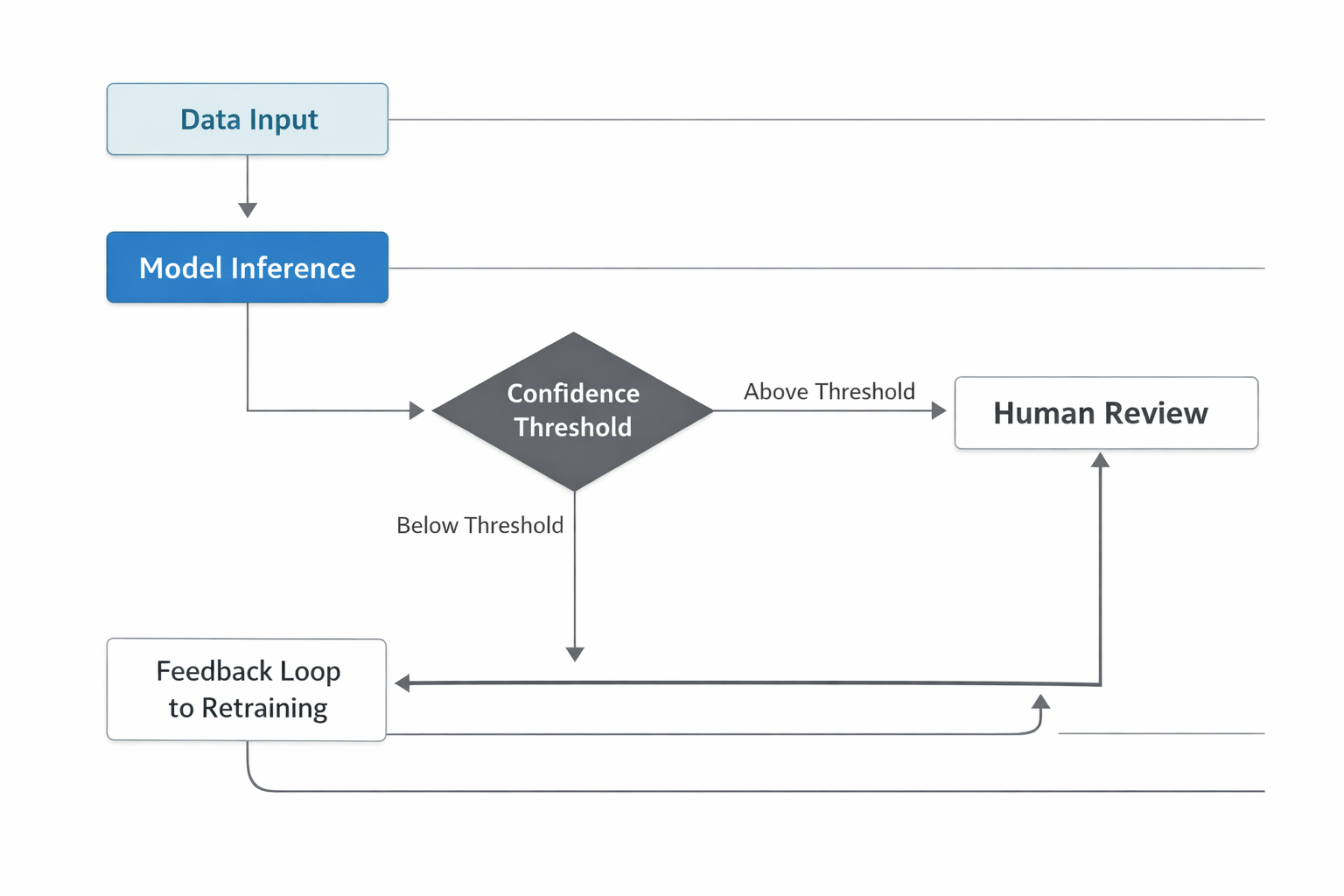
A HITL system works best when review is selective, not universal. That means building review gates that decide which AI outputs can proceed automatically and which require human attention. The most common gating signal is model confidence, but confidence should never be the only signal. Risk level, user segment, action type, policy sensitivity, and historical error patterns should also influence routing. NIST emphasizes risk-based management, and the AI RMF playbook encourages organizations to tailor controls to their context and use case. (nist.gov)
A practical pattern is to define three buckets: auto-approve, review-required, and escalate. Auto-approve is for low-risk, high-confidence cases. Review-required is for normal manual inspection. Escalate is for situations that are ambiguous, novel, high impact, or policy-sensitive. For example, a customer refund under a small amount might auto-approve if confidence is high and fraud signals are absent, while a large refund or a complaint involving legal claims should go directly to a specialist. In healthcare or compliance, escalation might be triggered by certain keywords, protected attributes, or a mismatch between AI output and source documentation. (commission.europa.eu)
Confidence thresholds should be calibrated using real validation data, not intuition. If the model’s score is poorly calibrated, a 95% confidence score may not mean what stakeholders think it means. Risk-based routing is better when thresholds are tied to observed error rates, downstream cost, and policy constraints. A useful design principle is to optimize for expected harm avoided, not just review volume reduced. In other words, the goal is not to minimize manual work at all costs; it is to ensure that scarce human attention is spent on the cases where it has the highest value. (nvlpubs.nist.gov)
Good escalation rules also include exception handling: missing data, contradictory evidence, low-quality input, model uncertainty spikes, and out-of-distribution cases should all be forced into review. Over time, you can refine the gate by studying override patterns and reviewer disagreements. That is how a static threshold becomes a dynamic control system. (airc.nist.gov)
6. Building the reviewer workflow: UI/UX, queue management, explanations, and decision capture
Even a good model can fail operationally if the reviewer experience is poor. The reviewer workflow should make it easy to understand the AI’s recommendation, inspect the underlying evidence, make a decision quickly, and record the reason in a structured way. If the interface is cluttered or vague, reviewers will make more mistakes, spend too long per case, or ignore important context. NIST’s AI RMF resources highlight the value of human-centered design and of involving end users in the lifecycle. (nvlpubs.nist.gov)
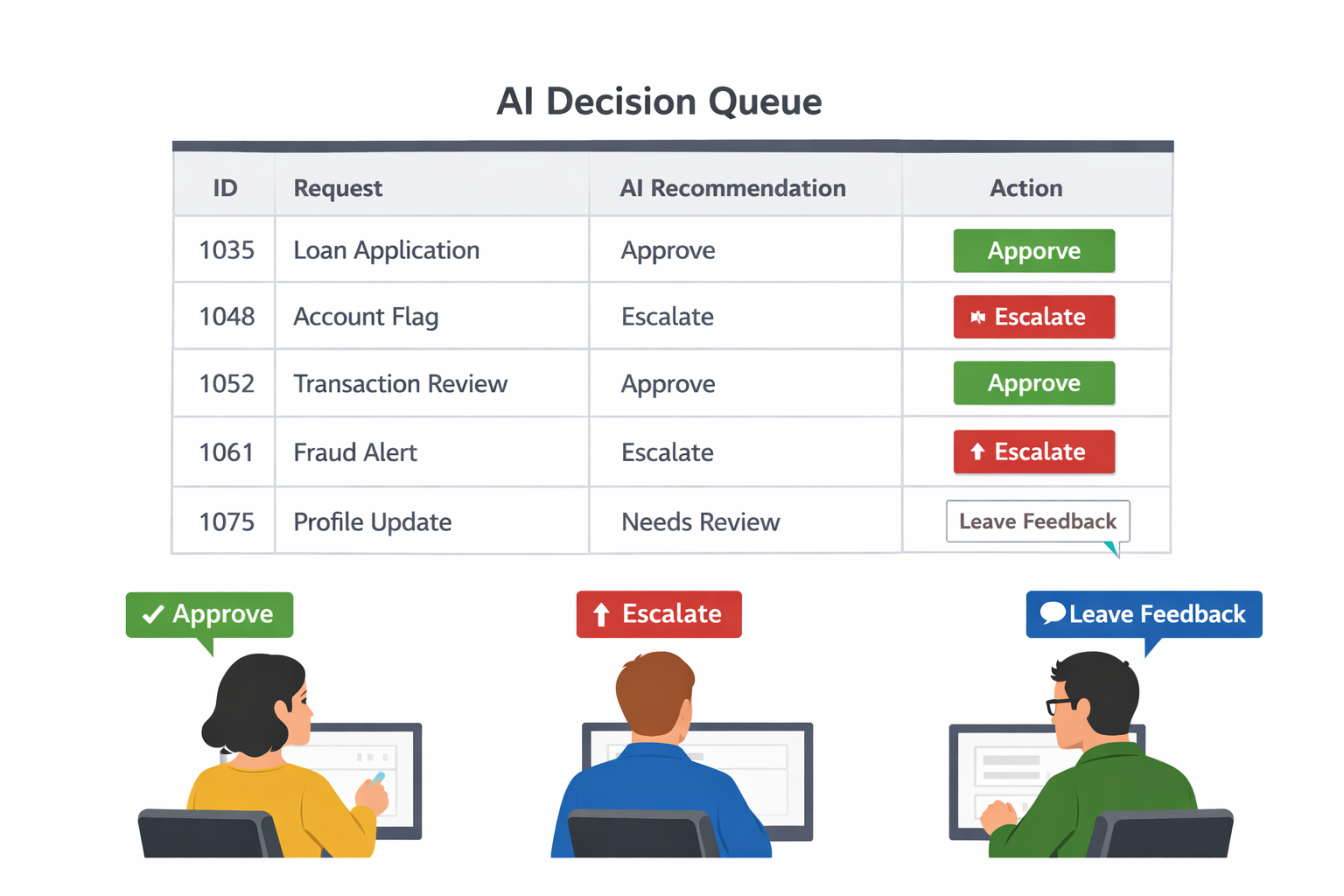
At the UI level, show the reviewer the AI output, supporting evidence, confidence or risk indicators, and the specific policy question being asked. Do not overwhelm them with raw model internals unless those internals genuinely help the decision. The best interfaces present just enough explanation to support informed judgment: why the case was routed, what changed since the last stage, and what action is available. If the AI output is a recommendation, the reviewer should be able to accept, edit, reject, or escalate it with minimal friction. The system should also capture a concise rationale, especially for overrides. That rationale becomes training data, audit evidence, and a learning signal. (airc.nist.gov)
Queue management is just as important as UI. Review queues should be prioritized by risk, aging, SLA, and case severity. Otherwise, the most important cases can get buried behind routine ones. For large volumes, consider separate queues by task type, specialty, and escalation level. A reviewer who handles fraud cases may not be the right person for policy disputes, and vice versa. Workload balancing also matters; if the queue is too long, reviewers will rush and quality will drop. A good HITL system makes throughput visible so operations leaders can adjust staffing before the queue becomes a bottleneck. (airc.nist.gov)
Decision capture should be structured, not just free text. Record the AI version, model score, timestamp, input snapshot, reviewer identity or role, final decision, reason code, and any downstream action taken. This creates traceability and supports later analysis. It also helps when regulations or internal audits require you to explain why a decision was made. In short: the workflow should be fast for reviewers, rich enough for governance, and precise enough for learning. (nvlpubs.nist.gov)
7. Quality control for reviewers: training, calibration, inter-rater agreement, and audit trails
Human review only improves AI if the humans themselves are consistent, trained, and accountable. That is why reviewer quality control needs to be designed with the same seriousness as model quality control. NIST explicitly calls for AI risk management training and clear roles and responsibilities, and ISO/IEC 42001 frames AI governance as a management system that should be maintained and improved continuously. (nvlpubs.nist.gov)
Start with training. Reviewers need to understand the policy, the edge cases, the model’s limitations, and the difference between normal variance and true failure. Training should include examples, counterexamples, and practice cases. It should also explain what to do when the evidence is incomplete or when the AI output conflicts with the reviewer’s intuition. Next comes calibration. Reviewers should periodically score the same sample cases and compare results so you can spot drift in judgment. Calibration sessions help align standards across teams and reduce “personal policy” behavior, where each reviewer invents their own interpretation of the rules. (airc.nist.gov)
A strong quality program also measures inter-rater agreement. If reviewers frequently disagree, that may indicate ambiguous policy, unclear labels, or a task that is too subjective for the current process. Disagreement is not automatically bad—sometimes it reveals a genuinely nuanced decision—but it should be tracked and analyzed. Sample audits can then focus on high-disagreement cases, high-impact cases, and cases where reviewer decisions diverge from downstream outcomes. NIST’s materials emphasize that documentation and evaluation support transparency and accountability, which makes audit trails a core part of quality control. (airc.nist.gov)
Finally, keep audit trails for both human and machine actions. Log what the AI suggested, what the reviewer decided, and why. Track exceptions, supervisor overrides, and policy updates. When a decision goes wrong, the audit trail should let you reconstruct the event without guesswork. That is essential for continuous improvement, incident response, and regulatory defensibility. A HITL program without auditability is just manual labor; a HITL program with auditability becomes a learning system. (nvlpubs.nist.gov)
8. Metrics that matter: accuracy lift, false positive reduction, latency, throughput, and cost
You cannot improve what you do not measure, and HITL should be evaluated on more than just “did a human look at it?” The core question is whether human review improves outcomes enough to justify the cost and delay. NIST’s framework centers on measurement, evaluation, and risk management across the lifecycle, which means HITL should be treated as a measurable control, not a vague safety gesture. (nist.gov)
A useful first metric is accuracy lift: how much the final human-plus-model system outperforms the model alone. In some workflows, the model may already be strong and human review adds little. In others, especially nuanced or high-stakes settings, reviewer intervention can meaningfully improve correctness. A second metric is false positive reduction. This matters in alerting and moderation systems, where AI may over-flag harmless cases. Human review can reduce unnecessary escalation, customer friction, or blocked transactions. (airc.nist.gov)
Operational metrics are equally important. Latency measures how long it takes for a case to move through review. Throughput measures how many cases a reviewer or team can handle per hour or day. Cost captures staffing, tooling, training, and the opportunity cost of slower decisions. A HITL design that improves accuracy but doubles turnaround time may still be unacceptable in a real-time workflow. That is why many organizations define service-level targets for different risk tiers. Low-risk cases can move fast; high-risk cases can wait for human review. (nvlpubs.nist.gov)
The best scorecard combines quality and operations: model error rate, reviewer override rate, agreement rate, backlog size, SLA attainment, incident rate, and downstream business impact. Over time, you should also measure whether review gates are becoming smarter—meaning fewer low-value cases reach humans, while the most important cases still get expert attention. That is the real promise of HITL: not just more caution, but better targeting of human judgment where it matters most. (airc.nist.gov)
9. Governance, compliance, and standards: documentation, accountability, and oversight policies
HITL becomes durable only when it is embedded in governance. That means policies, accountability, documentation, and oversight are not optional extras—they are the backbone of the system. NIST’s AI RMF says governance is a cross-cutting function, that roles and responsibilities should be documented, and that executive leadership takes responsibility for AI risk decisions. ISO/IEC 42001 similarly frames AI as something to be managed through an organizational system that is implemented, maintained, and continually improved. (airc.nist.gov)
Good governance starts with clear ownership. Who decides the thresholds? Who can change reviewer policy? Who approves exceptions? Who investigates incidents? These responsibilities should be documented and visible. Next comes documentation: model cards, decision rules, reviewer instructions, escalation paths, validation results, and change logs. Documentation is not just for auditors; it helps internal teams understand how the system works and why it behaves the way it does. NIST explicitly notes that documentation can enhance transparency, improve human review processes, and bolster accountability. (airc.nist.gov)
Compliance requirements will vary by sector and geography, but the direction is clear: high-risk AI systems need stronger oversight, especially where rights or safety are involved. The European Commission states that high-risk AI systems must meet safety requirements, including appropriate human oversight measures. For organizations operating globally, that means HITL design should be aligned with the strictest applicable expectations, not the loosest. (commission.europa.eu)
A mature oversight policy should also cover change management. If the model is updated, if the policy changes, or if reviewer staffing shifts, the review process may need recalibration. Governance is not a one-time launch checklist; it is the control system that keeps the control system working. That is why documentation, approvals, audits, and periodic reassessment are central to HITL. (iso.org)
10. Implementation roadmap and pitfalls: how to pilot, scale, and continuously improve HITL
A successful HITL program usually starts small. The first step is to pick a use case with enough risk to justify review, but not so much complexity that the pilot becomes unmanageable. Define the decision, the reviewer role, the routing logic, the SLA, and the quality metrics before going live. NIST’s playbook encourages organizations to operationalize AI risk management with context-specific actions rather than generic checklists, which is exactly the right mindset for a pilot. (nist.gov)
During the pilot, focus on learning. Observe how often humans agree with the model, how often they override it, how long reviews take, and where confusion appears. Use those findings to refine labels, thresholds, explanations, and workflow design. It is common for teams to discover that some cases need more context, some review queues need better prioritization, and some “high confidence” outputs are not actually trustworthy in the real world. This is not failure; it is the point of the pilot. (airc.nist.gov)
Scaling introduces new pitfalls. The most common are reviewer fatigue, inconsistent decision-making, poor queue design, overreliance on automation, and a tendency to add too many review steps. Another major mistake is using HITL as a fig leaf—keeping humans in the process nominally while allowing the AI to dominate decisions in practice. To avoid that, define the reviewer’s authority clearly and check whether the human is actually influencing outcomes. Also watch for drift: as the model, policy, or business context changes, the review process must be recalibrated. NIST’s emphasis on continual risk management and ISO/IEC 42001’s continual improvement model both point toward the same operational truth: HITL must evolve with the system it oversees. (airc.nist.gov)
A practical roadmap looks like this: pilot one workflow, measure quality and throughput, tune gates, standardize reviewer training, add audit trails, expand to adjacent use cases, and then formalize governance across the organization. Done well, HITL becomes less of a manual burden and more of a structured trust layer that lets organizations use AI more safely and confidently. (nvlpubs.nist.gov)
Conclusion
Human-in-the-loop review is not about resisting automation; it is about using automation responsibly. The most effective HITL programs place human judgment where it matters most, design review gates around risk, support reviewers with clear workflows, and measure whether the process actually improves outcomes. As AI becomes more agentic and more deeply embedded in sensitive decisions, organizations need oversight models that are documented, auditable, and continuously improved. NIST, ISO/IEC 42001, and the EU’s AI governance direction all point toward the same principle: trustworthy AI requires clear human roles, lifecycle risk management, and operational accountability. (airc.nist.gov)
The main takeaway is simple: start with risk, not with technology. Define where humans add the most value, build gates and workflows around those moments, and keep tightening the loop with data, training, and governance. If you do that, HITL can become one of the most practical ways to make AI safer, more accurate, and more defensible in the real world. (nist.gov)