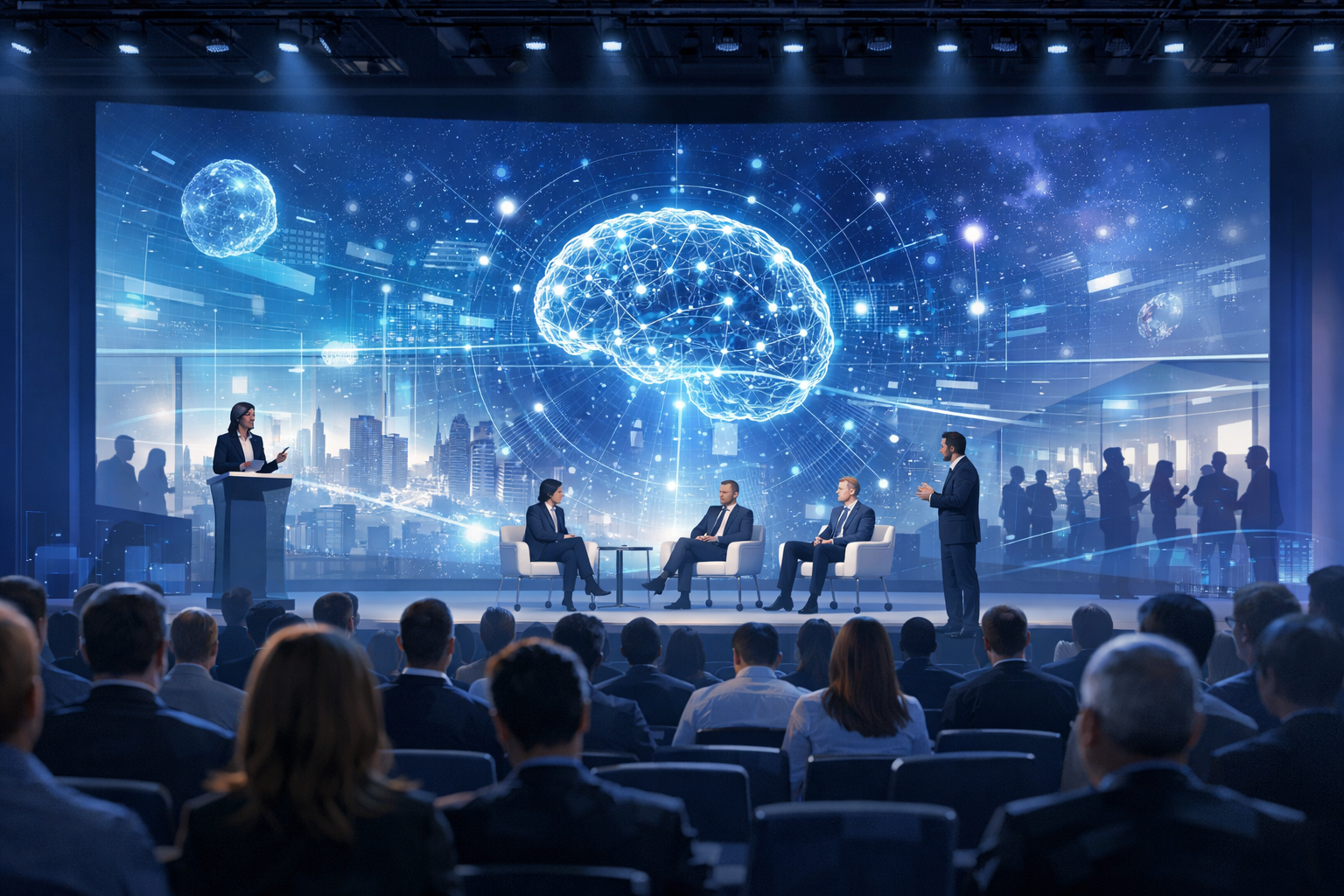
How AI Community Events Are Evolving in 2026
June 13, 2026
AI community events in 2026 are not just surviving in a world overflowing with online content — they’re becoming more valuable because of it. When tutorials, livestreams, newsletters, and AI-generated summaries are available all day, every day, the role of a meetup has changed. People do not come to events only to “learn what AI is.” They come to see what works in practice, compare notes with peers, ask honest questions, and leave with a clearer sense of how to apply AI in real work. That shift is especially important now that AI adoption has moved beyond novelty and into organizational use. Stanford HAI’s 2026 AI Index Report says organizational adoption reached 88%, and 4 in 5 university students now use generative AI. McKinsey’s 2026 AI Trust Maturity Survey also reports that organizations are moving from experimentation toward scaled deployment, while governance and training gaps remain a major hurdle. (hai.stanford.edu)
For event organizers, that means the old “three speakers, a pizza break, and a panel” model is no longer enough. The best AI events now feel more like a learning system: a place where beginners, practitioners, students, founders, and local builders can exchange useful experience and build durable connections. This post explores how AI community events are evolving in 2026, what attendees want, and how organizers can create meetups people actually return to.

1. Why AI community events still matter when online content is everywhere
It’s fair to ask whether in-person AI events still matter. After all, nearly any AI topic can be explained in a video, summarized by a chatbot, or discussed in a forum. But the abundance of online content is exactly why live community events remain relevant. Digital content gives you information; events give you context. At a meetup, people can hear how others are actually using tools, what broke in production, which workflows saved time, and which “big” use cases turned out to be less impressive than promised. That kind of nuance is hard to get from a polished webinar or a viral thread.
AI events also satisfy a different kind of need: they create social proof and momentum. Many people are experimenting with AI in private, but they still want reassurance that their questions are normal and their challenges are shared. In 2026, this matters even more because AI is no longer a niche interest. Stanford’s AI Index notes broad organizational adoption, and McKinsey reports that AI trust and governance have become foundational to scaling AI use. When technology moves from “interesting” to “embedded,” people need spaces to compare notes and learn from one another. (hai.stanford.edu)
There’s also a human reason. Community events create commitment. Watching a recording is easy to postpone; showing up to a room full of peers is a stronger signal that learning matters. That is especially powerful for newer practitioners who need encouragement, for students who need role models, and for founders who need feedback from people outside their own bubble. In other words, AI events are not competing with online content anymore. They’re complementing it by offering the one thing the internet still can’t fully replicate: shared experience.
2. The state of AI adoption in 2026 and what it means for event organizers
AI adoption in 2026 is shaping event strategy in a very direct way: organizers can no longer assume the audience is either totally new or uniformly advanced. The Stanford 2026 AI Index Report says organizational adoption reached 88%, and 4 in 5 university students now use generative AI. McKinsey’s 2026 trust survey says organizations are shifting from experimentation to scaled deployment of gen AI and, increasingly, agentic AI across core business functions. At the same time, the survey finds that strategy, governance, and agentic AI controls still lag, and knowledge and training gaps are the leading barrier to responsible AI implementation. (hai.stanford.edu)
That combination changes how events should be designed. If adoption is high, audiences will not be impressed by generic “AI 101” talks unless those sessions are extremely well framed for a specific use case or audience segment. Instead, organizers should think in layers. A single event may need an entry-level overview for newcomers, a practical workshop for people already using tools, and a more strategic discussion for those responsible for governance, change management, or deployment. The audience is broader, but also more specific.
It also means organizers should plan around trust and implementation, not just tools. Many attendees in 2026 care about questions like: How do we use AI safely? How do we measure value? What guardrails should we set? How do we avoid wasting time on pilots that never reach users? McKinsey’s findings make clear that these are no longer edge concerns; they’re central to adoption. Event programming that addresses these issues will feel more relevant than sessions focused only on shiny demos. (mckinsey.com)
For organizers, the practical takeaway is simple: the more AI becomes normal, the more event value shifts from novelty to judgment. The best events help attendees decide what to use, when to use it, and what to watch out for.
3. What attendees actually want: practical skills, real use cases, and honest tradeoffs
In 2026, attendees are increasingly skeptical of hype. They want to know what AI can do in the real world, how much effort it takes, what failure looks like, and whether the result is worth the cost. That shift is visible in broader workplace AI trends too: Microsoft’s 2026 Work Trend Index emphasizes that AI value is not just about individual tool use, but about organizational readiness, workflows, and human agency. McKinsey similarly points to governance, training, and risk management as key barriers to scaling AI. (news.microsoft.com)
For events, that means attendees want three things above all else. First, they want practical skills. Not broad theory, but something they can try the next day: how to write a better prompt for a specific task, how to evaluate a model output, how to design a lightweight workflow, or how to connect AI tools to existing work. Second, they want real use cases. People are much more engaged when they hear a founder explain how they built a support bot, a student show how they used AI to study, or a practitioner walk through how AI saved time on a repetitive process. Third, they want honest tradeoffs. What failed? What took longer than expected? What required human review? What created new risks?
This is where many AI events go wrong. They oversell polish and underdeliver on specificity. But audiences in 2026 are more mature than that. They’ve seen enough AI demos to know that a great-looking interface does not guarantee a usable system. They want the operational details: what data was used, what manual checks were needed, what the team would do differently, and where the bottlenecks were. That honesty builds trust and keeps people coming back.

4. Designing a meetup format that balances talks, demos, and peer networking
The best AI meetups in 2026 tend to avoid a single-format identity. A purely lecture-based event can feel passive, while a purely networking-based event can feel unfocused. The sweet spot is a structure that blends learning, showing, and connecting. That usually means three core elements: short talks, live demos or case studies, and structured peer interaction.
Short talks work best when they are tightly scoped. Instead of asking a speaker to cover “AI in healthcare” or “the future of AI,” ask for a narrower promise: how one team reduced support time, how one student used AI to prototype an idea, or how a founder chose between build-vs-buy options. This keeps sessions concrete and easier to follow. Demos or walkthroughs add proof. Attendees want to see workflows, not just hear claims. Even a simple screen share showing a prompt chain, a dashboard, or a workflow diagram can make the event feel much more useful.
Peer networking should be intentional, not accidental. If organizers simply “leave time afterward,” the room often fractures into familiar cliques. Better approaches include small discussion tables, topic-based breakout prompts, speed networking with guiding questions, or post-talk reflection cards. The goal is to make it easy for strangers to start useful conversations without forcing awkward icebreakers.
A strong meetup format also respects attention. AI audiences are often busy, and many are already overloaded with digital information. A concise schedule, clear transitions, and a visible learning arc can make the experience feel professional and worthwhile. The format itself becomes part of the value proposition: “Come here, and you will leave with ideas, examples, and people you can actually follow up with.”
5. The importance of local communities for students, practitioners, and founders
Local AI communities matter because AI learning is not just technical; it is social, contextual, and career-shaping. For students, local events can be the bridge between classroom knowledge and real-world practice. Students often need examples of how AI is being used in nearby industries, by local startups, or in civic and nonprofit settings. They also benefit from exposure to career paths they may not have considered. In a city or region with an active community, a student can meet practitioners, ask basic questions without embarrassment, and discover projects that lead to internships or research opportunities.
For practitioners, local communities offer a place to keep skills fresh without having to attend large conferences every time. They can test ideas, ask peers how others are handling governance or workflow design, and learn from adjacent industries. McKinsey’s 2026 survey highlights persistent gaps in training and governance, which makes peer learning especially valuable. Local communities can function as a low-pressure support network for people trying to bring AI into established organizations. (mckinsey.com)
For founders, local communities provide signal. The AI space moves fast, but not every trend matters to every market. Local meetups help founders hear what potential users actually care about, what jargon confuses them, and what problems are urgent enough to solve. That feedback is often more valuable than chasing online buzz. A founder might discover that a “fancy” feature is not compelling, while a mundane workflow improvement is. That kind of correction is easier to get face-to-face.
Locality also creates trust. People return more readily to events where they recognize names, see familiar faces, and feel part of something ongoing. Eventbrite’s 2026 social study emphasized that many people want live experiences that connect them to community, and that hyperlocal connection is increasingly important. Even if an event starts small, the local layer gives it staying power. (eventbrite.com)
6. Turning one-off events into a durable learning ecosystem
A great AI event should not end when the room empties out. The most effective communities in 2026 think in terms of ecosystems rather than isolated meetups. That means every event should feed the next one: notes become resources, questions become future topics, and attendees become contributors instead of passive participants.
One practical way to do this is to build a recurring learning loop. Start with a meetup, then share a concise recap, slides, demo links, and a few discussion prompts. Invite attendees to continue the conversation in a group chat, newsletter, or online community space. Collect questions that were not answered and use them to shape the next event. Over time, the community develops memory. People stop coming only for the speaker and start coming for the ongoing conversation.
Another useful pattern is to create “on-ramps” and “deepening paths.” A newcomer might attend an introduction session, then a hands-on workshop, then a project showcase, then a peer roundtable. This helps people progress rather than bouncing in and out randomly. It also makes the community more inclusive because people can join at different levels of familiarity.
The strongest ecosystems also create opportunities for contribution. Attendees can host lightning talks, share tools, mentor newcomers, or present a project in progress. That matters because people value events more when they feel ownership. A durable community is not built by a single charismatic organizer; it is built by a repeatable structure that helps others step in.
In 2026, AI communities that last are the ones that treat learning as a continuous process. The event is the spark, but the ecosystem is the engine.
7. How to choose speakers and topics that feel timely without chasing hype
Choosing speakers and topics in AI is tricky because the field evolves fast and hype cycles are constant. A topic can feel essential one month and cliché the next. The answer is not to chase whatever is trending, but to choose sessions that sit at the intersection of timeliness, usefulness, and clarity.
Timely topics should reflect real adoption questions, not just headline buzz. In 2026, that means speakers on workflow design, governance, agentic AI controls, evaluation, and human-AI collaboration may be more valuable than yet another generic “future of AI” keynote. McKinsey’s research makes clear that organizations are dealing with trust, training gaps, and risk management as they scale deployment, which suggests these issues are highly relevant for event audiences. (mckinsey.com)
The best speakers are usually not the most famous ones. They are the people who can explain a concrete problem clearly, show what they tried, and tell the truth about what worked. That might include builders from startups, educators, researchers, product managers, nonprofit leaders, or operators inside traditional companies. Diversity of perspective matters because AI adoption looks different in education, health care, software, public sector, and small business contexts.
Topic selection should also balance freshness and durability. A good event topic should be current enough to feel urgent but stable enough to remain useful after the news cycle passes. For example, “how teams are using AI agents safely in internal workflows” is likely more durable than “which AI model just launched this week.” The former helps attendees build judgment; the latter may be outdated almost immediately.
A simple test for whether a topic is worth featuring: Will attendees be able to apply it, debate it, or reuse it in a month? If the answer is yes, it’s probably worth the stage.
8. Measuring event success beyond headcount: engagement, follow-up, and project outcomes
Headcount is the easiest metric to track, but in 2026 it is one of the least useful ways to judge an AI event. A room full of people does not automatically mean the event was valuable. Instead, organizers should measure what happens before, during, and after the meetup.
Engagement is the first better metric. Did attendees ask thoughtful questions? Did they participate in demos or small-group discussions? Did they stay through the end? Did newcomers talk to each other? These are strong signs that the event was more than a passive lecture. Follow-up is another important measure. Did people join the community afterward? Did they subscribe to the newsletter, show up to the next event, or continue a discussion online? Follow-up shows whether the event created momentum.
The most meaningful metric is project outcome. Did someone start a project because of the meetup? Did an attendee adopt a new workflow? Did a collaboration form between a student and a practitioner, or between a founder and a potential customer? These outcomes are harder to count, but they are much closer to the real purpose of a community event.
Organizers can collect this data without making the experience feel corporate. A short post-event survey, a quick “what are you doing next?” prompt, or a follow-up form a week later can reveal a lot. Qualitative feedback matters too. Comments like “I finally understood how to approach this” or “I met someone who solved the same problem” are often more valuable than a vanity metric.
In short, success in 2026 is not about how many people showed up. It is about whether the event changed what they know, who they know, or what they build next.
9. Common mistakes AI events make and how to avoid them
One common mistake is over-indexing on hype. If every event promises to reveal the “future of AI,” audiences will quickly tune out. People are more interested in concrete learning than in grand claims. The fix is to narrow the promise and make the agenda specific. Replace vague buzzwords with direct language about problems, workflows, and decisions.
Another mistake is ignoring audience diversity. AI events often attract students, engineers, founders, marketers, designers, and managers in the same room. If the event assumes everyone has the same background, many people will feel excluded. Organizers should vary the depth of content, define jargon, and offer multiple ways to participate. A mixed audience is an advantage if the event is designed for it.
A third mistake is making networking an afterthought. If people do not know who to talk to or why, they may leave without making a useful connection. Structured interaction is better than hoping the room will “naturally network.” Another problem is speaker imbalance. A panel of experts who all say similar things will feel thin. It’s more useful to include practical voices and people with different experiences.
Finally, many events fail to build continuity. They happen, they are decent, and then nothing follows. Without recaps, community channels, or a next step, the event becomes forgettable. That is a missed opportunity because AI communities thrive on momentum. Organizers should think beyond the event date and design a path for continued learning.
Avoiding these mistakes is not about perfection. It’s about intention. A modest but thoughtful event often outperforms a flashy but shallow one.
10. Closing: a roadmap for building a meetup people return to and recommend
If there is one lesson from AI community events in 2026, it is that people return to events that help them make sense of change. AI adoption is now widespread, but clarity is still scarce. Stanford’s AI Index shows broad organizational adoption and student use, while McKinsey’s trust survey shows that governance, training, and risk remain major barriers. That combination creates a strong need for events that are practical, local, and human. (hai.stanford.edu)
A roadmap for a great meetup is surprisingly straightforward. Start with a clear audience and a specific promise. Build an agenda that combines concise talks, real demos, and structured networking. Choose speakers who can speak from experience, not just theory. Focus on topics that are timely because they solve real problems, not because they sound trendy. Measure success by engagement, follow-up, and the projects or relationships that emerge afterward. Most importantly, design the event as part of a larger ecosystem, where each meetup becomes a stepping stone to the next one.
When AI events do this well, they become more than calendar items. They become trusted spaces where people learn, question, collaborate, and grow together. And in a year when online content is abundant but attention is fragmented, that kind of community is not just useful — it is essential.