
Hello World in Rust with Axum: The Latest Beginner-Friendly Guide
June 4, 2026
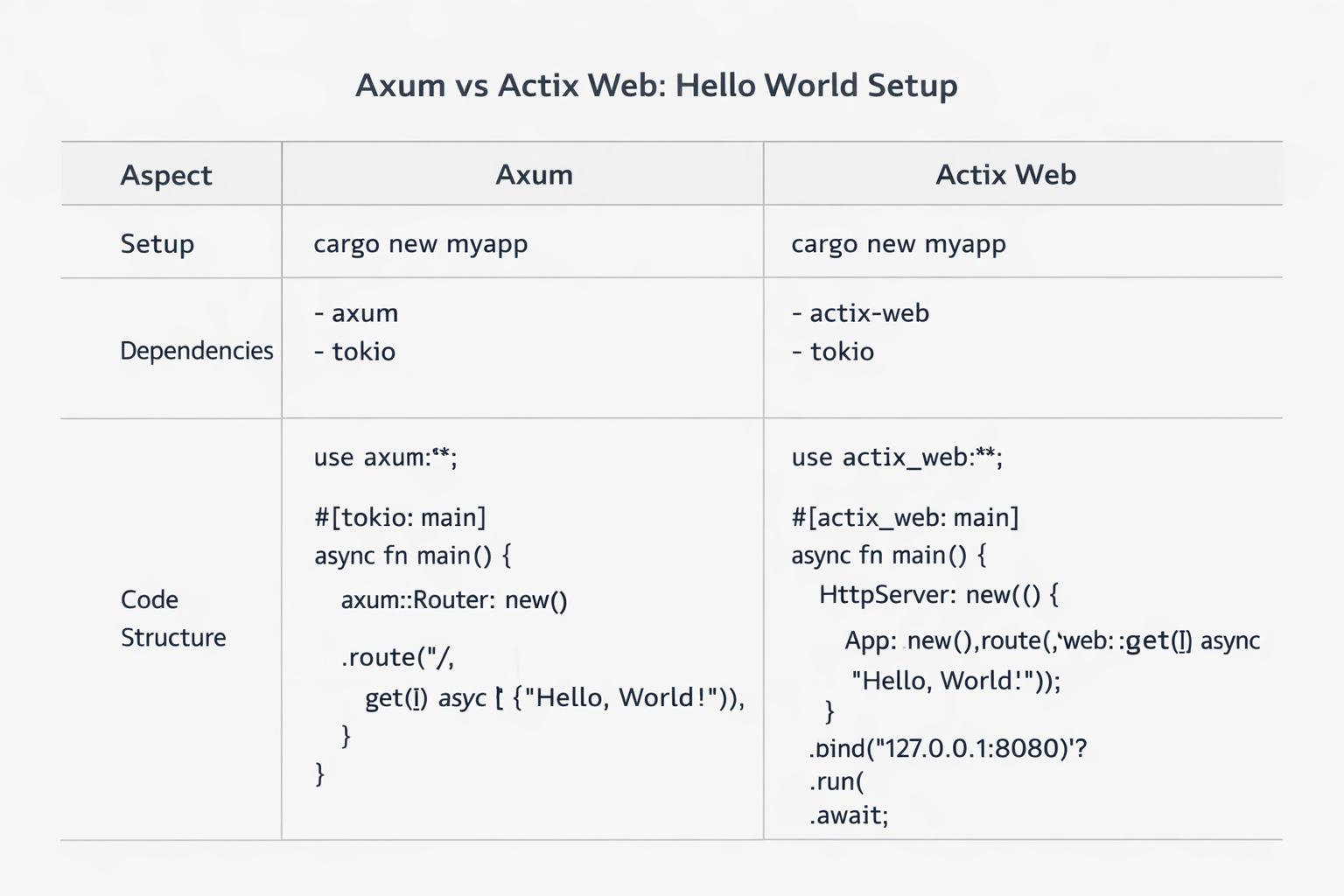
Rust web development has matured quickly, but it still feels “new” to many developers because the ecosystem is evolving around async I/O, type-safe request handling, and high-performance server runtimes. Two frameworks sit near the center of that conversation: Axum, which is designed around Tokio and Hyper with a lightweight, composable router model, and Actix Web, which has long been known for its performance, feature-rich API, and mature routing/server ergonomics. Axum’s official docs emphasize its handler-and-router style, while Actix Web highlights a more integrated HttpServer + App model and built-in macros for routes. (docs.rs)
For beginners, the “Hello World” app is the best way to understand how these frameworks differ in practice. The code is small enough to learn quickly, but it already exposes the important concepts: async functions, routing, request extraction, response conversion, and the runtime that powers everything. This guide walks through both Axum and Actix Web, compares their ergonomics, and shows how a tiny server becomes the foundation for a real application. (docs.rs)
1. Introduction: Why Rust web frameworks are still growing and where Axum/Actix fit
Rust web frameworks are still growing because Rust itself is still expanding as a backend language of choice. Teams adopt Rust for memory safety, predictable performance, and strong compile-time guarantees, but building web services in Rust requires an async runtime and a framework that fits Rust’s ownership model. The Rust Book’s async chapter explains that async/await is the language mechanism for expressing non-blocking work, while a runtime coordinates those futures. That means web frameworks in Rust are not just “routing libraries”; they are part of a broader async execution stack. (doc.rust-lang.org)
Axum fits especially well when you want a minimal, composable design. Its docs describe a handler as an async function that accepts extractors and returns something convertible into a response, and the router is the main building block for composing endpoints. In practice, Axum tends to feel very “Rusty”: types are explicit, handlers are ordinary async functions, and the framework integrates naturally with Tokio. (docs.rs)
Actix Web sits in a different but equally important position. It offers a richer framework-style experience with HttpServer, App, and route registration through services or route macros. The official site emphasizes type safety, out-of-the-box features, extensibility, and performance. That makes it attractive for teams that want a battle-tested server framework with strong ergonomics and a very complete feature set. (actix.rs)
The practical takeaway is that these frameworks are not competing to solve exactly the same problem in exactly the same way. Axum is often favored for simplicity, modularity, and alignment with the Tokio ecosystem. Actix Web is often chosen for its maturity, breadth of features, and straightforward server/application structure. Both are credible production choices, and both are widely used in Rust backend development. (docs.rs)
2. What you need before starting: Rust toolchain, Cargo, and project setup
Before writing any web code, you need a working Rust toolchain. The standard path is to install Rust and Cargo via rustup, which the official Cargo book treats as the normal starting point for new projects. Cargo is the build system, dependency manager, and project organizer for Rust, so you will use it to create the binary crate, add framework dependencies, and run the server. (doc.rust-lang.org)
A minimal setup usually looks like this:
rustup update
cargo new hello-web
cd hello-web
That creates a standard binary project with a Cargo.toml manifest and a src/main.rs entry point. From there, the main difference between Axum and Actix Web is which dependencies you add and how you structure the runtime. Actix’s getting started guide notes that the framework currently expects Rust 1.72 or later, and it uses #[actix_web::main] to run the async main function inside the Actix runtime. (actix.rs)
For Axum, you typically add Axum plus Tokio, because Axum is designed to work with Tokio and Hyper. Its docs show #[tokio::main] as the common entry point and a tokio::net::TcpListener used with axum::serve. That is an important concept for beginners: Axum does not hide the runtime; it leans into it. (docs.rs)
A clean beginner project usually starts with only the dependencies you need for the first server. Avoid adding extra crates too early. In practice, your first Cargo.toml entries might include only the framework and runtime, then you can add JSON, middleware, templating, or database crates later when the app actually needs them. This keeps compilation faster and makes error messages easier to understand. Cargo’s project model is designed to support exactly that incremental approach. (doc.rust-lang.org)
3. Axum Hello World: minimal app structure, router, handler, and Tokio runtime
Axum’s simplest app is intentionally small: define a handler, create a router, bind a TCP listener, and serve requests. The framework’s docs describe handlers as async functions that accept zero or more extractors and return something that can be converted into a response. In other words, an Axum handler is basically a normal async function with a few web-friendly constraints. (docs.rs)
Here is the canonical shape of a Hello World app:
use axum::{routing::get, Router};

async fn hello_world() -> &'static str {
    "Hello, World!"
}

#[tokio::main]
async fn main() {
    let app = Router::new().route("/", get(hello_world));

    let listener = tokio::net::TcpListener::bind("127.0.0.1:3000")
        .await
        .unwrap();

    axum::serve(listener, app).await.unwrap();
}
This code demonstrates several important ideas. First, the handler is just an async function returning a string slice. Axum knows how to convert that into an HTTP response. Second, Router::new().route("/", get(...)) declares that the root path responds to GET. Third, Tokio provides the runtime and the listener binding. Axum’s docs show exactly this pattern, including tokio::main, TcpListener, and axum::serve. (docs.rs)
From a beginner perspective, this is a very approachable mental model: router in, handler out. There is no special server object to configure before you define routes, and the handler is not tied to a custom trait or framework-specific request type for the simplest case. That makes Axum feel compact and composable, especially if you want to grow the app later by layering routers, adding extractors, or plugging in middleware. Axum’s docs also show fallback handling and method-not-allowed logic on the router itself, reinforcing the idea that routing is the central abstraction. (docs.rs)

4. Actix Web Hello World: minimal app structure, HttpServer, App, and route handlers
Actix Web’s beginner story is just as straightforward, but the structure is different. The framework centers around HttpServer and App, and its getting started guide shows a tiny app using route macros like #[get("/")] plus an async main function annotated with #[actix_web::main]. (actix.rs)
A minimal Hello World example looks like this:
use actix_web::{get, App, HttpServer, Responder};

#[get("/")]
async fn index() -> impl Responder {
    "Hello, World!"
}

#[actix_web::main]
async fn main() -> std::io::Result<()> {
    HttpServer::new(|| App::new().service(index))
        .bind(("127.0.0.1", 8080))?
        .run()
        .await
}
The important distinction is that Actix Web uses an application factory closure inside HttpServer::new, then registers routes on App::new(). The official docs explain that HttpServer binds to a socket, starts worker threads automatically, and runs until shutdown. That means the server lifecycle is a first-class part of the framework API, not something you manually assemble from a listener and a serve function. (actix.rs)
Actix Web also supports manual route registration with App::route, while route macros such as #[get] and #[post] make endpoint registration concise. The getting started guide illustrates both styles and explains that macro-annotated handlers are registered via service, whereas manually routed handlers can use route. This flexibility is one reason Actix Web often feels productive for new service code. (actix.rs)
For beginners, the main conceptual difference from Axum is that Actix Web feels more integrated. You declare handlers, build an app, and then run a server. The framework’s official site emphasizes type safety and rich out-of-the-box features, which gives it a “full web framework” feel even in the smallest example. (actix.rs)
5. Side-by-side comparison: Axum vs Actix for simplicity, ecosystem, and ergonomics
At the Hello World level, both frameworks are easy to start with, but they optimize for different kinds of ergonomics. Axum is often perceived as simpler in terms of conceptual surface area: define an async handler, wire it into a Router, and serve it using Tokio. Actix Web is often perceived as more complete out of the box: define handlers, attach them to App, and start them with HttpServer. (docs.rs)

Simplicity
Axum’s simplicity comes from the fact that its handler abstraction is intentionally small and composable. The docs describe handlers as async functions that accept extractors and return response-convertible values. This makes the framework feel close to plain Rust. For many developers, that reduces cognitive overhead. (docs.rs)
Actix Web is also simple in a different sense: its HttpServer and App abstractions provide a clear path from request handler to running server. The documentation shows direct, readable patterns for defining routes and starting the server. That can be easier for beginners who like an opinionated framework structure. (actix.rs)
Ecosystem fit
Axum is explicitly designed to work with Tokio and Hyper. If your stack already uses Tokio-based async tasks, that alignment is valuable. It also means you can reason about your web server with the same runtime model used by other async services in Rust. (docs.rs)
Actix Web has its own ecosystem and long-standing maturity. Its docs emphasize a broad feature set including HTTP/2 and logging, and it provides a well-integrated approach to application state, routing, and server execution. (actix.rs)
Ergonomics
Axum tends to shine when you want explicit composition and a strong match with extractor-driven request handling. Actix Web tends to shine when you want built-in route macros, a compact application structure, and easy access to a mature feature set. The best choice usually depends on whether you prefer a framework that feels “minimal and composable” or “integrated and feature-rich.” (docs.rs)
6. How the latest ecosystem trends affect framework choice: adoption, learning, and production use
The Rust web ecosystem continues to evolve around two broad trends: stronger async-first application design and increasing demand for ergonomic, production-ready frameworks. The Rust async book chapter explains why this is happening technically: asynchronous code lets servers handle concurrent work without blocking threads, which is exactly what modern web services need. That makes async literacy a core part of choosing any Rust web framework today. (doc.rust-lang.org)
For learning, Axum often maps well to developers who already understand Tokio or who want a framework whose surface area is intentionally small. Because its handler model is just an async function plus extractors, the learning path tends to be linear: learn the router, learn extractors, then add middleware and state. That can be especially attractive for teams adopting Rust gradually. (docs.rs)
Actix Web’s ecosystem trend is slightly different. It has long been a high-performance choice and continues to present itself as feature-rich, type-safe, and extensible. The official site highlights built-in strengths like HTTP/2 and logging, which matters when you want fewer moving parts in the first production version of a service. (actix.rs)
Adoption also depends on operational comfort. Production teams often select the framework that fits existing architectural preferences: some want the clean composition of Axum, especially in Tokio-heavy systems; others want Actix Web’s mature application and server model. There is no universal winner. The ecosystem trend is toward specialization: frameworks are getting better at serving distinct developer tastes rather than collapsing into one dominant style. That is good news for Rust because it means you can choose the tool that matches your team’s mental model instead of adapting your architecture to a one-size-fits-all framework. This is an inference based on the official positioning of the two frameworks and the growing prominence of async-native Rust server design. (docs.rs)
7. Common pitfalls for first-time users: async basics, routing, dependencies, and compilation issues
The first pitfall is underestimating async fundamentals. Rust’s async model is not “magic background threads”; it is a future-based model that must be driven by a runtime. If you are new to Rust, you may write an async function and forget that the function itself does nothing until the runtime polls it. The Rust Book’s async chapter is the right conceptual reference here. (doc.rust-lang.org)
The second pitfall is route registration confusion. In Axum, routes are attached to a Router, and handlers must satisfy Axum’s handler rules. In Actix Web, route macros and manual routes are both valid, but you need to register the handler using service or route depending on how it was defined. Beginners often mix these styles or expect the frameworks to infer too much. The official docs for both frameworks show the correct registration patterns. (docs.rs)
The third pitfall is dependency mismatch. Axum is built to work with Tokio and Hyper, so forgetting Tokio or using the wrong runtime attributes can lead to compile errors. Actix Web expects its runtime macro and currently documents a minimum supported Rust version of 1.72, so older toolchains can create friction. Cargo’s role here is important because it keeps dependency resolution explicit and reproducible. (docs.rs)
The fourth pitfall is type conversion at the response boundary. Axum handlers must return types convertible into responses, while Actix Web handlers return something that implements Responder. Both frameworks are ergonomic, but Rust’s type system will push you to be precise. When a handler signature doesn’t match, the compiler will complain loudly. In Axum’s docs, this is even called out with guidance around Handler-related error messages. (docs.rs)
The fifth pitfall is overcomplicating the first app. A beginner Hello World should not include database pools, template engines, complex middleware stacks, or custom error layers. Start with a tiny server, verify it runs, then add one capability at a time. In Rust, incremental growth is not just a teaching strategy; it is often the fastest way to keep compile times and debugging complexity manageable. (doc.rust-lang.org)
8. Extending Hello World into a real app: JSON responses, state, middleware, and templates
The real value of a Hello World tutorial is that it becomes the seed of a production service. Both Axum and Actix Web support this path well, but they approach it with slightly different idioms. The next step after plain text responses is usually JSON. In Axum, handlers can return response-friendly types and use extractors for input; in Actix Web, handlers can return Responder values and benefit from the framework’s application model. Both frameworks are designed to scale from toy examples to structured APIs. (docs.rs)
Application state is usually the second extension. Actix Web explicitly documents shared state via web::Data<T> within application scope. That makes it convenient to store configuration, database clients, counters, or shared caches in a type-safe way. Axum also supports state and extractor-based patterns, which aligns with its compositional design. (actix.rs)
Middleware is the third extension. In real applications, you may want logging, authentication, compression, request tracing, CORS, or error normalization. Actix Web describes middleware as part of the application-building story, while Axum typically leans on Tower-compatible middleware layers because it is built around Tokio/Hyper and Tower-style composition. That difference matters: Axum often feels like you are composing building blocks, whereas Actix Web often feels like you are configuring a web application with framework-native features. (actix.rs)
Templates are the fourth extension, especially for hybrid apps that serve HTML as well as JSON. Both frameworks can work with template engines, but neither requires you to start there. The smartest path is to keep the first endpoint text-based, then add JSON, then state, then middleware, and only then templates if your product actually needs server-rendered views. That progression keeps the architecture understandable and the debugging surface small. This is an inference based on the documented core abstractions of both frameworks and standard Rust project evolution. (actix.rs)
// Conceptual progression:
// 1. Hello World
// 2. JSON response
// 3. Shared state
// 4. Middleware
// 5. Templates
9. Performance and maturity notes: why both frameworks are popular for Rust backend development
Performance is one reason both frameworks have strong followings, but performance should be understood in context. Actix Web explicitly markets itself as “blazingly fast” and notes features like HTTP/2 support and multi-threaded worker execution. Its server model starts a number of workers by default equal to the number of physical CPUs, which helps explain why it is often discussed in high-throughput scenarios. (actix.rs)
Axum’s performance story is slightly different because it rides on Tokio and Hyper, two foundational pieces of the Rust async ecosystem. That makes Axum a natural fit for teams that want to use a modern async stack without adopting a heavier framework API. The docs show a lean serving model using TcpListener and axum::serve, which aligns with the framework’s minimalist philosophy. (docs.rs)
Maturity also matters. Actix Web has a long history and a very established documentation footprint. Axum is newer in style but well-integrated with the current async ecosystem and widely discussed as a modern choice for Rust services. The practical effect is that both are mature enough for real systems, but they emphasize different trade-offs: Actix Web often leads with breadth and integrated features, while Axum often leads with composability and ecosystem alignment. (actix.rs)
For backend developers, this is good news. It means Rust no longer forces you into a single framework philosophy. You can optimize for ergonomics, runtime alignment, or operational maturity depending on the project. If your service is small and you want a clean async core, Axum is compelling. If you want a framework with lots of built-in web server affordances and a battle-tested server story, Actix Web is equally compelling. (actix.rs)
10. Conclusion: which framework to choose based on your goals and next steps
If you want the shortest path to understanding Rust web fundamentals, Axum is an excellent starting point. Its handler model is simple, its router is explicit, and it pairs naturally with Tokio. The result is a tiny amount of code that teaches the most important Rust backend concepts without hiding the runtime model. (docs.rs)
If you want a more integrated web framework with a mature server model, strong type safety, and lots of built-in features, Actix Web is a great choice. Its HttpServer + App structure is easy to follow, its route macros are ergonomic, and its official docs show a direct path from hello world to a production-ready application. (actix.rs)
The best practical advice is to try both with a single endpoint. Build the same Hello World in each framework, then add one JSON route and one stateful endpoint. That small experiment will tell you more than any feature comparison. In Rust, framework choice is often less about raw capability and more about which mental model your team will use correctly and consistently over time. That is the real difference between a framework you can use and one your team will enjoy. (docs.rs)
Key takeaways
Axum is a strong fit if you want a minimal, composable, Tokio-native approach to Rust web development. (docs.rs)
Actix Web is a strong fit if you want a mature, feature-rich framework with a very direct server/application model. (actix.rs)
For beginners, the biggest learning curve is not routing syntax; it is understanding Rust async and runtime-driven execution. (doc.rust-lang.org)
The best next step is to build one small app in each framework, then choose based on ergonomics, team familiarity, and project needs. (docs.rs)