
Healthcare Tech Transformation in 2026: A Practical Playbook for Safer, Smarter Operations
June 12, 2026
Healthcare technology transformation in 2026 is no longer just about replacing old software with newer software. In regulated environments, every change touches patient data, reimbursement, compliance, reporting, and public trust. That makes transformation more complex than a standard IT refresh, but it also makes it far more strategic. Organizations that modernize well can improve resilience, reduce operational drag, make better decisions faster, and create a stronger foundation for service delivery.
The pressure to modernize is also intensifying. CMS finalized interoperability and prior authorization rules that push the industry toward more standardized electronic exchange and API-driven processes, with key requirements phasing in through 2026 and 2027. At the same time, NIST’s AI Risk Management Framework continues to shape how organizations think about trustworthy AI, security, and governance in operational settings. In short: healthcare tech transformation now sits at the intersection of regulation, workflow design, data governance, and risk management. (cms.gov)
This blog post is a practical playbook for healthcare and healthcare-adjacent organizations, including professional associations, member-based groups, payer support functions, and back-office operations. It focuses on what really matters: how to assess legacy pain points, define a modern target state, choose vendors intelligently, reduce procurement risk, and implement change without disrupting mission-critical work.

1. Why healthcare technology transformation is different in regulated environments
Healthcare transformation is different because the stakes are different. In many industries, a technology rollout primarily affects productivity or customer experience. In healthcare, a poorly designed change can affect patient access, claims processing, compliance exposure, reporting accuracy, and the ability to exchange information with outside partners. That means leaders must evaluate not just whether a tool works, but whether it works under regulatory, audit, and continuity constraints.
Interoperability is central to this challenge. HIMSS describes interoperability as the ability of different systems and software to communicate, exchange, and use information, and it emphasizes that modern healthcare depends on secure, appropriate, standards-based exchange. CMS has reinforced this direction through the Interoperability and Prior Authorization Final Rule, which is meant to improve health information exchange and streamline prior authorization using APIs and other technology-enabled processes. (himss.org)
Regulated environments also require stronger change control. Healthcare organizations often operate with multiple systems that have different owners, different compliance obligations, and different data-retention requirements. Finance, membership, content, clinical support, and operations may all use separate tools that were never designed to work together. In that environment, transformation fails when teams treat implementation as a software purchase instead of an operating-model redesign.
Another difference is trust. Patients, members, clinicians, and partners all expect data to be handled carefully. That means organizations need governance, auditability, access controls, and documented decision-making from the outset. NIST’s AI RMF is a useful reminder that trustworthiness is not a slogan; it is a set of operational practices involving governance, mapping, measurement, and management. Even if your transformation does not include AI on day one, the same discipline applies to core systems and data flows. (nist.gov)
The practical takeaway is simple: healthcare modernization must be designed for regulation, not retrofitted for it.
2. The real business case: moving beyond cost savings to resilience, visibility, and trust
Many transformation business cases start with cost reduction, but that is usually the weakest reason to modernize. The stronger case is resilience. When systems are fragmented, leaders cannot quickly answer basic questions: What is the current revenue exposure? Which work queues are delayed? Where is member content stored? Which process breaks if a vendor outage lasts a day? In healthcare, these questions matter because service interruptions can affect patients, providers, and financial stability at the same time.
Visibility is the second major benefit. Healthcare finance organizations, including HFMA’s membership base, operate in an environment where rapid access to accurate operational data is essential. Better visibility into claims, billing, content publishing, approvals, renewals, and member engagement helps leadership spot bottlenecks earlier and make better decisions. HFMA positions itself as a leading organization for healthcare finance, underscoring how important finance operations have become to the broader healthcare mission. (hfma.org)
Trust is the third leg of the business case. Trust grows when an organization can demonstrate control over data, consistency in processes, and reliable service delivery. That matters internally, where teams need confidence in reports and workflows, and externally, where members, providers, patients, and regulators expect dependable execution. HIMSS’s interoperability work reflects this broader point: data exchange is not just a technical matter, but a prerequisite for more usable and responsive healthcare operations. (himss.org)
A more complete business case also includes risk reduction. Legacy systems often hide risk in manual workarounds, spreadsheet reconciliations, duplicated data entry, and unowned integrations. These hidden costs are easy to miss until a compliance review, audit, or business interruption exposes them. Modern platforms, when properly governed, reduce that fragility.
The strongest transformation cases therefore combine hard and soft outcomes:
fewer manual reconciliations,
faster cycle times,
better audit readiness,
more reliable reporting,
stronger data access controls,
and improved confidence across the organization.
In healthcare, resilience, visibility, and trust are not abstract benefits. They are operational assets.
3. How to assess legacy pain points across finance, operations, and content management
A useful assessment starts by mapping pain points by domain rather than by department. Finance, operations, and content management usually fail in different ways, even though the symptoms may look similar on the surface. Finance teams struggle with reconciliation, closed-loop approvals, delayed reporting, and siloed budget data. Operations teams struggle with workflow handoffs, duplicate records, manual status tracking, and inconsistent service levels. Content teams struggle with version control, fragmented asset libraries, approval bottlenecks, and outdated publishing processes.
One effective approach is to trace pain points to business processes. Ask where information enters the organization, where it changes, who approves it, and where errors appear. Then measure how often people need to step outside the system to complete work. If staff regularly rely on email, spreadsheets, shared drives, or manual cross-checks, those are not small inefficiencies—they are signs of structural system mismatch.
Healthcare organizations should also assess how legacy systems affect interoperability and data exchange. CMS’s final rule, along with its 2026 proposed drug-related interoperability rule, shows that the industry is moving toward more standardized APIs and more consistent data-sharing expectations. If your internal systems cannot support clean exchange, external compliance will become harder and more expensive. (cms.gov)
Content management deserves special attention because it is often underestimated. For professional associations, healthcare-adjacent organizations, and service providers, content is a core operational asset: educational materials, policy updates, member communications, knowledge articles, and regulatory guidance. If that content is scattered across shared drives and disconnected publishing tools, the organization loses version confidence, reuse efficiency, and approval visibility.
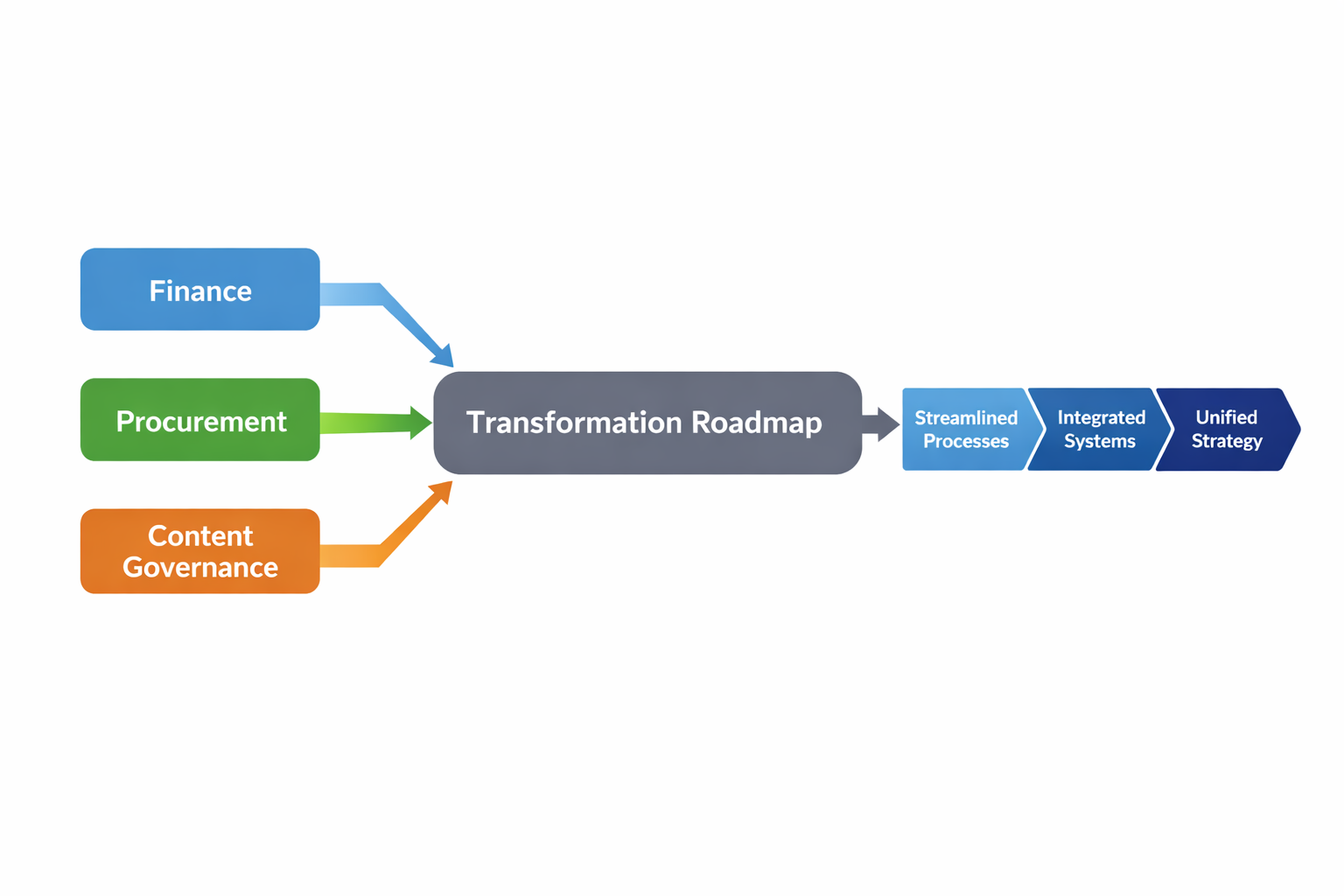
A strong assessment typically includes:
system inventory,
process mapping,
integration mapping,
data quality review,
manual-work analysis,
compliance and access-control review,
and user interviews across functions.
The goal is not to collect complaints. The goal is to identify which constraints are structural and which are merely local work habits. Once those are separated, it becomes much easier to prioritize modernization efforts that create real operating leverage.
4. Building a modern target state: modular ERP, connected planning, and governed digital assets
A modern target state in healthcare should be modular, not monolithic. That means choosing systems that do one job well, connect cleanly through APIs, and can evolve without forcing a total rewrite every few years. For many organizations, that starts with a modular ERP backbone, integrated planning tools, and a governed repository for digital assets and content.
Modular ERP matters because healthcare organizations rarely need one giant system to do everything. Finance, procurement, HR, planning, and reporting often need distinct capabilities, but they also need a shared data model and reliable integration. A modular architecture makes it easier to update one part of the stack without disrupting the entire operation. It also supports phased implementation, which is especially useful in regulated environments where uptime and continuity matter.
Connected planning is the second pillar. Organizations need a way to align financial planning, workforce planning, activity planning, and scenario modeling. Without that connection, leaders end up making decisions from disconnected spreadsheets and stale reports. In healthcare, where volume shifts, reimbursement changes, and staffing constraints can affect outcomes quickly, connected planning helps leadership respond faster and with more confidence.
Governed digital assets are the third pillar. Professional associations and healthcare-adjacent organizations often manage large libraries of documents, templates, learning materials, visual assets, and member-facing resources. These assets need metadata, version control, approval workflows, permissions, and lifecycle rules. That governance supports consistency, reduces duplication, and makes it easier to reuse approved material safely.
The target state should also anticipate AI and automation without depending on them. NIST’s AI RMF emphasizes governance and risk management around AI-enabled capabilities, which is a useful lens for any future automation layer. If your data, permissions, and workflows are already well governed, it becomes much safer to introduce intelligent routing, summarization, categorization, or decision support later. (nist.gov)
The best target states share four traits:
clear ownership,
clean data flows,
modular components,
and audit-ready governance.
That combination creates an environment where the organization can change without breaking itself.
5. Selecting the right vendors: evaluation criteria that go beyond feature checklists
Feature checklists are useful, but they are not enough. In healthcare transformation, the real question is whether a vendor can support your operating model, compliance posture, integration requirements, and future growth. A vendor with a long feature list may still be the wrong choice if their implementation approach creates hidden complexity or if their interoperability model is too rigid.
Start by evaluating vendors on architectural fit. Can the system work in a modular environment? Does it support APIs, configurable workflows, and standards-based exchange? Does it integrate cleanly with existing finance, content, identity, and reporting tools? CMS’s focus on APIs and health information exchange makes this question more important than ever. (cms.gov)
Next, assess governance maturity. Does the vendor support role-based access, audit trails, approval workflows, retention controls, and data lineage? Can administrators manage change without constant vendor intervention? This is especially important if your organization handles regulated content or sensitive operational data.
Then look at implementation realism. Many solutions are attractive in demos but difficult in production because the vendor does not understand healthcare process complexity. Ask for examples of similar organizations, similar use cases, and similar regulatory constraints. Demand proof that the vendor has handled integrations, change management, and operating-model adoption—not just software deployment.
Support model matters too. A good vendor should explain:
how they handle go-live support,
how they manage escalations,
how they document configuration,
and how they transfer knowledge to your internal team.
Finally, consider roadmap alignment. You are not buying only today’s product. You are buying the vendor’s ability to support tomorrow’s needs, including automation, AI governance, and evolving interoperability requirements. NIST’s AI guidance is a reminder that technology choices increasingly carry governance implications. Your vendor should be able to evolve with that reality, not just sell to it. (nist.gov)
Good vendors reduce complexity. Great vendors make complexity governable.
6. Running a low-risk procurement process: RFP design, stakeholder alignment, and proof points
The best procurement processes are designed to reduce ambiguity early. In healthcare, a poorly framed RFP can produce impressive proposals that are not actually comparable. To avoid that, define the business problem first, then design the RFP around use cases, constraints, and outcomes.
Begin with stakeholder alignment. Finance, operations, content owners, IT, compliance, and executive sponsors should all agree on the business objectives before the RFP is issued. Without that alignment, each group tends to optimize for its own pain point, and the selection process drifts into compromise instead of strategy.
The RFP should include realistic scenarios, not just feature grids. Ask vendors to show how they would handle:
a new approval workflow,
a reporting correction,
a data integration failure,
a content version dispute,
or a role-based access change.
Those scenarios reveal more than a static capability list.
Proof points are also essential. Ask for evidence in the form of references, sample project plans, implementation artifacts, or live demonstrations of relevant workflows. If possible, test the vendor against a small number of real use cases using your own sample data. That gives your team a better sense of usability, configuration effort, and support quality.
A low-risk process should also define decision criteria before proposals arrive. Weight factors such as:
interoperability,
compliance support,
implementation approach,
usability,
governance features,
total cost of ownership,
and long-term scalability.
Avoid overvaluing flashy functionality that does not advance your operating model. In regulated environments, procurement should reward reliability, transparency, and fit.
CMS’s interoperability and prior authorization rules also underscore the importance of vendor readiness. If a vendor cannot support your exchange requirements in time for regulatory deadlines, that is not a minor issue; it is a business risk. (cms.gov)
A good procurement process does not just choose software. It chooses an execution path.
7. Data governance and interoperability as the foundation of any transformation
Data governance and interoperability are not supporting tasks. They are the foundation. If data definitions are inconsistent, access is poorly controlled, or systems cannot exchange information reliably, no amount of UI polish will produce a successful transformation.
Interoperability in healthcare depends on standards, shared definitions, and disciplined implementation. HL7’s FHIR standard has become a major interoperability framework because it is designed for modern data exchange and API-friendly workflows. CMS’s rules continue to push the industry toward electronic exchange and improved prior authorization processes, reinforcing the need for connected systems and shared technical standards. (hl7.org)
Governance is the mechanism that makes interoperability safe. That includes:
defining canonical data elements,
assigning data ownership,
managing master data,
controlling access and permissions,
tracking lineage,
and maintaining documentation for integrations and transformations.
Without governance, interfaces become fragile, and every new system introduces more uncertainty. With governance, data becomes a managed enterprise asset.
This is also where AI readiness begins. NIST’s AI RMF treats governance, mapping, measurement, and management as core functions of trustworthy AI, and that logic applies broadly to healthcare operations. If you cannot confidently govern data today, you will struggle to govern AI-enabled workflows tomorrow. (nist.gov)
A practical data governance program should answer:
Who owns each critical data domain?
Which definitions are authoritative?
Which systems create, transform, and consume the data?
What is the escalation path for errors?
How are exceptions documented and reviewed?
Interoperability should be treated as an enterprise discipline, not an integration project. When governance and exchange are aligned, organizations gain better reporting, less duplication, and more reliable decision support.
8. Change management for professional associations and healthcare-adjacent organizations
Professional associations and healthcare-adjacent organizations face a unique change management challenge. They often operate with lean teams, broad stakeholder groups, and a mix of administrative, educational, publishing, and advocacy responsibilities. A transformation can touch member services, content operations, finance, and communications all at once.
Change management in this context should begin with mission alignment. People adopt new systems more readily when they understand how the change improves the organization’s ability to serve members, support professionals, or deliver trusted information. The message should not be “we are installing a new platform.” It should be “we are creating a safer, faster, more reliable operating model.”
Training should be role-based. A content editor, finance analyst, operations manager, and executive sponsor all need different information. If training is too generic, adoption suffers. If it is too technical, users tune out. The best programs show people how the new workflow fits into their everyday work.
Communication matters just as much as training. Staff need to know:
what is changing,
why it is changing,
when it is changing,
what support will be available,
and how success will be measured.
Because many associations serve highly engaged external communities, they should also consider downstream impact. Changes in publishing systems, member portals, renewal workflows, or content libraries can affect the customer experience directly. That means internal readiness and external communications must be planned together.
HIMSS’s focus on interoperability and digital health ecosystems reflects a broader truth: connected systems only create value when people trust and use them. Technology adoption is ultimately a behavioral process, not just a technical one. (himss.org)
A strong change plan includes champions, feedback loops, short learning cycles, and visible executive sponsorship. It also gives teams room to adapt as they discover what actually works in practice.
9. What current trends say about the future of healthcare back offices: AI, APIs, and automation
The future of healthcare back-office operations is being shaped by three forces: AI, APIs, and automation. Each is important on its own, but the real transformation comes when they are combined in a governed way.
APIs are the connective tissue. CMS’s interoperability rules show that healthcare is moving toward more standardized electronic exchange. That shift supports faster data movement, more reliable integrations, and less manual reconciliation. In practical terms, APIs make it easier to automate workflows across finance, operations, and member-facing systems. (cms.gov)
Automation is the next layer. Once data flows are standardized, organizations can automate repetitive work such as routing, notifications, approvals, document classification, and exception handling. The goal is not to remove people from the process; it is to remove unnecessary manual friction so staff can focus on higher-value decisions.
AI is becoming more relevant, but it must be governed carefully. NIST’s AI RMF and related resources emphasize trustworthiness, security, and resilience, which are crucial in healthcare settings where errors can have real consequences. AI can assist with summarization, triage, drafting, categorization, search, and pattern detection, but only if the underlying data and workflows are controlled. (nist.gov)
The practical trend line is clear:
more systems will expose APIs,
more work will be automated,
and more decisions will be supported by AI-assisted tools.
But the winners will not be the organizations that adopt the most AI the fastest. They will be the organizations that build strong governance, clean data, and flexible workflows first.
10. A practical roadmap: phased implementation, quick wins, and success metrics
A successful transformation roadmap should be phased, not all-at-once. The reason is simple: regulated operations cannot afford unnecessary disruption. Phasing helps teams learn, adjust, and build confidence while delivering value early.
Start with a baseline assessment. Document current systems, process gaps, manual work, and reporting pain points. Use that baseline to identify quick wins—areas where moderate effort can create visible relief. Common quick wins include workflow standardization, report cleanup, content governance, and simple integration improvements.
Then define implementation waves. A typical sequence might be:
stabilize data and access controls,
modernize one core workflow,
connect reporting and planning,
improve content governance,
automate repetitive tasks,
and finally expand to adjacent processes.
Each wave should have clear success metrics. Good metrics are both operational and adoption-oriented. For example:
cycle time reduction,
fewer manual reconciliations,
reduced error rates,
faster approval turnaround,
higher data completeness,
improved user adoption,
and fewer support tickets after go-live.
It is also smart to define risk metrics:
number of failed integrations,
unresolved data exceptions,
access-control violations,
or workflow backlogs.
These metrics help leadership see whether the transformation is truly reducing friction or just moving it around.
A phased roadmap should also include governance checkpoints. Before each wave goes live, confirm that ownership, escalation paths, training, and support plans are ready. That discipline is especially important when the organization is navigating interoperability requirements or preparing for AI-enabled capabilities. (cms.gov)
In practice, the best roadmaps balance ambition with control. They produce early value, but they never lose sight of the larger operating model.
Conclusion
Healthcare tech transformation in 2026 is a strategic discipline, not a software purchase. The organizations that succeed will be the ones that treat regulated complexity as a design constraint, not an excuse to delay change. They will build business cases around resilience, visibility, and trust; assess pain points across finance, operations, and content; and create target states that are modular, governed, and ready for interoperability.
They will also select vendors more carefully, run procurement with clearer proof points, and invest in data governance before layering on automation and AI. Just as importantly, they will manage change as a human process—one that depends on leadership, communication, and confidence.
The result is not just a modern technology stack. It is a safer, smarter operating model built for the realities of healthcare in 2026 and beyond.