
Event-Driven Architecture: When It Helps, When It Hurts, and Why It’s Growing in 2026
June 3, 2026
Event-driven architecture (EDA) is having a moment because modern systems are increasingly expected to do more than respond to web requests. They need to react to sensor data, user behavior, fraud signals, inventory changes, AI agent actions, and operational events in near real time. In that world, a synchronous request/response model is still useful—but it is no longer enough on its own for many teams. EDA helps systems react as things happen, not just when someone asks for something. It also introduces tradeoffs that can be expensive if you adopt it too early or without the right discipline. That’s why understanding both the upside and the pain points matters more in 2026 than it did a few years ago. IBM describes EDA as a model built around the publication, capture, processing, and storage of events, while Microsoft notes that it decouples producers and consumers through asynchronous channels and accepts eventual consistency as a tradeoff in many designs. (ibm.com)
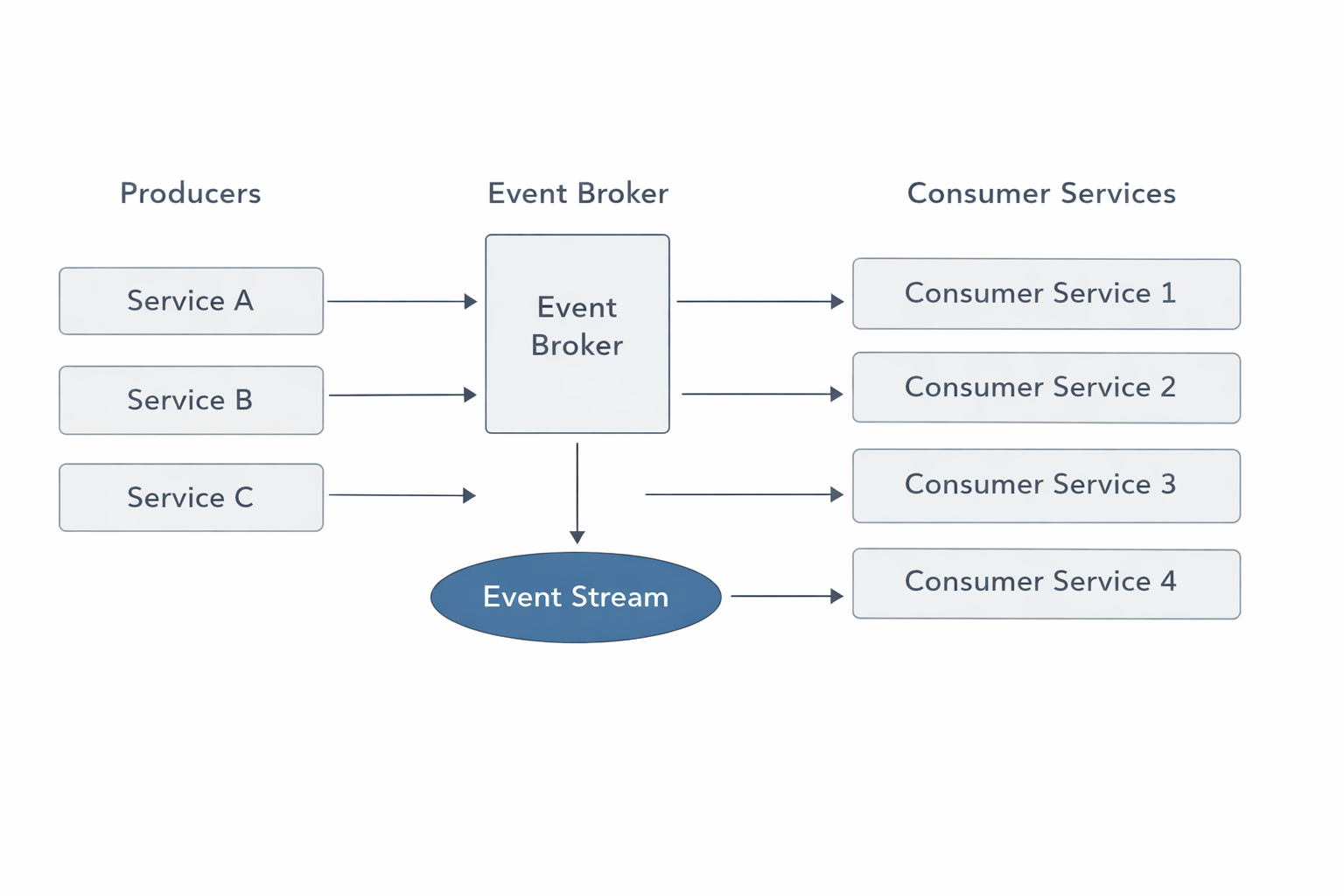
1. What Event-Driven Architecture Is and How It Differs from Request/Response Systems
At its core, event-driven architecture is a way of designing software around events: facts that something happened. A customer placed an order. A temperature sensor crossed a threshold. A payment failed. A model completed inference. In EDA, these events are published to a broker, stream, or message bus, and one or more downstream systems react to them. IBM describes EDA as a software design model built around publication, capture, processing, and storage of events, and Microsoft emphasizes that producers and consumers communicate asynchronously through event channels rather than direct API calls. (ibm.com)
That differs sharply from request/response systems. In a synchronous API model, one service asks another for an answer right now. The caller waits, and both sides are coupled by timing and availability. If the downstream service is slow or unavailable, the request can fail or time out. In EDA, the producer typically does not wait for the consumer to finish. It emits an event and moves on. This improves decoupling, but it also means the system may not be immediately consistent everywhere. Microsoft explicitly notes that data across services is not immediately consistent after an event is published and that this tradeoff is often accepted to favor availability and partition tolerance. (learn.microsoft.com)
A simple way to think about the difference is this: request/response asks, “What is the answer now?” EDA says, “This happened—what should react to it?” That distinction matters because the architectural choice affects latency, reliability, debugging, and how teams coordinate changes. EDA shines when multiple systems need to respond to the same fact, especially when the reaction can be asynchronous. But for simple CRUD operations, tight consistency requirements, or one-off user interactions, the complexity may outweigh the benefit. Microsoft notes that the operational overhead of event brokers, asynchronous error handling, and eventual consistency is not justified for simple interactions. (learn.microsoft.com)
2. Why EDA Is Gaining Momentum in 2025–2026: Cloud-Native, AI, and Real-Time Workflows
EDA is gaining momentum because software itself is changing. Cloud-native systems are more distributed, microservice-based, and automation-heavy than traditional monoliths. In those environments, services often need to react to changes in state rather than wait for a direct API call. IBM says EDA increases responsiveness, flexibility, and agility, while Microsoft highlights the value of asynchronous communication and decoupling in modern architectures. (ibm.com)
The second driver is AI. AI systems, especially agentic and workflow-oriented systems, often depend on events to trigger actions, route work, ingest documents, or coordinate tools. AWS describes event-driven architecture as “the backbone of serverless AI,” using events as the primary mechanism for integration and control. Its guidance gives examples like a document upload triggering a summarization pipeline, which is exactly the kind of pattern that benefits from asynchronous orchestration. (docs.aws.amazon.com)
The third driver is the demand for real-time workflows. Businesses increasingly want instant notifications, live fraud detection, continuous inventory updates, streaming analytics, and customer experiences that update as soon as data changes. IBM notes that businesses often adopt EDA to become more aware of what is happening “as it’s happening,” and it points to real-time processing, decision-making, and automation as core advantages. (ibm.com)
There’s also an operational story here: teams are using event streaming and event-driven tooling to connect cloud services, data platforms, and automation layers with less custom glue code. Confluent’s 2025 data streaming report says 90% of IT leaders see data streaming as enabling AI product innovation, which is a strong signal that event and stream processing are becoming part of the AI delivery stack rather than a niche integration pattern. (confluent.io)
3. Where EDA Helps Most: Decoupling, Scalability, Resilience, and Fan-Out Processing
EDA delivers the most value when you need systems to be loosely coupled. That means producers do not need to know which consumers exist, how many there are, or what each one does with the event. IBM calls out decoupling as a major benefit because producers and consumers interact through events rather than direct API calls, reducing dependencies and improving resilience. (ibm.com)
Scalability is another big win. Because consumers process work asynchronously, you can scale them independently from the producer. If event volume spikes, you can add more consumer instances, increase partitions, or introduce downstream workers without redesigning the producer. IBM explicitly highlights fine-grained scalability as a key benefit of EDA. (ibm.com)
Resilience improves too. In a request/response system, a downstream outage can block the caller. In an event-driven system, events can often be buffered, retried, or replayed later, so producers keep moving even if consumers are temporarily unavailable. That doesn’t eliminate failure; it changes how failure is absorbed. This is especially useful when a process can tolerate a short delay but not dropped work. Microsoft’s architecture guidance discusses how EDA’s asynchronous channels allow producers and consumers to operate independently, while also warning that teams must design for eventual consistency and ordering challenges. (learn.microsoft.com)
Fan-out processing is a particularly strong fit. One event can trigger multiple downstream actions: update a read model, send a notification, log an audit record, enrich a customer profile, and kick off an AI workflow. That kind of one-to-many response is awkward in a synchronous API chain but natural in EDA. IBM’s materials also note that event streaming supports analytics and enrichment processing, which aligns with fan-out use cases where the same event feeds different systems with different responsibilities. (ibm.com)

4. Current Adoption Trends and Market Signals: Cloud-Native Usage, Event-Driven Tooling, and AI-Driven Demand
The adoption signal for EDA is not just anecdotal; it is visible in cloud vendor guidance, observability trends, and AI platform design. Major cloud providers now present event-driven patterns as first-class architecture styles rather than optional add-ons. Microsoft maintains a dedicated event-driven architecture style guide, and AWS provides prescriptive guidance positioning EDA as foundational for serverless AI. That matters because vendors usually formalize patterns when customer demand is broad enough to justify it. (learn.microsoft.com)
Tooling is also maturing. IBM’s event-driven materials reference schema registries, lifecycle management, versioning, policy controls, and AsyncAPI-based interface description, which points to the growing need for governance around event contracts. In other words, EDA is moving from “send messages and hope” toward an engineered platform discipline. (ibm.com)
AI is another strong market signal. AWS positions events as the control plane for serverless AI workflows, while Confluent reports that 90% of IT leaders in its 2025 data streaming study see streaming as enabling AI product innovation. Datadog’s 2026 AI engineering report adds another clue: as AI systems scale, organizations run into capacity, reliability, and operational complexity limits, which creates more demand for architectures that can absorb bursts, isolate failures, and orchestrate work asynchronously. (docs.aws.amazon.com)
Cloud-native adoption is also pushing this shift. Containerized applications, serverless functions, and distributed services naturally benefit from event backbones because they often do not share memory, process space, or even stable network paths. That makes direct coupling harder and asynchronous integration more attractive. The result is a broader move toward event streams, message brokers, and event meshes as connective tissue across modern platforms. IBM’s EDA guidance describes an “event backbone” that serves multiple teams and projects, which is a sign of platform-level adoption rather than isolated implementation. (ibm.com)
5. Best-Fit Use Cases: IoT, Real-Time Analytics, Inventory, Notifications, Fraud Detection, and Serverless Automation
Some problems are almost tailor-made for EDA. IoT is one of the clearest examples. Sensors produce continuous streams of state changes, and those changes often need to be processed as they arrive. Microsoft explicitly notes that guaranteed delivery is especially important in some IoT scenarios, which is one reason EDA is commonly used in device telemetry, monitoring, and industrial systems. (learn.microsoft.com)
Real-time analytics is another strong fit. IBM highlights analytics processing in streaming data, where events can be used to predict future events or enrich data with context. That makes EDA valuable for dashboards, customer behavior analysis, operational intelligence, and alerting systems that must react quickly to fresh input. (ibm.com)
Inventory and order management also benefit because state changes often need to propagate to many systems: warehouse software, storefronts, shipping, finance, and customer notifications. If a product is reserved, sold, canceled, or restocked, multiple downstream services may need to know. EDA is useful here because a single inventory event can update multiple consumers without the inventory service directly calling each one. IBM and Microsoft both emphasize the decoupling and responsiveness advantages that make this kind of fan-out practical. (ibm.com)
Fraud detection is another excellent candidate. Fraud systems often need to score transactions, combine them with historical context, and trigger decisions immediately. EDA enables event streams to feed rules engines, anomaly detectors, and alerting systems in near real time. IBM explicitly mentions proactive identification of issues and immediate response to emerging situations as core EDA benefits. (ibm.com)
Serverless automation may be the most visible growth area in 2026. AWS describes event-driven architecture as the backbone of serverless AI and highlights patterns like document uploads triggering pipelines and event context driving decisions. This pattern maps well to modern automation: file arrives, workflow starts; payment clears, notification sends; model finishes, next step is invoked. (docs.aws.amazon.com)
6. Where EDA Hurts: Variable Latency, Eventual Consistency, Duplicate Events, and Harder Debugging
EDA is not free. The first cost is variable latency. Because consumers process events asynchronously, there is no guarantee that the reaction happens immediately. For many workflows, that is fine. For others, it is a deal-breaker. Microsoft points out that if you cannot tolerate windows where different parts of the system disagree on the current state, eventual consistency works against you. (learn.microsoft.com)
Eventual consistency is the second major pain point. In a request/response system, a write can often be followed by an immediate read of the updated state. In EDA, downstream consumers may see the change later. That means user interfaces, reports, and automation rules may temporarily disagree. Microsoft recommends designing consumers and downstream reads to tolerate stale or partially updated data when eventual consistency is acceptable. (learn.microsoft.com)
Duplicate events and ordering issues are another source of complexity. In real systems, retries happen, network glitches occur, and message brokers may deliver more than once. Microsoft notes that running multiple consumer instances can create challenges if events must be processed in order or if idempotent processing is not implemented. This is why EDA often forces teams to think carefully about deduplication, sequencing, and exactly-once assumptions. (learn.microsoft.com)
Debugging is harder too. In a synchronous system, tracing a failure often means following one call chain. In an event-driven system, one event may trigger many downstream tasks, each with different timing, retries, and partial failures. Microsoft explicitly warns that observability is hard to retrofit into a decoupled system and should be planned from the start. That warning is worth taking seriously, because many EDA projects become operationally painful not because the design is wrong, but because the team underestimated the visibility and tracing needed to run it well. (learn.microsoft.com)
7. Operational Complexity: Observability, Governance, Schema/Versioning, Retries, Backpressure, and Testing
Operational complexity is where many EDA projects succeed or fail. Observability is the first challenge. With more async steps and more consumers, you need correlation IDs, distributed tracing, event logs, dashboards, and replay tools. Microsoft recommends planning instrumentation from the start because retrofitting it later is much more difficult in decoupled systems. (learn.microsoft.com)
Governance matters just as much. Once many teams publish and consume events, the organization needs clear event contracts, ownership, lifecycle management, and policy controls. IBM’s EDA materials mention built-in schema registry support, versioning, policy-based controls, and AsyncAPI-based interface description, all of which point to the need for disciplined event management. Without that discipline, event streams can become a messy, undocumented integration layer. (ibm.com)
Schema evolution is a constant concern. If one service changes the structure of an event, every consumer may be affected. Teams need versioning strategies, backward compatibility rules, and contract testing. This is especially important when events are used as shared business interfaces across domains. The more consumers you have, the more expensive a breaking change becomes. (ibm.com)
Retries and backpressure are also harder in EDA. A failed consumer may need exponential backoff, dead-letter queues, and replay mechanisms. But retries can amplify traffic if the consumer is already overloaded. Backpressure policies matter because “just retry” can make a bad situation worse. In practice, teams need a clear strategy for poison messages, circuit breakers, and capacity limits. AWS’s serverless AI guidance emphasizes managed integrations and observability because orchestration becomes much more complex once workflows are broken into multiple async steps. (docs.aws.amazon.com)
Testing is the final major challenge. End-to-end tests for event-driven systems are often slower and more fragile than unit tests or simple API tests. You need to validate message contracts, consumer behavior, replay scenarios, and failure recovery. That means teams adopting EDA should invest in test harnesses, synthetic events, and staging environments that resemble production event traffic. In other words, EDA is an architectural choice and a testing discipline. If you cannot support both, adoption can backfire. (learn.microsoft.com)
8. Decision Framework: When to Choose EDA vs. Synchronous APIs, Queues, or Monoliths
A good rule of thumb is to choose EDA when the system’s main challenge is reaction to change, not immediate answer to a question. If several downstream systems must respond to the same fact, or if the work can happen later, EDA is often the best fit. IBM’s guidance on responsiveness, decoupling, and real-time processing supports this view. (ibm.com)
Choose synchronous APIs when you need immediate consistency, a simple call chain, and straightforward debugging. Microsoft’s architecture guidance makes it clear that if you cannot tolerate temporary disagreement between services, eventual consistency is a poor fit. That makes synchronous APIs better for many user-facing transactional operations, especially where the user expects an immediate read-after-write guarantee. (learn.microsoft.com)
Use queues when the main need is buffering work for a single consumer or a small worker pool. Queues are often simpler than full-blown event streaming because they are narrower in scope: one producer, one kind of work, clearer ownership. EDA becomes attractive when the same event must feed multiple consumers or when you want an event backbone that many teams can reuse. IBM’s event-backbone framing is useful here because it distinguishes local queue-based offloading from organization-wide event reuse. (ibm.com)
Monoliths still make sense for some teams. If the domain is small, the transaction boundaries are tight, and the team is not ready to manage distributed systems complexity, a monolith can be faster, safer, and easier to operate. Microsoft explicitly says the overhead of EDA is not justified for simple interactions. That is an important reminder that “modern” does not automatically mean “better.” (learn.microsoft.com)
9. Architecture Patterns That Make EDA Safer: Pub/Sub, Event Streaming, CQRS, Saga Orchestration, and Idempotency
Several patterns can make EDA much safer and more predictable. The first is pub/sub, where one event is published and many subscribers react independently. This is the most natural form of fan-out and works well when consumers should not know about each other. IBM’s discussions of asynchronous messaging and event processing align closely with this model. (ibm.com)
Event streaming is another important pattern. Instead of treating messages as disposable packets, streams act as durable logs that can support replay, analytics, enrichment, and multiple consumer groups. IBM highlights streaming data for analytics and enrichment, and Confluent’s report underscores how streaming is increasingly tied to AI product innovation. (ibm.com)
CQRS—Command Query Responsibility Segregation—pairs well with EDA when write operations and read operations need different models. Commands change state; events update read models. This helps systems scale reads and writes independently, but it also means teams must manage eventual consistency carefully. Microsoft’s guidance on accepting eventual consistency in some workflows is directly relevant here. (learn.microsoft.com)
Saga orchestration helps coordinate multi-step workflows without relying on distributed transactions. Instead of one giant atomic commit, a saga executes steps and compensating actions across services. This is especially useful in orders, payments, and fulfillment. EDA makes sagas practical because each step can be triggered by an event and each compensating action can also be event-driven. (learn.microsoft.com)
Finally, idempotency is non-negotiable. Since duplicate delivery is a normal reality in distributed systems, consumers must be able to process the same event more than once without causing bad side effects. Microsoft’s warning about ordering and idempotent processing is a reminder that this is not an advanced optimization—it is a baseline design requirement. (learn.microsoft.com)
10. Practical Adoption Checklist and Migration Strategy for Teams Considering EDA
The safest way to adopt EDA is incrementally. Start with one workflow that has clear event boundaries and obvious asynchronous value, such as notifications, audit logging, or document processing. AWS’s serverless AI examples and IBM’s real-time automation examples both show how event-triggered pipelines can deliver value without forcing a full rewrite. (docs.aws.amazon.com)
Before you migrate, ask four questions:
Does this workflow need immediate consistency?
If yes, EDA may be the wrong fit, at least for the transactional core. Microsoft notes that eventual consistency can be a problem when users or systems cannot tolerate disagreement about current state. (learn.microsoft.com)Will multiple consumers need the same event?
If yes, EDA is a stronger candidate because fan-out is one of its biggest strengths. IBM highlights decoupling and responsiveness for exactly this kind of case. (ibm.com)Do we have observability and governance ready?
If not, pause. Microsoft and IBM both emphasize instrumentation, schema management, lifecycle control, and policy enforcement. (learn.microsoft.com)Can we make consumers idempotent and replay-safe?
If not, retries and duplicates will eventually cause pain. Microsoft explicitly warns about ordering and idempotent processing in multi-instance consumer setups. (learn.microsoft.com)
A practical migration strategy is to wrap existing monolith functions with events rather than splitting everything at once. Publish events for one bounded context, let a downstream service consume them, and measure the operational burden before expanding. From there, you can introduce a shared event backbone, standardize schema versioning, and add workflow orchestration where needed. IBM’s idea of a staged journey toward a real-time enterprise is a good mental model: start tactical, then expand as patterns prove themselves. (ibm.com)
Conclusion
Event-driven architecture is growing in 2026 because it matches the way modern systems work: distributed, cloud-native, AI-assisted, and increasingly real time. It is especially powerful when you need decoupling, scalability, resilience, and fan-out processing across many consumers. But EDA also introduces tradeoffs that matter: eventual consistency, debugging difficulty, duplicate handling, and a heavier operational burden. (ibm.com)
The right takeaway is not “use EDA everywhere” or “avoid it completely.” The right takeaway is to use it where asynchronous reaction to events creates clear business value, and to avoid it where immediate consistency and simplicity matter more. If you adopt EDA with strong observability, schema governance, idempotent consumers, and a careful migration plan, it can become one of the most valuable design choices in your architecture toolkit.