Designing for Extensibility: How to Avoid Rebuilding Everything Later
August 12, 2026
Introduction: Why extensibility matters more in 2026
In 2026, extensibility is no longer a “nice to have” architecture trait. It is a survival skill. AI features are moving from experimental add-ons into core product experiences, automation is reshaping internal workflows, and platforms change fast enough that today’s stable integration can become tomorrow’s maintenance burden. The systems that age well are not the ones that predict every future requirement; they are the ones that can absorb change without forcing a rewrite.
That matters because most organizations do not fail from lack of ambition. They fail from accumulated rigidity. A product launches with a clean, simple architecture, then grows through urgent exceptions: one custom integration, one special workflow, one temporary UI shortcut, one manual data fix. Over time, those exceptions become the architecture. When the business needs to move faster, the codebase fights back.
Extensibility is the discipline of designing for change on purpose. It means acknowledging that capabilities, integrations, user interfaces, and AI-driven workflows will evolve at different speeds. NIST’s AI Risk Management Framework emphasizes that AI systems must be adaptable as technologies continue to develop, which is a useful reminder that future-proofing is less about guessing the future and more about structuring your system so change is survivable. (nist.gov)
The practical goal is simple: keep the parts that should stay stable isolated, and make the parts that will change easy to replace. If you do that well, you do not rebuild everything later. You evolve it.
What extensibility means in practice
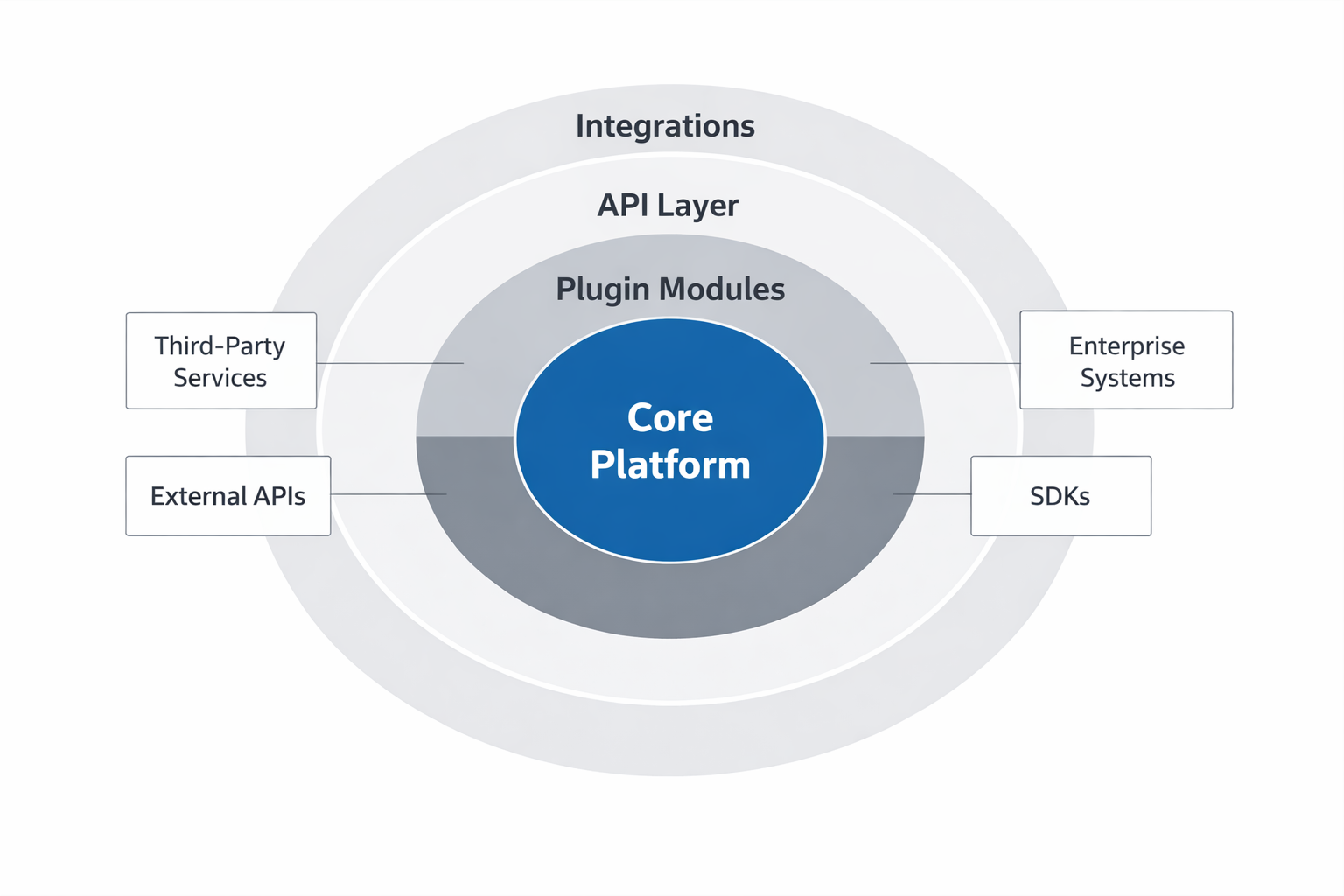
Extensibility sounds abstract until you translate it into system boundaries. In practice, it means separating stable core business capabilities from changeable integration points, features, and UI surfaces. The core should represent the durable logic that defines your business: pricing rules, order state, entitlement checks, policy enforcement, or customer identity. Around that core, you build layers that are expected to change: external APIs, partner integrations, workflow automations, feature flags, dashboards, and user-facing screens.
This distinction matters because not everything should be equally flexible. A checkout flow might change every quarter, but the rule that an order cannot ship before payment clears may be far more stable. A reporting dashboard might be replaced entirely, but the finance ledger model must remain trustworthy. Extensibility is therefore not “make everything configurable.” It is “design different parts of the system for different rates of change.”
A useful mental model is the “core versus surface” split. The core should expose explicit contracts and clean domain concepts. The surface should adapt to channels and use cases without leaking channel-specific logic into the core. That is especially important now that applications often have to serve humans, other systems, and AI agents at once. OpenAI’s function calling and Structured Outputs are examples of how modern systems increasingly depend on well-defined contracts between the model and external tools, which reinforces the value of explicit interfaces and schema discipline. (help.openai.com)
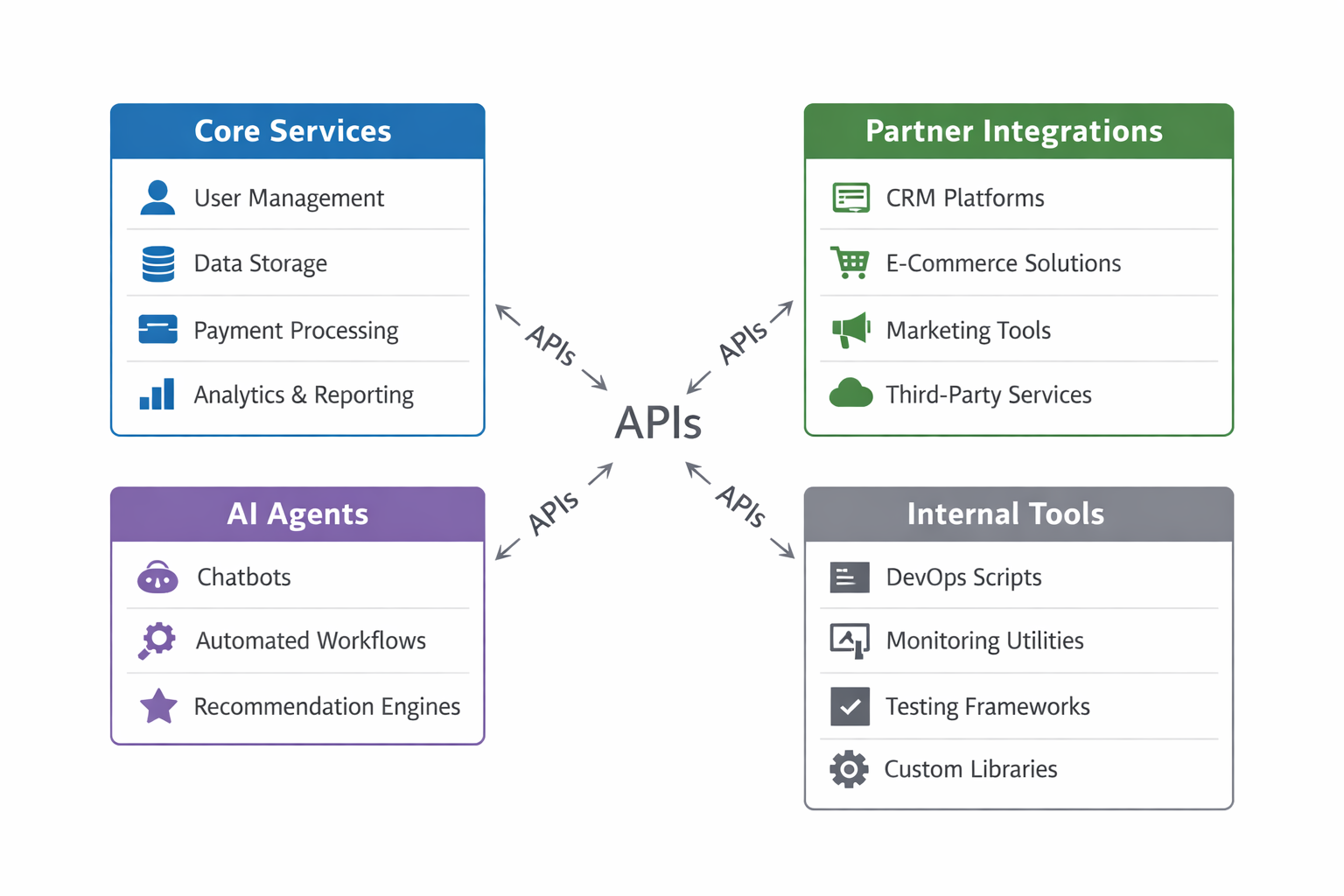
This also means not every extension belongs in the same place. A plugin, an API integration, and a UI customization are all forms of extensibility, but they deserve different design rules. A plugin may need sandboxing and version negotiation. An API may need backward compatibility and deprecation policy. A UI extension may need safe composition and permission boundaries. The more clearly you separate these concerns, the easier it becomes to change one without destabilizing the others.
The business case: why rigidity gets expensive
The business case for extensibility is not theoretical. Rigid systems get expensive because they turn every change into a project. When architecture is tightly coupled, even small requests require cross-team coordination, testing across unrelated modules, and a high risk of regressions. That slows delivery, increases support load, and creates a hidden tax on every roadmap item.
Technical debt is part of the story, but not the whole story. The larger issue is that obsolete systems and brittle architectures accumulate friction in ways leadership can feel: missed launch windows, rising cloud or infrastructure costs, repeated production incidents, and longer onboarding time for new engineers. A system that is hard to change also becomes hard to retire. Old interfaces stay alive because something, somewhere, depends on them. That dependency web is what makes replacement projects so risky.
Rigid architecture also increases organizational risk. If one monolithic component owns too much business logic, a defect or outage can cascade across the company. If integrations are tangled directly into product code, partner changes become production emergencies. If teams cannot change components independently, delivery becomes a queue, not a flow.
API and versioning guidance from Google Cloud underscores the importance of compatibility and careful change management when many clients depend on a service. The more independent clients you have, the more carefully you must protect compatibility. (cloud.google.com)
This is why extensibility pays off in business terms. It reduces rewrite pressure, preserves optionality, shortens lead time, and lowers the cost of experimentation. When the market shifts, you want to update a module, an adapter, or a workflow—not replace the entire house. That difference is often the difference between compounding growth and stalled execution.
Core design principles for extensibility
The first principle is modular boundaries. If a system can be divided into coherent pieces, each piece should own a clear purpose. A module should be understandable on its own and should not require deep knowledge of unrelated parts. Good boundaries reduce the blast radius of change and make ownership more obvious.
The second principle is loose coupling. Components should depend on contracts, not on internal implementation details. If service A knows too much about service B’s tables, classes, or workflow assumptions, change becomes dangerous. Loose coupling does not mean no dependency; it means dependency through stable abstractions. In practice, that often means APIs, events, schemas, or interfaces rather than direct calls into internal logic.
The third principle is clear contracts. Every boundary should specify what goes in, what comes out, and what happens when things go wrong. That includes data types, error behavior, timeouts, idempotency rules, and versioning policies. Clear contracts are especially important for AI-enabled workflows because agents and tool calls behave best when the system tells them exactly what is expected. OpenAI’s documentation explicitly recommends using Structured Outputs or validation to ensure tool arguments match schema, which is a strong reminder that contracts are not optional in machine-driven systems. (help.openai.com)
The fourth principle is domain-driven ownership. Teams should own the business capabilities they understand, not arbitrary technical slices. If the payments team owns payment rules, they can evolve that domain without waiting for a central platform group to interpret every edge case. This improves accountability and reduces the number of handoffs. The result is not just cleaner code; it is cleaner organization design.
The fifth principle is design for replacement, not permanence. A truly extensible system assumes that pieces will be swapped over time. That means keeping state transitions explicit, minimizing hidden side effects, and avoiding assumptions that a component will live forever. When replacement is a normal event, architecture becomes calmer.
Architecture patterns that support future change
Several architecture patterns are especially useful when the goal is long-term flexibility.
Modular monoliths are often the best starting point. They preserve a single deployable unit while enforcing internal boundaries between domains or features. This gives teams most of the maintainability benefits of modularization without the operational overhead of distributed systems. For many organizations, a modular monolith is the most economical way to stay extensible while the product and domain are still changing rapidly.
Microservices can support extensibility when the organization truly needs independent scaling, deployment, and ownership. But they are not a shortcut to good design. If boundaries are unclear, microservices merely distribute the complexity. They work best when domain boundaries are already understood and teams can handle the cost of service coordination.
Plugin architectures are ideal when you expect customers, partners, or internal teams to extend the product in controlled ways. This pattern is common in ecosystems where new behaviors need to be added without changing the core. The key is to define safe extension points, permission boundaries, and compatibility rules.
Event-driven systems help when change needs to propagate asynchronously across many consumers. Instead of forcing synchronous dependencies, events let other parts of the system respond at their own pace. That reduces coupling and creates room for new use cases later. Event-driven designs are especially useful when one action must trigger several independent downstream workflows.
API-first design makes extensibility visible at the boundary. If your API is a first-class product, then documentation, versioning, payload shape, and error handling become part of the architecture, not afterthoughts. Google Cloud’s API versioning guidance highlights the need to protect compatibility as client dependence grows. (cloud.google.com)
In reality, the best systems often combine these patterns. A modular monolith may expose APIs and events. A microservice platform may still contain plugin points. The point is not to choose one pattern forever. The point is to choose the pattern that best matches the current scale of the problem while preserving an escape path for later.
Data and integration design for long-term flexibility
Data design is where extensibility often succeeds or fails. A system can have clean services and still become rigid if its data model is too literal, too public, or too tightly bound to one workflow. To stay flexible, many teams use a canonical model for shared concepts such as customer, order, product, or entitlement. The canonical model acts as a stable business language, while adapters map between that language and the needs of external systems.
That does not mean every model should be universal. In fact, forcing one model to fit every use case can create a new kind of rigidity. The better approach is to define stable core concepts and allow bounded contexts to translate as needed. That translation layer is often where flexibility lives.
Versioned APIs are another key part of long-term integration health. Versions let you introduce change without forcing every client to update at once. SemVer-style thinking is widely used to distinguish backward-compatible from backward-incompatible changes, and Google’s API guidance stresses the need for careful compatibility handling as the number and independence of clients increase. (cloud.google.com)
Backward compatibility should be treated as a design constraint, not a cleanup task. Prefer additive changes over breaking ones. Keep old fields available when practical. Deprecate gradually and visibly. Make removals a policy decision, not an accident.
Asynchronous workflows also improve flexibility. If one system needs time to process, validate, enrich, or route data, an async workflow avoids tying the caller to the internal speed of the downstream system. That matters for resilience as well as extensibility. A queue, event stream, or job orchestration layer gives you room to swap implementations later without changing every caller.
The larger lesson is that integration design should protect the core from churn. External partners will change. Internal systems will be replaced. AI tools will evolve. If your data and integration layer can absorb those changes, your product can keep moving without a full rewrite.
Governance and platform engineering
Extensibility does not survive on design alone. It needs governance. Without guardrails, teams often create local optimizations that fragment into inconsistent patterns, duplicate libraries, and conflicting standards. That is how “move fast” becomes “maintain everything twice.”
Platform engineering helps prevent that outcome by providing shared capabilities in a reusable way: authentication, logging, deployment pipelines, service templates, observability, secrets handling, and policy enforcement. When teams can use a common platform, they spend less time rebuilding plumbing and more time differentiating the business. The platform should not force every team into the same workflow, but it should make the correct path the easiest path.
Reference architectures are also valuable. They give teams a known-good blueprint for how services, APIs, events, data, and AI integrations should fit together. This reduces ambiguity and accelerates reviews. Instead of debating every new project from scratch, teams can start from a shared baseline.
Shared libraries should be used carefully. They can reduce duplication, but only when they are truly stable and broadly useful. If a shared library becomes a dependency magnet with frequent breaking changes, it can become a central bottleneck. The same is true for internal platforms: they should enable autonomy, not replace local judgment.
Governance works best when it is light enough to move with the organization. Policies should define non-negotiables such as security, compatibility, naming, and lifecycle management. Within those constraints, teams should be free to choose the right implementation for their domain.
This is especially important in AI-adjacent systems. The NIST AI RMF is intended to help organizations operationalize trustworthy AI in flexible ways, which aligns well with a governance approach that sets guardrails rather than dictating every implementation detail. (nist.gov)
Testing and observability for safe change
Extensible systems are only valuable if teams feel safe changing them. That safety comes from testing and observability.
Contract tests are one of the most effective tools for systems with clear interfaces. They verify that a provider and consumer still agree on the shape and behavior of the contract. This is crucial when APIs, events, or shared schemas evolve independently. Without contract tests, teams may unknowingly break downstream consumers even when unit tests still pass.
Automated regression suites provide broader protection. They catch unintended behavior changes across workflows that span multiple components. The goal is not to test everything manually. The goal is to create enough automated confidence that small, routine changes do not require heroic caution.
Telemetry and observability are the third layer. Logs, metrics, traces, and domain-specific signals let teams see whether a change actually behaves as intended in production. If you can detect latency spikes, error rates, workflow stalls, and unusual usage patterns quickly, you can release more confidently and recover faster.
For AI-enabled systems, observability needs an extra dimension. You must track not just system health, but model behavior, tool-call success, schema compliance, fallback rates, and user outcomes. OpenAI’s guidance around function calling and Structured Outputs makes it clear that validation and schema adherence are core parts of robust AI workflows, not optional polish. (help.openai.com)
Release confidence mechanisms tie all of this together. Feature flags, canary releases, gradual rollouts, rollback plans, and environment parity reduce the risk of shipping change. A system that is easy to observe and easy to roll back is a system that can evolve.
Planning for AI and emerging capabilities
AI changes extensibility requirements in a very practical way: it introduces new kinds of volatility. Models improve, model behavior shifts, tools expand, and prompt logic changes more often than traditional application code. If you want to avoid refactoring everything later, you need architectural room for agent workflows, model swaps, and new automation.
The first rule is to keep AI behind a service boundary. The rest of your application should not depend directly on a specific model prompt, vendor API, or output format. Instead, define an internal capability layer such as “summarize ticket,” “classify request,” “extract entities,” or “recommend next action.” That capability layer can evolve its implementation from one model to another without rewriting the product.
The second rule is to treat prompts, tools, and schemas as versioned artifacts. A model integration is not just code; it is a contract between the application and the model. Function calling and Structured Outputs are useful because they let developers constrain model behavior to predictable schemas, which is essential when AI is taking actions in business workflows. (help.openai.com)
The third rule is to design for human-in-the-loop and machine-in-the-loop paths from the start. Not every task should be fully automated, and not every automation should be invisible. Leave room for review, escalation, correction, and fallback. That makes it easier to add agentic behavior later without rebuilding the underlying workflow.
The fourth rule is to isolate model-specific concerns. Token budgets, context windows, prompt instructions, output parsing, retries, and safety checks should live in an AI integration layer, not scattered across the application. That separation will make model swaps far less painful.
NIST’s AI RMF is useful here because it treats AI systems as evolving systems that must remain trustworthy as the technology changes. That mindset fits extensible architecture well: build the system so that new AI capabilities can be introduced, tested, constrained, and replaced without destabilizing the rest of the product. (nist.gov)
Common mistakes and a practical checklist
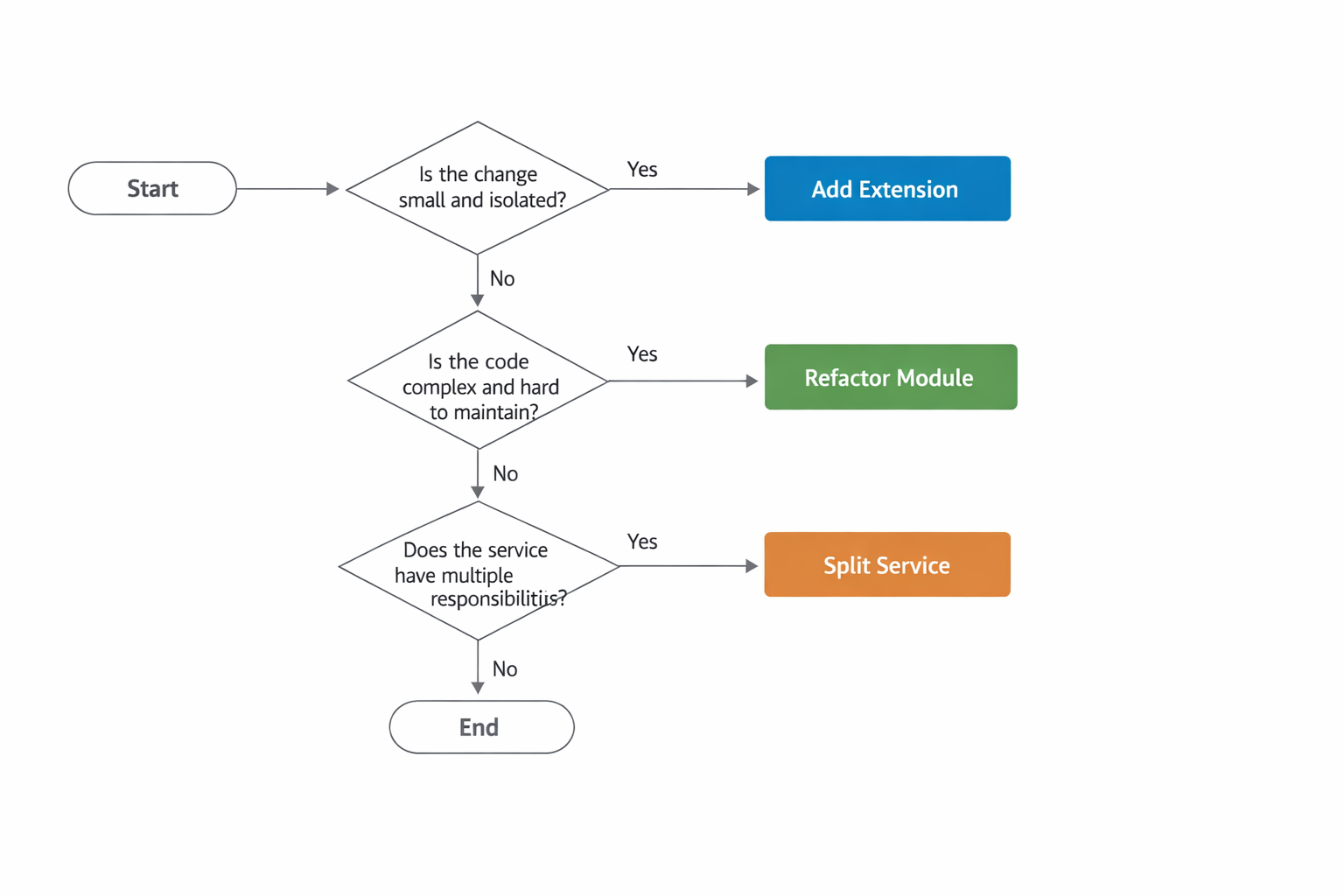
A common mistake is overengineering. Teams sometimes design for every possible future scenario and end up with abstractions no one can understand. Extensibility is not about adding layers for their own sake. It is about creating useful seams where change is likely.
Premature microservices is another classic trap. Distributed systems add deployment, observability, data consistency, and operational burden. If the team does not yet understand the domain boundaries, splitting into microservices can make the system harder to change, not easier.
Hidden coupling is often worse than obvious coupling. Code may look modular while still sharing database tables, global configuration, reused business logic, or undocumented assumptions. If a change in one area frequently breaks another, the boundary is fake.
A final mistake is confusing simplicity with short-term shortcuts. Sometimes the most extensible choice is also the simplest one: a modular monolith, a stable API, a queue, or a few well-defined domain services. If your problem is not yet large enough to justify complexity, keep the design boring and stable. Extensibility should reduce future cost, not inflate present-day ceremony.
Practical checklist
Define the stable business core and keep it isolated.
Separate APIs, events, and UI from domain logic.
Use explicit contracts for inputs, outputs, and errors.
Prefer additive changes and versioned interfaces.
Avoid direct database sharing across unrelated domains.
Choose modular monoliths before microservices when boundaries are still evolving.
Use asynchronous workflows where latency and independence matter.
Build shared platform capabilities for logging, security, deployment, and policy.
Add contract tests, regression suites, and observability before scaling change.
Keep AI integrations behind a capability layer with versioned prompts, tools, and schemas.
Revisit boundaries regularly; extensibility is a practice, not a one-time decision.
Conclusion: key takeaways
Extensibility is how modern systems stay useful as the business changes around them. In a world shaped by AI, automation, and fast platform evolution, the winning architecture is not the one that predicts every future requirement. It is the one that preserves the ability to adapt without rebuilding from scratch.
The most important idea is to separate stable core capabilities from the surfaces most likely to change. From there, use modular boundaries, loose coupling, clear contracts, and thoughtful ownership to keep the system understandable. Support those choices with architecture patterns, integration discipline, governance, testing, and observability.
For AI, the lesson is especially important: treat models and agent workflows as replaceable components, not permanent foundations. Build with versioned contracts, guardrails, and fallback paths so that new capabilities can be adopted safely.
If you do that well, extensibility becomes an advantage that compounds. You ship faster, break less, and preserve options for the future. Most importantly, you avoid the most expensive outcome of all: having to rebuild everything later.