
Beyond Go-Live: How to Turn HR Technology Into a Living Operating Model
June 5, 2026
Implementing new HR technology is often treated like crossing a finish line: the system is configured, the integrations are tested, users are trained, and the launch date arrives. But in practice, go-live is not the end of the story. It is the start of a new operating model—one that has to keep pace with changing business needs, employee expectations, security requirements, and emerging AI capabilities.
That shift matters more in 2025 and 2026 than it did even a few years ago. Employees now expect faster answers, cleaner self-service, and more intuitive digital experiences. Leaders expect HR to show measurable value after launch, not just technical completion. And AI is changing the shape of HR service delivery, from copilots that help users find answers to agentic workflows that can complete tasks across systems. At the same time, governance expectations are rising because automated systems can affect payroll, privacy, fairness, and employee trust. Deloitte’s 2026 thinking on agentic AI and human capital trends emphasizes that organizations are moving from experimentation toward operationalization, but they still struggle when work is simply automated without being rethought. Gartner has also highlighted that AI adoption often fails when executive urgency outruns workforce design and governance. (deloitte.com)
This is why the most successful HR transformations no longer ask, “Did we go live?” They ask, “How do we run this capability every day?” That question changes everything: ownership, service design, metrics, change management, and the role of AI. A living operating model treats HR technology as something continuously managed, improved, and governed—much like payroll, talent, or employee relations. In that model, the platform is not a one-time project deliverable. It is a business capability.

1. The Real Finish Line Is Not Go-Live: HR Technology as an Operating Capability
The biggest mistake organizations make is assuming implementation success equals operational success. A system can launch on time and still fail to deliver real value if no one owns its ongoing performance. HR technology is especially vulnerable to this problem because it sits at the intersection of employee experience, compliance, data accuracy, and cross-functional operations. When a new platform is treated as a project, the team optimizes for cutover. When it is treated as an operating capability, the organization optimizes for sustained outcomes.
That distinction matters because HR technology does not exist in isolation. It is connected to payroll, identity and access management, finance, benefits, security, and manager workflows. If one part of the experience breaks—say a manager cannot approve a job change, or an employee cannot update banking information—the impact is immediate and visible. The issue is not merely technical. It becomes an operating issue. Deloitte’s 2026 human capital work suggests that organizations need to move from change management to changefulness, embedding continuous learning and support directly into work rather than relying on a one-time rollout. (deloitte.com)
A living operating model means HR, IT, payroll, security, and business leaders all share responsibility for outcomes. It also means the organization accepts that post-launch optimization is not optional. Processes change, policy changes happen, new compliance requirements emerge, and the workforce itself evolves. In other words, the “final” configuration is always temporary. The more quickly you recognize that, the more resilient your HR tech ecosystem becomes. The goal is not to avoid change after go-live. The goal is to be ready for it.
2. What Changed in 2025–2026: AI, Agentic Workflows, and Higher Expectations
The last two years have changed the HR technology conversation in a fundamental way. In 2025 and 2026, AI is no longer just a feature to demo; it is becoming part of how work gets done. Deloitte’s 2025 and 2026 HR technology coverage describes agentic AI as a major trend, with systems that can automate complex workflows and, in some cases, take actions across multiple systems. At the same time, Deloitte’s 2026 reporting notes that many organizations still struggle to convert pilot enthusiasm into measurable transformation, especially when AI is layered onto legacy workflows instead of redesigning the work itself. Gartner’s 2025 survey data also shows that enthusiasm for AI exists, but adoption can stall when peer behavior, governance, and organizational readiness are weak. (deloitte.com)
For HR, this means expectations have shifted in three important ways. First, employees expect speed. They want answers now, not after a ticket bounces around three teams. Second, they expect self-service to feel intelligent. If a system can suggest next steps, prefill information, and guide them through a process, it should. Third, they expect trust. If AI is involved in a process that affects pay, leave, hiring, or personal data, people need to understand when humans review the output and how exceptions are handled. Deloitte’s 2026 analysis emphasizes that enterprise processes are deterministic and must deliver consistent, auditable outcomes—not just “almost right” answers. (deloitte.com)
This is why HR operating models now need to include AI governance from the start. It is not enough to ask whether a bot can answer questions. Leaders have to ask whether the bot should answer them, when it should escalate, what it can and cannot do with sensitive data, and how its behavior is reviewed over time. AI has raised the ceiling for HR service delivery, but it has also raised the bar for design and control.
3. The Post-Launch Drop-Off: Why Enthusiasm Fades After Day One
Nearly every HR implementation starts with momentum. Leaders are engaged, project teams are energized, and employees are curious. But after launch, that energy often fades. People return to their regular jobs, minor issues pile up, and new system behaviors are not reinforced. The result is a familiar pattern: help-desk volume stays high, users revert to spreadsheets or email, and data quality begins to drift.
This drop-off happens because adoption is rarely a single event. It is a behavior change that has to be maintained. If managers do not know how to use a new workflow, they may delegate work back to HR. If employees do not trust the knowledge base, they will call the service center. If the system is slightly inconvenient, workarounds become normal. Once that happens, inconsistent data becomes a downstream problem for payroll, reporting, and compliance. Deloitte’s 2026 human capital insights point to sustained strain and cultural friction in organizations, which is a good reminder that change fatigue is real and that employees need support in the flow of work. (deloitte.com)
The key signal of post-launch decline is not just fewer logins. It is whether the business starts creating parallel processes. For example, if managers keep approving changes by email instead of in the system, or HR analysts start using offline trackers because the workflow is too hard to follow, the new technology is not truly embedded. Another warning sign is when the service center sees recurring tickets for the same issue, which usually means the root cause is not user error but design friction. Gartner’s employee experience research also underscores that adoption levels and perceived value should inform roadmap decisions, not just technical readiness. (gartner.com)
The post-launch dip is normal, but it should not be accepted as inevitable. The organizations that win are the ones that treat week two, month two, and quarter two as seriously as go-live week.
4. Define Ownership Clearly: From Project Teams to Product and Service Owners
One of the most important post-launch decisions is who owns what. During implementation, ownership often lives with a project team. After launch, that structure becomes too blunt. A living operating model needs clear accountability across product, process, data, service, and governance layers.
A practical way to think about this is to split ownership into roles. Product owners manage the roadmap and priorities for the HR platform experience. Process owners are responsible for end-to-end workflows such as onboarding, promotions, leaves of absence, or job changes. Service owners manage the day-to-day support model, including case handling, knowledge, and escalation. Data owners define rules for quality, retention, and access. Security and compliance owners ensure controls are in place for sensitive information, privileged access, and auditability. In many organizations, HR, IT, payroll, and security each own part of the process, which makes cross-functional governance essential. Deloitte’s 2026 reporting on agentic AI and enterprise functions highlights how siloed structures can limit agility and value. (deloitte.com)
The point is not to create bureaucracy. It is to make decisions faster. When ownership is vague, every issue becomes a debate. When ownership is clear, teams know who evaluates a change request, who approves a policy update, and who handles an exception. This also reduces the common post-go-live trap where the implementation vendor or project manager remains the unofficial decision-maker long after the project ends.
A strong ownership model should answer four questions plainly:
Who owns the employee experience?
Who owns the process outcome?
Who owns the system configuration?
Who owns the control environment?
If those answers are unclear, your HR technology is still operating like a project, not a capability.
5. Build a Service Model Employees Can Trust
Employees judge HR technology by how it behaves when something goes wrong. That means the service model is not a side function; it is part of the product experience. If the service model is slow, confusing, or inconsistent, employees will assume the technology is unreliable even if the software itself is solid.
A trustworthy service model starts with case management. Employees should know where to go, what information they need to provide, and how long a response should take. Service teams should have categories that reflect real employee journeys, not just internal system codes. Knowledge articles need to be easy to search, short enough to use, and updated when policies or workflows change. Escalation paths must be defined so that issues move quickly from frontline support to subject matter experts, payroll, IT, or security when needed. Service-level agreements should be visible and meaningful, not hidden in an internal document no one reads. Deloitte’s 2025 and 2026 HR tech perspectives emphasize that better employee experience and stronger governance are now central design goals, especially as AI becomes more embedded in service delivery. (deloitte.com)
Self-service is often where organizations succeed or fail. Good self-service design does more than expose forms. It anticipates intent, guides the user, and prevents avoidable mistakes. For example, if an employee is changing their address, the system should explain the downstream effects on payroll, tax, and benefits. If a manager is initiating a transfer, the workflow should clarify approvals, timing, and exceptions. This is where AI can help by suggesting answers or surfacing relevant articles, but only if the underlying content and process design are strong.
In a healthy service model, the goal is not to eliminate human support. It is to reserve human attention for the cases that truly need judgment, empathy, or exception handling. That is how service becomes scalable without becoming impersonal.
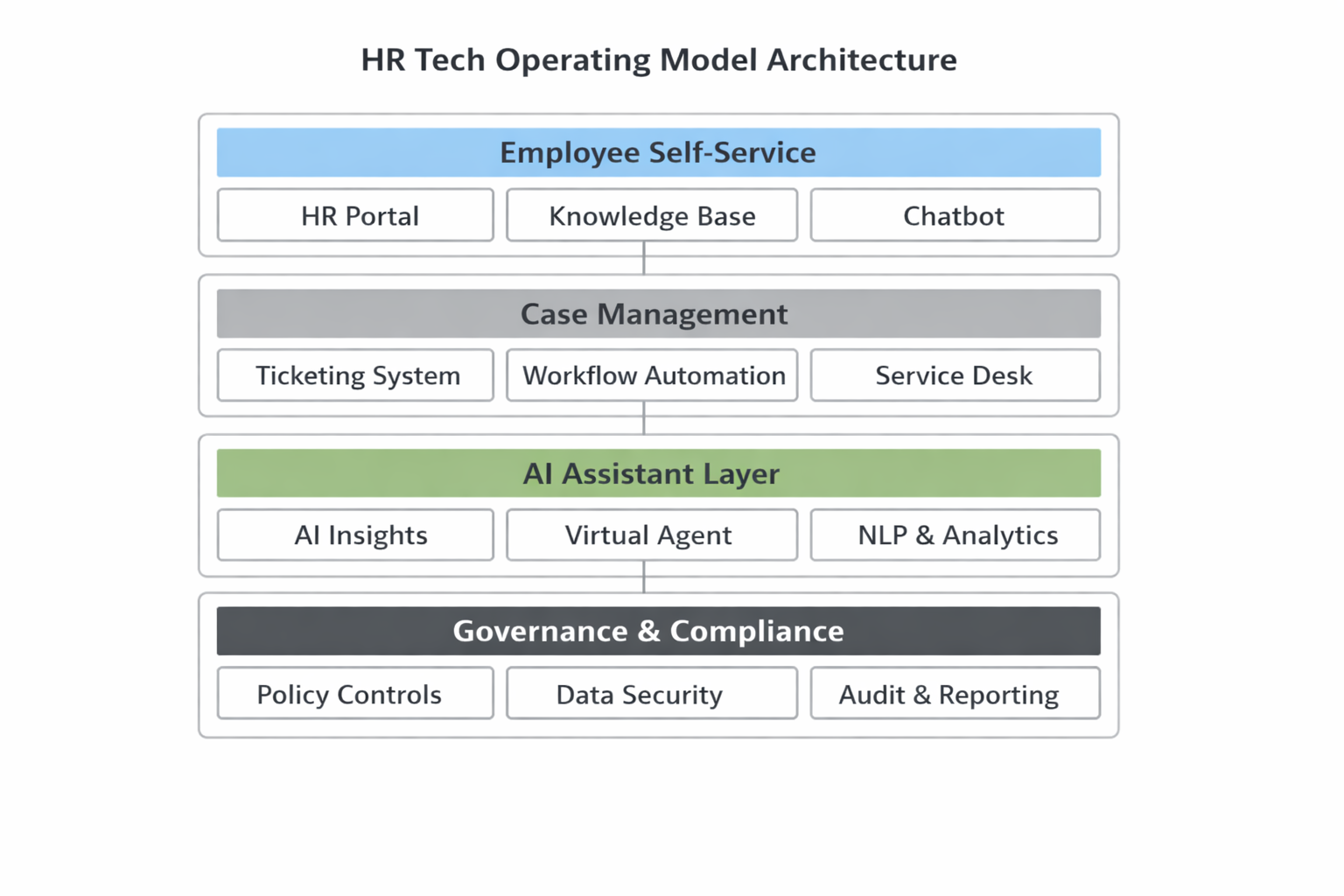
6. Use Data as an Operational Dashboard
If HR technology is a living operating model, then data is the dashboard that tells you whether it is healthy. Too many organizations measure launch success with a checklist: system live, integrations complete, training delivered. Those measures matter, but they do not tell you how the system is performing in the real world.
An operational dashboard should focus on outcomes. Adoption metrics show whether people are using the right channels. Cycle time shows whether workflows are faster or slower than before. Data quality reveals whether records are reliable enough for payroll, reporting, and compliance. Case deflection shows whether self-service and knowledge are actually reducing support demand. Payroll exception rates reveal whether upstream process issues are creating downstream risk. Manager satisfaction tells you whether the system helps or hinders day-to-day leadership. Deloitte’s 2026 reports repeatedly emphasize the need for measurable impact, not just experimentation, and for processes that produce auditable outcomes. (deloitte.com)
The most useful dashboards combine leading and lagging indicators. Leading indicators help you intervene early, before employees experience pain. Examples include incomplete submissions, abandoned workflows, repeated searches for the same knowledge article, or spikes in ticket routing to a specific queue. Lagging indicators show the actual business effect, such as time to resolve cases, time to complete onboarding, or payroll correction volume.
A good dashboard should also be segmented. Overall averages can hide serious problems in a single region, business unit, or employee population. For instance, one group may have excellent self-service adoption while another relies heavily on manual workarounds. If you only look at enterprise averages, you will miss the friction. The best HR operators use the dashboard in regular governance meetings and tie trends to action items. If the data does not change decisions, it is just reporting.
7. Managing AI and Automation Responsibly
AI can make HR technology feel dramatically more helpful, but it also introduces new risk. The central question is not whether to use AI. It is where AI adds value safely, and where human judgment must remain in the loop.
In HR, copilots are often useful for search, summarization, guided navigation, and drafting routine responses. Agents can be useful for repetitive multi-step tasks, such as routing a request, checking prerequisites, or assembling a case package. But human review remains essential whenever the outcome affects pay, eligibility, compliance, employment status, sensitive personal data, or exception handling. Deloitte’s 2026 reporting makes a strong point that enterprise processes require deterministic, auditable outcomes. Gartner’s 2025 and 2025–2026 research also shows that governance maturity remains a major barrier as agentic AI spreads. (deloitte.com)
Responsible AI management in HR should answer five questions:
What use cases are approved?
What data can the AI access?
When must a human review the output?
How are errors detected and corrected?
Who approves changes to the model, prompt, workflow, or policy?
This is especially important because HR data is often highly sensitive. Even helpful automation can create problems if it exposes information too broadly, makes assumptions about intent, or sends a worker down the wrong path. Governance therefore has to cover not only compliance and security, but also the employee experience. That is a theme echoed in Gartner’s HR AI commentary and Deloitte’s work on agentic governance. (gartner.com)
The smartest organizations are not trying to automate everything. They are deciding where automation should create speed, where it should reduce error, and where it should hand off to a person. That balance is what makes AI sustainable in HR rather than simply impressive in a demo.
8. Continuous Improvement Cadence: Make Optimization a Habit
A living operating model needs a rhythm. Without one, improvement becomes reactive and uneven. The most effective organizations create a cadence that is easy to maintain and visible to stakeholders.
A monthly release review is a good starting point. This meeting should look at what changed, what worked, what broke, and what needs follow-up. It should include business feedback, service center trends, and data quality signals. A quarterly process audit goes deeper, checking whether workflows still align with policy, whether controls are working, and whether any manual steps can be removed. Over time, the organization should maintain a backlog of improvements ranked by employee friction, business risk, and operational value. Deloitte’s 2026 human capital guidance supports this shift toward continual adaptation rather than one-time transformation. (deloitte.com)
The backlog should not be a dumping ground for every request. It should reflect the highest-friction employee journeys first. For example, if onboarding is causing repeated delays, that may be more valuable to fix than a cosmetic change to a dashboard. If payroll exceptions cluster around one particular workflow, that issue deserves priority because it affects trust and accuracy. If managers struggle with a recurring approval process, the solution may be redesign, not more training.
Continuous improvement works best when it is cross-functional. HR may identify the pain point, but IT may own the technical fix, payroll may validate the impact, and security may review the control implications. The cadence keeps the entire model aligned and prevents the platform from drifting away from actual business needs. In a fast-changing environment, the most valuable HR technology is the one that gets better every month.
9. Change Management After Launch
Change management does not end at go-live. In many ways, it becomes more important afterward because the real audience is no longer just the launch group. New hires join, managers rotate, policies evolve, and frontline teams need refreshers. If the organization stops communicating, the system becomes harder to use over time.
After launch, training should shift from one-time events to ongoing enablement. New hires need role-based onboarding that teaches them the workflows they will actually use. Managers need practical coaching for approvals, employee conversations, and exception handling. Communications should be refreshed whenever a workflow changes, a new feature is released, or a recurring issue is identified. Super-user communities can be especially valuable because they create local advocates who understand both the technology and the business context. Deloitte’s 2026 human capital work points to the value of continuous learning and in-the-moment support, which fits well with this approach. (deloitte.com)
This is also where organizations can reduce help-desk pressure. Many tickets are not caused by unwillingness to learn; they are caused by people forgetting infrequent tasks. A short refresher video, an improved knowledge article, or a guided workflow can often solve more than a formal training session. For managers, timing matters. Training that is delivered months before a process is used will not stick. Just-in-time support is usually more effective.
The best change management after launch is light, frequent, and targeted. It respects people’s time while reinforcing the behaviors the new operating model depends on. In that sense, communication is not a campaign. It is part of the service.
10. A 90-Day and 12-Month Roadmap
A practical roadmap helps organizations move from stabilization to optimization without losing momentum. The first 90 days should focus on control, clarity, and quick wins. The next 12 months should focus on redesign, governance maturity, and scaling the value of the platform.
In the first 90 days, prioritize stability. Confirm ownership, monitor help-desk volume, fix high-impact defects, and clean up data issues that could affect payroll or reporting. Review the most common employee journeys and identify where users get stuck. Tighten knowledge articles and escalation paths. Validate which AI or automation features are genuinely helping and disable anything that creates confusion or risk. The objective is to build confidence in the operating model before expanding it.
Over 12 months, shift toward optimization. Redesign the most painful workflows, strengthen governance, and establish a recurring improvement cadence. Expand self-service where it clearly reduces friction. Introduce AI thoughtfully, with clear guardrails and human oversight. Use dashboards to prioritize changes based on impact, not anecdote. If a new release creates measurable value, scale it. If it creates confusion, revise it. Deloitte’s 2025–2026 research suggests that organizations are increasingly expected to operationalize AI and digital capability rather than merely deploy tools, which makes this roadmap especially relevant. (deloitte.com)
A simple way to structure the roadmap is:
0–30 days: stabilize support and fix critical issues
31–90 days: improve adoption, data quality, and service design
3–6 months: streamline top pain points and strengthen governance
6–12 months: scale automation, refresh training, and expand continuous improvement
The point is not to finish the roadmap. The point is to create a repeatable way of improving the operating model over time.
Conclusion: The New Measure of Success
HR technology no longer succeeds because it goes live smoothly. It succeeds because it becomes a dependable part of how the organization operates every day. That requires clear ownership, trustworthy service, disciplined metrics, responsible AI governance, and an improvement cadence that continues long after launch.
The shift from project to operating model is more than a process change. It is a mindset change. Instead of asking whether the implementation is complete, leaders ask whether the experience is getting better, whether the data is becoming more reliable, whether employees trust the service, and whether AI is being used in ways that are both helpful and safe. That is the difference between a system that is installed and a capability that lives.
Key takeaways:
Go-live is the beginning of operational management, not the end.
AI and agentic workflows raise the bar for speed, governance, and employee experience.
Adoption problems show up in workarounds, ticket volume, and data quality before they show up in formal complaints.
Ownership must move from project teams to product, process, service, and control owners.
Continuous improvement and post-launch change management are essential to long-term value.