
Beyond AI-Washing: How to Evaluate Enterprise Software That Actually Delivers
September 4, 2026
Enterprise software is in the middle of a major reset. Nearly every vendor now claims some kind of AI capability, but not every “AI-powered” product is meaningfully better than the software buyers already had. Some tools simply repackage old rules-based automation with a new label. Others offer useful embedded intelligence but stop short of true decision support. And a smaller group can genuinely improve operational outcomes when the data, governance, and workflow fit are right.
That’s why enterprise buyers need a more disciplined evaluation lens in 2026. The goal is no longer to ask, “Does it have AI?” The better questions are: What business problem does it solve? What data does it need? How does it behave when things get messy? Can it be governed safely? And does it produce measurable value in the real world, not just in a polished demo?
This guide walks through a practical way to separate AI marketing from AI substance. It is designed for buyers, operators, and business leaders who need to evaluate enterprise software on outcomes, risk, and readiness rather than buzzwords. Along the way, it references current governance frameworks such as NIST’s AI Risk Management Framework and ISO/IEC 42001, which organizations can use to think more rigorously about trustworthy AI. (nist.gov)

1. Why the enterprise AI market feels crowded
The enterprise AI market feels crowded because “AI” has become a default claim in software marketing. Vendors know that buyers want efficiency, better decisions, and lower operating costs, so they attach AI language to dashboards, search boxes, workflow rules, and chat interfaces. The result is a market where almost every product sounds transformative, even when the actual capability is modest.
There are two reasons this creates confusion. First, many AI features are not equally valuable. A product that can summarize a document is useful, but it is not the same as a system that detects risk, recommends next steps, or automates a complex workflow. Second, many demos are optimized to look impressive under ideal conditions. They can conceal the real questions buyers care about: How often does the model fail? What data does it require? How expensive is it to maintain? What happens when a human must intervene?
A more disciplined lens helps buyers avoid paying for novelty instead of outcomes. NIST’s AI Risk Management Framework was designed to help organizations manage AI risks and promote trustworthy use of AI systems, while ISO/IEC 42001 gives organizations a structured management-system approach to AI governance. Those standards are not procurement checklists by themselves, but they are useful reminders that AI should be evaluated as an operational capability, not a marketing feature. (nist.gov)
The practical takeaway is simple: ignore the label and examine the function. If a vendor says “AI,” ask what kind of AI, what job it performs, and what business result it affects. If those answers are vague, the product is probably still in the hype stage.
2. Start with the business problem, not the feature list
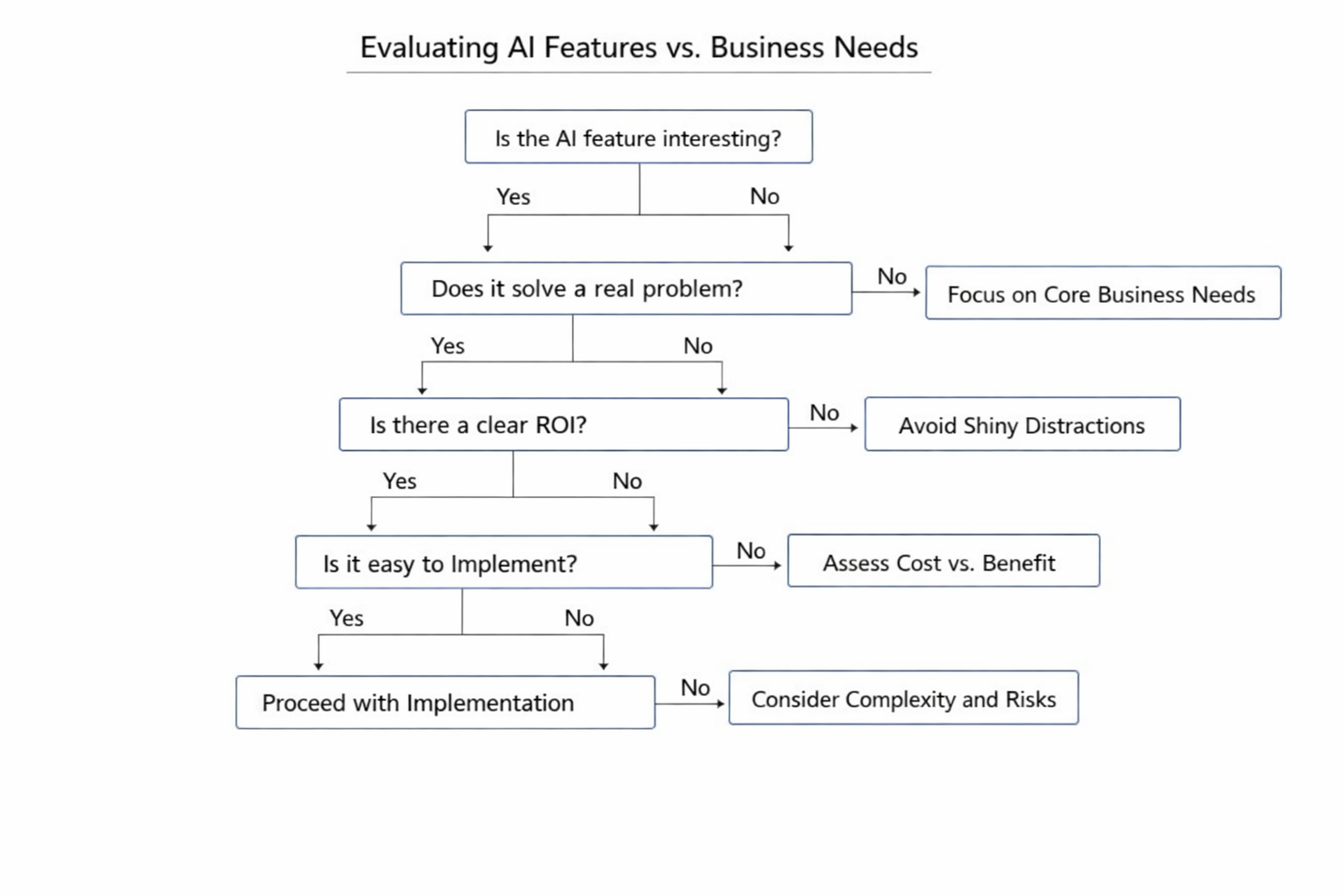
A strong AI evaluation starts with the workflow, not the vendor demo. Too many software purchases begin with a feature comparison sheet: natural language search, predictive scoring, AI copilot, agentic automation, and so on. But feature lists don’t tell you whether the software fits the real pain point. The right starting point is to define the business problem in operational terms.
For example, instead of saying “We need AI in procurement,” define the actual bottleneck: vendor intake is slow, contract review is repetitive, compliance checks are inconsistent, or purchase approvals take too long. Then quantify the cost of that problem. How many hours are spent per case? How often do errors create rework? What does delay cost the business? Which teams are affected? Once you define the workflow and the outcome, AI becomes a tool to support that process rather than a shiny object.
This also changes how you evaluate demos. A demo should not just show that the system can answer questions. It should show whether the tool improves a measurable step in the workflow: shorter cycle time, fewer manual touches, faster issue resolution, or better exception handling. NIST’s AI RMF emphasizes operationalizing trustworthiness considerations across design, development, deployment, and use, which aligns well with a workflow-first approach. In other words, the buyer should treat AI as a business system with performance requirements, not as a feature buffet. (nist.gov)
A useful framing question is: “What would have to be true for this AI capability to be worth paying for?” If the answer is tied to real workflow outcomes, you are on solid ground. If the answer is “it looks modern,” the business case is weak.
3. Separate embedded AI from true decision support
Not all “AI” is the same. In enterprise software, it helps to distinguish four levels: cosmetic AI, automation, predictive intelligence, and agentic capabilities.
Cosmetic AI is the lightest layer. This includes chat interfaces, search enhancements, summarization buttons, or content generation features that make a product feel current. These features can save time, but they often do not change core decision-making.
Automation goes further by executing repetitive tasks based on rules or patterns. A system might route tickets, populate forms, or trigger follow-up actions. This can reduce manual work, but the logic is usually narrow and deterministic.
Predictive intelligence is more meaningful. Here, AI helps estimate risk, prioritize actions, flag anomalies, or recommend next-best steps. This can support better decisions because the software is not just formatting information; it is analyzing data and surfacing likely outcomes.
Agentic capabilities are the most advanced and the hardest to trust. These systems attempt to complete multi-step tasks on a user’s behalf, often across applications. In theory, they can reduce labor dramatically. In practice, they require strong guardrails, excellent data access, and robust oversight because errors can compound quickly.
The reason this distinction matters is that many vendors blur the lines. A summarization tool may be marketed like a decision engine. A workflow automation product may be sold as if it were an autonomous agent. Buyers should ask what the system actually does, where human judgment still enters the process, and how much risk is introduced if the system is wrong.
This is where governance frameworks matter again. NIST highlights secure, resilient, privacy-enhanced trustworthiness characteristics, and ISO/IEC 42001 focuses on structured management of AI across the organization. Those ideas are especially relevant when evaluating whether a product is merely assistive or genuinely decision-supporting. (nvlpubs.nist.gov)
A simple rule: if the product’s AI can only help you read information faster, it is embedded AI. If it helps you decide faster and act more accurately, it is decision support.
4. Ask whether the data foundation is ready
AI software is only as useful as the data behind it. This is one of the most important truths in enterprise buying, and one of the most overlooked. Many AI projects fail not because the model is weak, but because the underlying data is incomplete, inconsistent, inaccessible, or poorly integrated.
Before buying, assess whether the vendor’s system can actually reach the data it needs. That means looking at data quality, access controls, lineage, and integration depth. If data is duplicated across systems, if key fields are missing, if permissions are messy, or if the AI can only see a shallow export rather than the live operational system, the promise of smart automation will quickly run into reality.
Data quality matters because AI can amplify bad inputs. Access controls matter because enterprise AI often touches sensitive information, so not every user should see the same records or outputs. Lineage matters because buyers need to know where a model’s answer came from, especially when the output informs a financial, legal, HR, or compliance decision. Integration depth matters because surface-level connectors are not enough if the process spans CRM, ERP, document systems, ticketing platforms, and identity layers.
This is also where the distinction between a demo and a deployed system becomes clear. A demo can use clean sample data. A real implementation must handle legacy data, incomplete records, exceptions, and business-specific logic. The more embedded the AI is in day-to-day operations, the more important it becomes to verify the quality of the data pipeline and the strength of the system integrations.
NIST explicitly links trustworthy AI with security, resilience, and privacy, and points organizations toward broader standards such as the NIST Cybersecurity Framework and Privacy Framework. That is a strong signal that data foundation is not a side issue; it is a prerequisite for useful AI. (nvlpubs.nist.gov)
5. Evaluate governance and risk posture
Governance is where AI purchases succeed or fail over time. A product can look brilliant in a pilot and still be dangerous in production if it lacks transparency, auditability, or human oversight. Buyers should therefore evaluate not just what the tool does, but how it is controlled.
Start with model transparency. Can the vendor explain what the system is optimized to do? Can it describe the data sources, training assumptions, and known limitations? Are outputs explainable enough for business users and auditors? Transparency does not require revealing every trade secret, but it does require meaningful clarity about behavior and boundaries.
Next, examine auditability. Can the system log inputs, outputs, user actions, and model changes? Can you reconstruct why a recommendation was made? This matters in regulated environments and any workflow where accountability is important.
Human oversight is another essential question. Does the tool allow review and approval before action? Are escalation paths built into the process? What happens when the model is uncertain, when it encounters conflicting data, or when it produces a potentially harmful suggestion?
Privacy and security also matter, especially when personal or sensitive business information is involved. Buyers should ask how data is segregated, retained, encrypted, and used for model improvement. They should also ask whether the vendor has a clear governance structure for internal AI development and deployment.
ISO/IEC 42001 is especially relevant here because it is the first global AI management system standard and is intended to help organizations establish, implement, maintain, and continually improve an AI management system. NIST’s AI RMF likewise provides a practical framework for managing AI risks in a rights-preserving, use-case-agnostic way. Together, they show that responsible AI is not just about ethics language; it is about operating discipline. (iso.org)
In 2026, a vendor that cannot explain its governance posture is not ready for serious enterprise deployment.
6. Measure value in operational terms
Many AI vendors promise “productivity,” but productivity is too vague to drive a purchase decision. Buyers need to translate value into operational metrics that show whether the software changes work in a measurable way.
The most useful metrics are often practical and specific:
Cycle time reduction: Does the process finish faster?
Error reduction: Are there fewer manual mistakes, exceptions, or corrections?
Adoption rates: Do employees actually use the tool, or do they avoid it?
Exception handling: Can the system handle unusual cases without breaking the workflow?
Escalation efficiency: When the AI cannot decide, does it route issues appropriately?
These measures are better than generic claims because they connect the software to actual operational performance. A tool that saves two minutes per task may sound minor, but if it is used thousands of times a month, the effect can be substantial. On the other hand, a tool that claims dramatic productivity gains but creates more rework, more exceptions, or more user frustration is not delivering real value.
When possible, compare baseline performance before deployment and performance after deployment. Use a narrow pilot with a defined process, a set of representative cases, and a measurement window that captures both standard and messy scenarios. That helps you evaluate not just the average case but also the tail risk. NIST’s AI RMF encourages organizations to prioritize risks and assess trustworthiness in context, which aligns with using real operational metrics instead of vanity metrics. (airc.nist.gov)
If the vendor cannot help you define success in measurable operational terms, the AI value proposition is probably still too abstract.
7. Test the AI in messy real-world scenarios
A polished demo can hide a lot. Real enterprise work is messy: incomplete data, conflicting instructions, odd exceptions, edge cases, and users who don’t follow the ideal process. That is why serious buyers should test AI in conditions that resemble reality.
A good pilot should include questions like:
What happens when the input is incomplete?
How does the system respond to contradictory records?
Can it explain uncertainty instead of inventing an answer?
What is the escalation path when it is wrong?
How does it behave when a user asks a question outside the supported scope?
Can it handle a high-volume burst without degrading quality?
What does it do when it encounters a sensitive or risky case?
The point is not to trap the vendor. It is to understand failure modes before users rely on the system. A product that works only when the data is perfect and the question is obvious may still be useful, but it is not ready for broad enterprise dependency.
You should also test hallucination handling in generative workflows. Does the system cite sources? Does it show confidence levels? Does it refuse unsafe requests? Does it preserve human review before any outward-facing action? NIST’s Generative AI Profile specifically addresses the unique risks posed by generative AI, which is a strong reminder that language-based systems need particular scrutiny because they can generate plausible but incorrect output. (nvlpubs.nist.gov)
In practice, the best pilots feel a little uncomfortable because they include real exceptions. That discomfort is valuable. It reveals where the AI helps, where it breaks, and where humans still need to stay in the loop.
8. Assess vendor trustworthiness and roadmap realism
AI software is not just a product; it is a promise. Buyers should judge whether the vendor can sustain that promise through implementation support, update cadence, customer evidence, and a realistic roadmap.
Implementation support is often the difference between success and shelfware. Ask how the vendor handles onboarding, data mapping, workflow design, training, and change management. If the answer is mostly self-service, make sure your internal team has the capacity to fill the gaps.
Update cadence matters because AI capabilities evolve quickly. But faster is not always better. Buyers should ask how model updates are tested, how changes are communicated, and whether updates can affect downstream workflows or compliance requirements.
Customer evidence is critical. Look for use cases that resemble your own industry, scale, and complexity. A flashy reference from a different environment may not be persuasive. You want proof that the vendor can deliver value in conditions similar to yours.
Roadmap realism is the final filter. Many vendors talk as if every feature on the roadmap is already around the corner. A more trustworthy vendor is honest about what is shipped, what is in beta, what requires custom work, and what is still aspirational. That honesty is especially important in AI because capabilities can sound close to magical while remaining operationally immature.
It also helps to evaluate whether the vendor’s broader security and responsibility posture matches your expectations. CISA’s guidance on secure by design and secure by demand underscores that technology providers should take ownership of customer security outcomes. That principle applies well to AI vendors too: if the product touches important workflows, the vendor should be able to speak credibly about risk, resilience, and support. (cisa.gov)
A trustworthy vendor does not just sell AI. It helps you deploy AI responsibly and maintain it over time.
9. Compare build, buy, and augment options
Not every enterprise AI use case calls for the same strategy. In some cases, native AI in a platform is enough. In others, an add-on copilot, workflow automation layer, or custom model will be a better fit. The right answer depends on your business problem, data maturity, risk tolerance, and internal capabilities.
Buy native AI when the vendor already owns the workflow and the AI capability is tightly integrated into daily operations. This is often the fastest path when the use case is standard and the vendor’s implementation is mature.
Add a copilot when users need assistance, summarization, search, or drafting support, but the core system of record remains the same. This can be a low-friction way to boost productivity without redesigning the whole process.
Use workflow automation when the main benefit is routing, approvals, handoffs, or repeatable process steps. Automation can be more reliable than a generative system in structured environments.
Build custom models or logic when the use case is highly specialized, when proprietary data gives you a unique advantage, or when you need tighter control over performance and governance. This option offers more flexibility but also demands more maintenance.
The key question is not “What is most advanced?” but “What is most appropriate?” A highly autonomous system may be unnecessary if a simpler workflow improvement solves the problem with less risk. Likewise, a native feature may be too limited if your organization needs custom controls, deeper integration, or domain-specific precision.
NIST’s AI RMF and ISO/IEC 42001 both support this kind of contextual decision-making because they frame AI as something to be governed according to use case, risk, and organizational capacity. That makes them useful for deciding whether to augment existing software or invest in a more bespoke capability. (nist.gov)
10. A practical buyer scorecard for 2026
A good scorecard keeps AI buying grounded in reality. Instead of getting distracted by impressive demos, you can rank vendors on the factors that actually determine success. Here is a simple rubric you can adapt:
You can score each category from 1 to 5, then weight them if some dimensions matter more to your organization. For example, a regulated industry may assign more weight to governance and auditability, while a fast-moving commercial team may emphasize cycle time and adoption. The important thing is consistency: every vendor should be evaluated against the same rubric.
You can also use a gatekeeper approach. If a vendor fails on data readiness or governance, it may not matter how impressive the model is. Likewise, if the use case lacks a measurable business problem, the project is likely too speculative. NIST’s AI RMF and ISO/IEC 42001 both reinforce this practical mindset by treating AI as something to be managed, measured, and continuously improved rather than simply admired. (nist.gov)
Conclusion
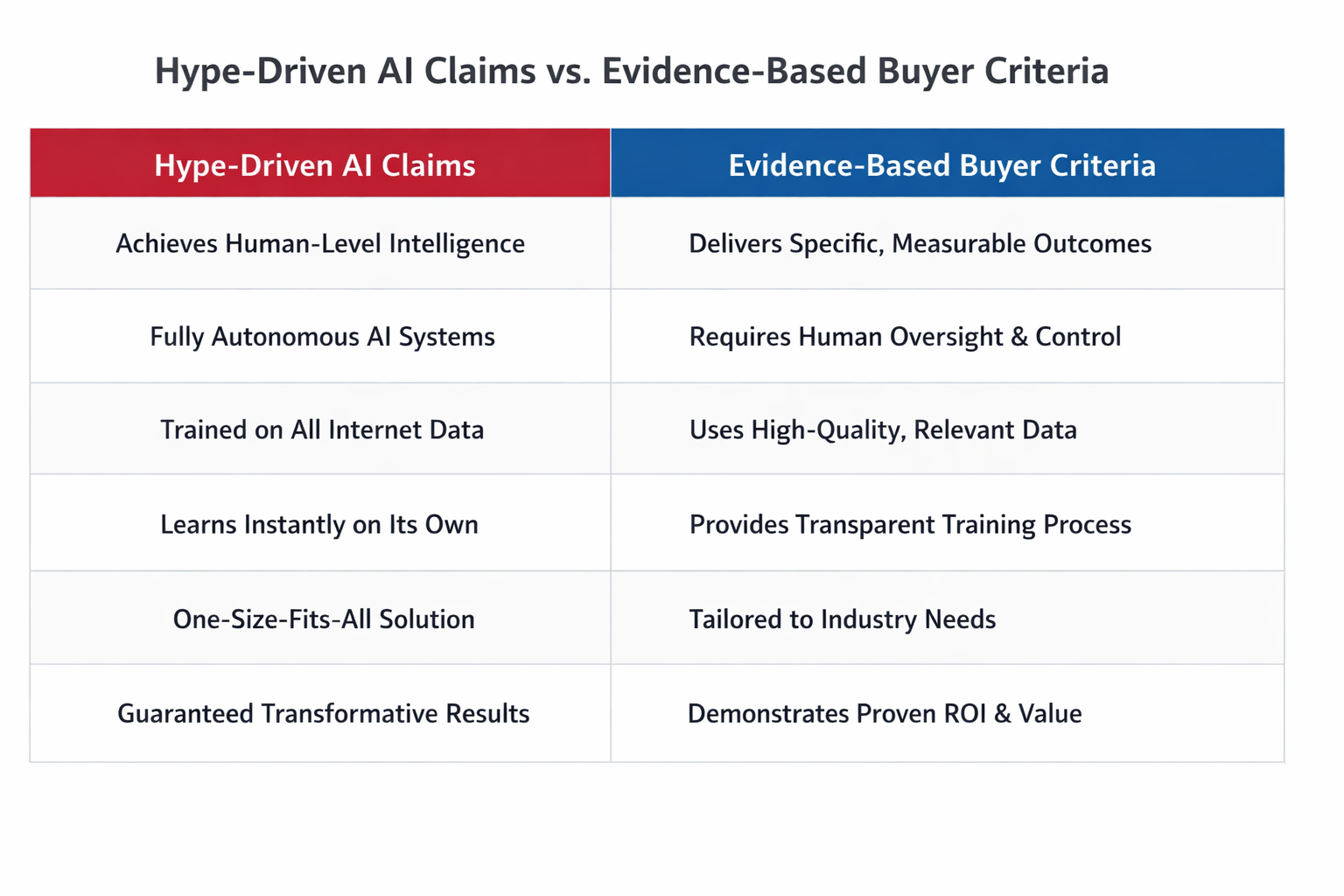
Enterprise AI is no longer scarce, but trustworthy and useful AI still is. The fact that a software product includes AI features does not mean it will improve your business. To separate real value from AI-washing, buyers should focus on the problem being solved, the quality of the data foundation, the strength of governance, and the ability to prove value in operational terms.
The best vendors will not just talk about intelligence. They will show how their product fits a real workflow, how it behaves under stress, how it protects users and data, and how it delivers measurable outcomes. Standards such as ISO/IEC 42001 and frameworks such as NIST’s AI RMF are useful because they remind organizations that AI is not merely a feature category; it is an operating capability that deserves rigor.
If you approach enterprise AI with a business-first mindset, a governance lens, and a willingness to test in messy conditions, you will be much better positioned to choose software that actually delivers.