
Architecture Review Checklist for Early-Stage Startups: A Practical 2026 Guide
July 1, 2026
Early-stage startups live in a constant tradeoff: ship quickly, stay lean, and avoid architectural choices that become expensive to reverse later. A good architecture review is not about overengineering or “perfect” design. It is about making a few high-impact decisions deliberately so the team can move fast without creating hidden risk, runaway cloud bills, or a future rewrite. Cloud architecture guidance from AWS emphasizes the classic balance of operational excellence, security, reliability, performance efficiency, cost optimization, and sustainability, while NIST’s cybersecurity guidance frames the problem as managing risk rather than checking boxes. (docs.aws.amazon.com)
For startups, this means architecture review should answer practical questions: What are we trying to prove in the next 3–6 months? What must stay simple? What failure modes are unacceptable? Where do we need guardrails now, and where should we deliberately defer complexity? The sections below provide a practical checklist you can use for a pre-launch or early-growth architecture review, whether you are building on a monolith, a modular monolith, microservices, event-driven workflows, or a web-queue-worker setup. Martin Fowler’s work remains a useful reference point here: microservices can improve independence and scaling, but they also add coordination and operational overhead that early teams often underestimate. (martinfowler.com)
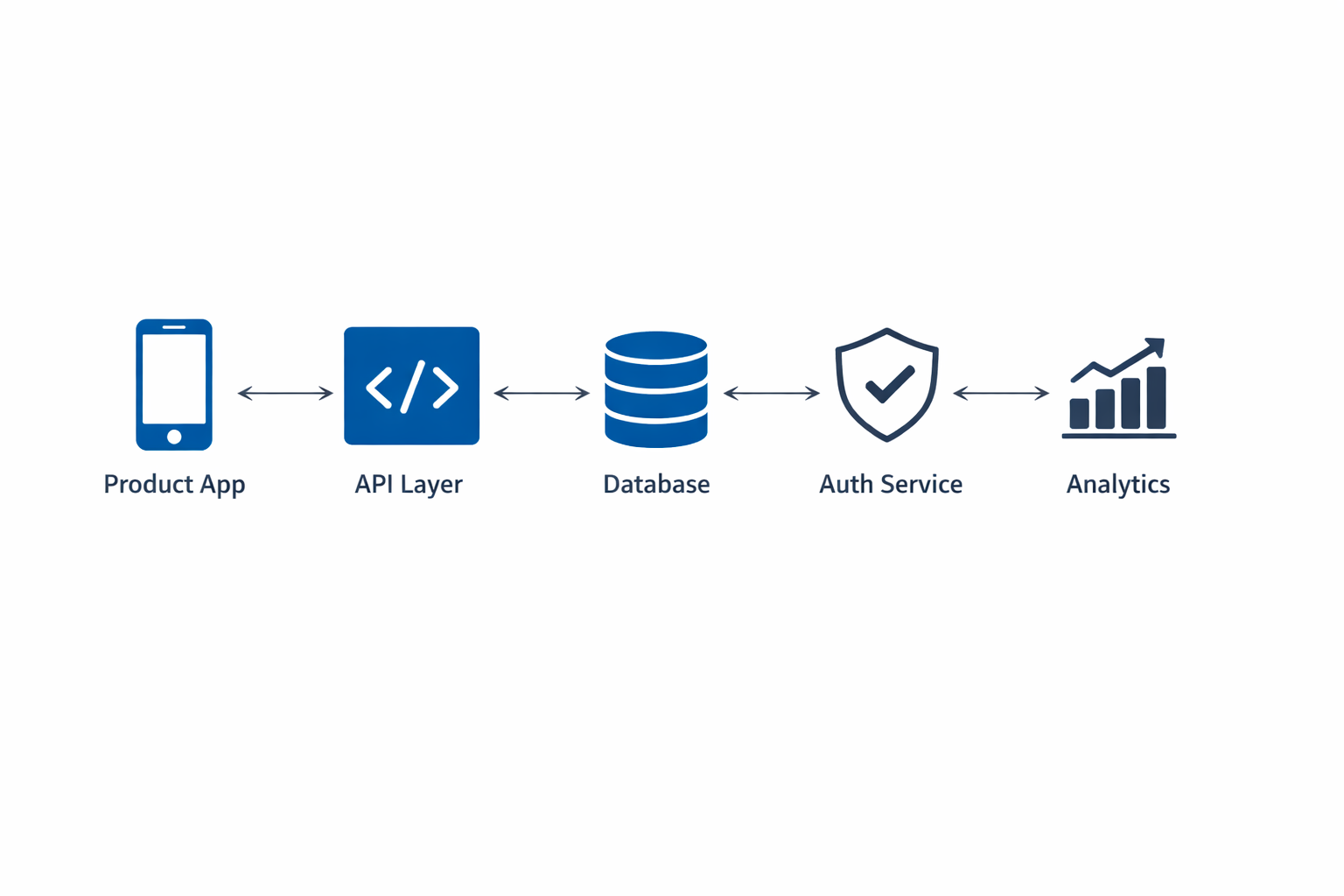
1. Why early-stage startups need an architecture review: balancing speed, cost, risk, and future change
An architecture review at the startup stage is less about “enterprise architecture” and more about preventing avoidable regret. When teams are small, architecture decisions often happen implicitly: the first service boundary becomes a product boundary, the first database becomes the system of record, and the first deployment pattern becomes the default forever. That can be fine if the team is intentional, but dangerous if the design is driven only by speed. AWS’s Well-Architected guidance is useful here because it explicitly connects architecture with reliability, security, performance, and cost rather than treating those concerns separately. (docs.aws.amazon.com)
The biggest early-stage mistake is assuming that “simple” means “no architecture.” In practice, every startup already has an architecture; the question is whether it is documented, reviewable, and aligned to the business. If you are about to launch, the review should identify which decisions are reversible and which are not. Examples of hard-to-reverse choices include database schema ownership, authentication strategy, cloud account structure, and third-party dependencies that become foundational to the product. NIST’s cybersecurity framework reinforces the idea that organizations should manage cybersecurity risk in a structured way, which is especially important when product pressure can otherwise push security and resilience into “later.” (nist.gov)
A practical startup review also creates shared language across founders, product, engineering, and operations. Instead of debating “microservices versus monolith” in the abstract, the team can ask: does the current architecture support the next launch milestone, the expected user growth, and the level of operational maturity the team can actually sustain? If the answer is yes, the design is probably good enough. If the answer is no, the review surfaces the gap before it becomes a production incident or a rewrite. (martinfowler.com)
2. Define the business goals first: product priorities, launch timelines, user growth assumptions, and measurable outcomes
An architecture review should always start with the business problem, not the diagram. A startup system should be designed around the product’s immediate priorities: what is being launched, what customer problem it solves, and what “success” looks like in measurable terms. For example, if the near-term goal is to validate product-market fit, the architecture should optimize for iteration speed, low operational overhead, and safe change. If the goal is to onboard a large pilot customer with strict security requirements, then access control, auditability, and environment separation may matter more than raw development velocity. AWS’s framework is explicit that architecture should support expectations and requirements, not become an end in itself. (docs.aws.amazon.com)
A useful checklist starts with four business questions. First, what are the top product priorities for the next quarter? Second, what is the launch timeline, and which dates are fixed versus flexible? Third, what growth assumptions are realistic: dozens of users, thousands, or much more? Fourth, what outcomes will prove the architecture is working—activation rate, latency, uptime, time-to-deploy, or cost per customer? These answers influence every technical decision that follows. A system that needs to support a fast experiment cycle should not be built like a regulated banking platform, and a system expecting low but spiky usage should not be overbuilt for constant enterprise-grade traffic. (docs.aws.amazon.com)
This section should also define explicit non-goals. Startups often benefit from saying, “We are not optimizing for multi-region active-active recovery yet,” or “We are not splitting this into five services before launch.” That is not a sign of weak architecture; it is a sign of prioritization. When the business goal is learning, architecture should reduce friction. When the business goal is trust, architecture should increase confidence. The review is successful when it makes those tradeoffs visible and agreed upon. (nist.gov)
3. Choose the right architecture style: monolith, modular monolith, microservices, event-driven, or web-queue-worker
Choosing an architecture style is really choosing a set of tradeoffs. For most early-stage startups, the default answer is still “start simpler than you think.” A monolith can be the right choice when the team is small, the product is still changing rapidly, and the cost of distributed systems would slow down learning. A modular monolith is often an even better compromise: it preserves a single deployable unit while creating clearer internal boundaries for future scaling or extraction. Martin Fowler’s articles on microservices emphasize that the style is about independently deployable services and operational independence, but they also implicitly show that the move to microservices is a major organizational and technical shift, not a cosmetic refactor. (martinfowler.com)
Microservices are appropriate when multiple teams need to deploy independently, scaling needs differ sharply across components, or the product has distinct bounded contexts that are already stable enough to separate. But for a startup, that only helps if the team can also handle the added operational burden: service discovery, observability, network failures, API versioning, and deployment coordination. In many cases, the first “microservices” design ends up being a distributed monolith with higher latency and more failure points. (martinfowler.com)
Event-driven architectures and web-queue-worker models are often underappreciated startup patterns. They can help decouple user-facing request handling from longer-running background work, and they are especially useful for email delivery, file processing, billing jobs, data enrichment, and AI tasks. The key is to use events and queues to isolate latency and failures, not to create complexity for its own sake. A lightweight heuristic is: if a synchronous request is becoming slow, unreliable, or expensive because of downstream work, move that work behind a queue or event. If the system is still small and one service can safely own the process end-to-end, keep it simple. (docs.aws.amazon.com)
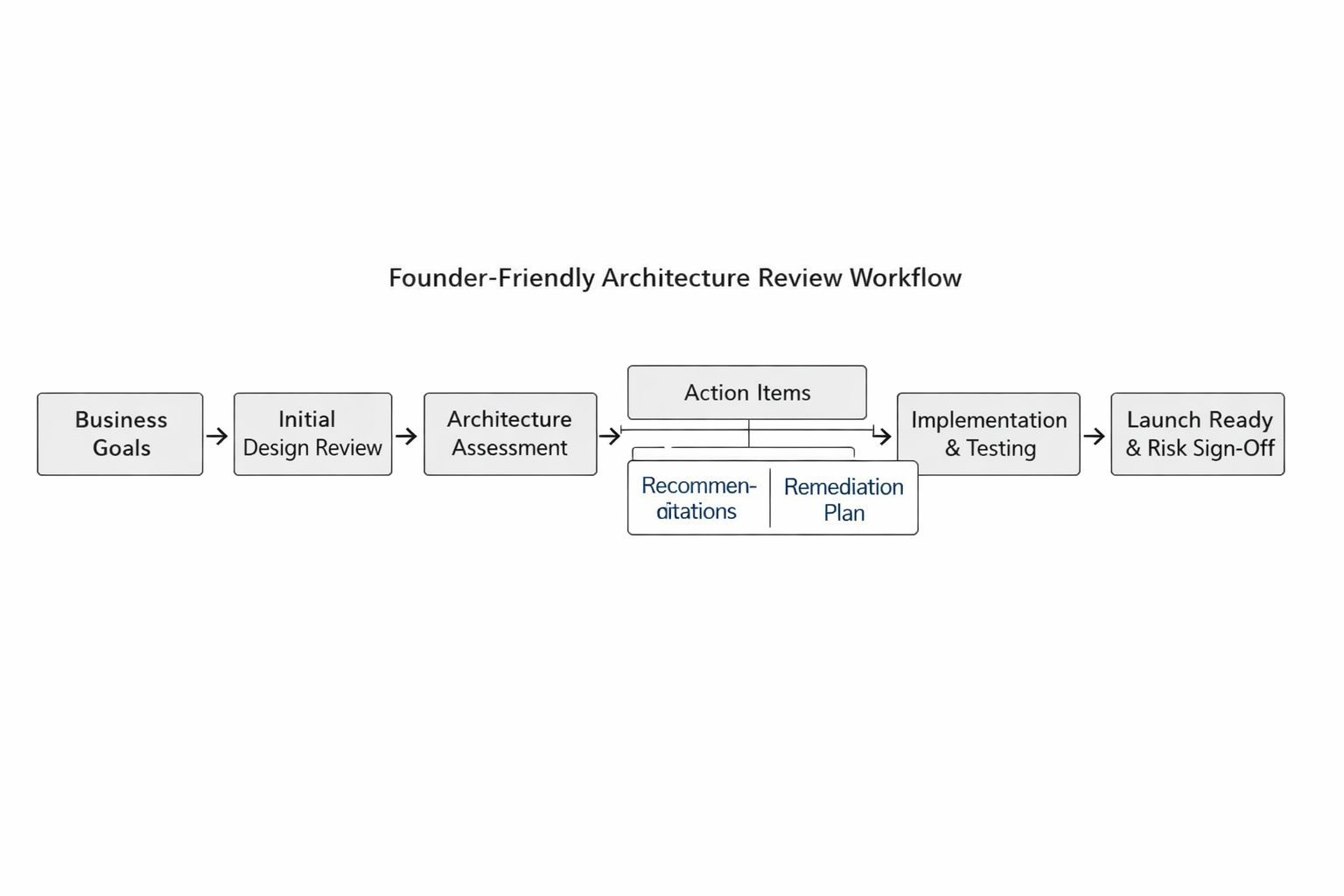
4. Core system design checks: service boundaries, data ownership, API contracts, failure isolation, and integration patterns
Once the style is chosen, the review should test whether the design actually behaves like that style. Service boundaries are the first check. Ask whether each component has a clear purpose, a single main responsibility, and a rationale that matches the product domain rather than the org chart. Boundary mistakes are common when teams split by technical layers instead of business capability. A well-chosen boundary reduces coordination overhead, while a poor boundary creates cross-service chatter and confusing ownership. Fowler’s guidance on microservices repeatedly stresses the importance of clear service independence and careful integration, which is just as relevant for modular monoliths and event-driven systems. (martinfowler.com)
Data ownership is the second major check. Every important dataset should have a single system of record, even if other services cache or project it. Shared databases are convenient early on, but they make change harder and blur accountability. The review should ask: who owns each table or dataset, who can write to it, and how are schema changes introduced? The goal is not zero coupling—it is controlled coupling. Similarly, API contracts should be explicit and versioned when needed. A startup can often move fast with simple internal APIs, but contract drift becomes costly once multiple clients depend on the same interface. (martinfowler.com)
Failure isolation is the third check. The architecture should not allow one broken dependency to take down the entire product if that can be avoided. This is where circuit breakers, retries with backoff, timeouts, bulkheads, queue-based buffering, and graceful degradation matter. Integration patterns should be intentional as well: synchronous calls are good for immediate user feedback, while asynchronous jobs and events are better for slow or failure-prone tasks. If a system needs to stay responsive when a downstream provider is unavailable, the architecture should make that behavior possible by design, not by luck. AWS’s reliability and performance guidance supports this kind of fault-aware design. (docs.aws.amazon.com)
5. Cloud and infrastructure review: environment setup, deployment model, scalability paths, observability, and disaster recovery
Cloud architecture reviews for startups should focus on simplicity and repeatability. The first question is whether development, staging, and production environments are clearly separated. Even if the stack is small, environment separation reduces the chance of testing changes in the wrong place and helps establish basic release discipline. The second question is deployment model: how does code move from source control to production, who approves it, and what is the rollback path? A startup does not need a heavyweight release process, but it does need a reliable one. AWS’s Well-Architected guidance highlights operational excellence and reliability as core pillars, which maps directly to deployment safety and runtime recovery. (docs.aws.amazon.com)
Scalability paths should be reviewed before the first growth spike, not after. The question is not whether the system can handle infinite load; it is whether the team understands the next bottleneck and has a plan for it. That may mean autoscaling application instances, moving heavy jobs to a queue, using managed databases, adding read replicas later, or caching expensive queries. For a startup, the right path is usually the one that minimizes bespoke infrastructure while preserving a clear upgrade path. Managed services often win here because they reduce undifferentiated operational work and let the team focus on product. (docs.aws.amazon.com)
Observability is another must-have. The review should verify that logs, metrics, traces, and alerts cover the critical user journey and key infrastructure components. If a request fails, can the team see where and why? If latency rises, can they tell whether the database, queue, external API, or application code is responsible? Disaster recovery should also be proportionate to risk: startups often do not need sophisticated multi-region setups, but they do need backups, restore tests, and a documented minimum recovery plan. A disaster recovery plan that has never been tested is not really a plan. (docs.aws.amazon.com)
6. Security and compliance checklist: identity/access control, secrets management, data protection, logging, and basic governance
Security in an early-stage startup should be pragmatic, not performative. The review should start with identity and access control: who can access production, who can deploy, who can read customer data, and how are privileges granted and revoked? NIST’s Cybersecurity Framework explicitly includes identity management, authentication, and access control as core protective measures, reinforcing that access restriction is a foundational control rather than an advanced one. (nist.gov)
Secrets management is another basic requirement. API keys, database credentials, signing keys, and tokens should not live in source code or be casually shared in chat tools. The startup should use a secure mechanism for storing and rotating secrets, even if the process is simple at first. Data protection should include encryption in transit, encryption at rest where appropriate, and a clear classification of sensitive data. The review should also ask whether personal data is minimized, whether retention rules exist, and whether backups are protected as carefully as primary systems. NIST’s privacy guidance is useful here because it frames data processing risks in terms of potential harms to individuals, not only compliance obligations. (nist.gov)
Logging and governance complete the baseline. The system should record security-relevant events such as logins, permission changes, deployment actions, and access to sensitive resources. Logs should be useful for investigation without exposing unnecessary sensitive data. Basic governance can be lightweight: defined owners for systems and data, a short approval process for production changes, and a clear incident response path. For startups, compliance is often about proving discipline rather than building bureaucracy. If you have a customer in a regulated industry, the bar may rise quickly, so the architecture review should identify those obligations early rather than treat them as future work. (nist.gov)
7. Cost and operational efficiency review: spend visibility, autoscaling, managed services, and avoiding premature complexity
Cost review should be part of architecture review from day one. Cloud bills are easy to underappreciate when the company is small and usage is low, but inefficient defaults scale quickly. AWS’s framework explicitly treats cost optimization as a first-class pillar, and its guidance on cost focus areas includes expenditure and usage awareness, resource cost-effectiveness, and demand-and-supply management. (docs.aws.amazon.com)
The first step is spend visibility. The startup should know where money is going by environment, service, and workload type. Cost alerts, tagging, and regular review of the largest line items help prevent surprises. The second step is autoscaling and right-sizing. If traffic is variable, the system should scale with demand rather than paying for peak capacity all the time. Managed services often reduce operational labor and failure risk, but they still need review because convenience can hide costs. A managed database, queue, or cache may be cheaper overall than self-hosting when engineering time is considered, but only if the service is sized correctly and usage is tracked. (docs.aws.amazon.com)
The review should also explicitly look for premature complexity. Some costs are financial, while others are operational: too many services, too many moving parts, or too many custom scripts that only one engineer understands. A startup should prefer designs that are cheap to run and cheap to change. The hidden cost of clever architecture is maintenance burden. If a simpler option meets the current goal, the architecture review should favor that option unless there is a clear and immediate reason not to. That principle aligns with the Well-Architected emphasis on balancing functional requirements with stable, efficient systems. (docs.aws.amazon.com)
8. AI and developer-tooling considerations: where AI coding tools fit, human review requirements, and quality guardrails
AI coding tools can be a productivity multiplier for startups, but they should be treated as assistants, not authorities. In 2026, many teams use AI to accelerate scaffolding, test generation, documentation drafts, refactoring, and exploratory implementation. The architecture review should ask where these tools are helpful and where they are risky. They are especially useful for repetitive code, boilerplate, and first-pass prototypes. They are less trustworthy for security-sensitive code, cross-service behavior, unusual edge cases, and business logic where correctness matters more than speed. NIST’s cybersecurity guidance and privacy framework both reinforce the idea that risk management must remain human-led, even when automation is involved. (nist.gov)
Human review is non-negotiable for anything that reaches production. That means pull requests, tests, static checks, and ownership review should remain part of the process regardless of how the code was generated. AI can produce plausible but wrong code, and the risk increases when developers paste outputs directly into critical paths without understanding them. A good architecture review sets guardrails: which repositories can use AI-generated code, what must be reviewed manually, what security checks must pass, and which patterns are banned outright. This is particularly important for authentication flows, permissions logic, payment code, and data processing pipelines. (nist.gov)
A startup should also think about developer experience as part of architecture. If AI tools shorten the path from idea to code, the rest of the system must still support quality: clear interfaces, reliable tests, predictable environments, and readable documentation. Otherwise, the team may create more code faster than it can safely understand. The right question is not “Should we use AI tools?” but “Where do they improve throughput without weakening control?” If the answer is well-defined, AI becomes a useful part of the stack. If not, it becomes another source of architectural noise. (docs.aws.amazon.com)
9. Documentation and decision-making: architecture decision records, diagrams, review cadence, and ownership
Good architecture is not only built; it is remembered. Startups move quickly, and decisions that made sense at 5 engineers can be forgotten by 15 engineers. That is why architecture decision records, or ADRs, are so valuable. An ADR captures the problem, the options considered, the decision made, and the reason it was made. This creates a lightweight history that helps future team members avoid re-litigating old tradeoffs. In a startup, the goal is not lengthy documentation; it is durable context. (docs.aws.amazon.com)
Diagrams also matter, but they should be simple and current. A useful startup diagram usually shows major services, data stores, integrations, and trust boundaries rather than every internal class or endpoint. The architecture review should verify that the diagrams reflect reality and are understandable to product and engineering stakeholders. If the diagram is too complicated to explain in a few minutes, it is probably too complicated for a startup to maintain. Review cadence should be regular but lightweight: for example, before major launches, after major incidents, or when the team adds a new system boundary. (docs.aws.amazon.com)
Ownership closes the loop. Every major service, data store, and operational process should have a named owner. Ownership does not mean one person does all the work; it means someone is accountable for health, changes, and review. The architecture review should confirm who approves changes, who responds to incidents, and who updates the documentation when the system changes. Without ownership, architecture drifts. With ownership, the system can evolve intentionally instead of accidentally. (nist.gov)
10. A lightweight startup architecture review template: what to approve now, what to defer, and red flags that require redesign
A good startup architecture review ends with decisions, not just discussion. The template below can be used in a one-hour review and expanded as the company grows.
Approve now if:
The architecture supports the next 1–2 product milestones.
Service boundaries are clear enough for the current team size.
One system of record exists for each major dataset.
Deployment is repeatable, reversible, and owned.
Basic security controls are in place for identity, secrets, and data protection.
Logging, monitoring, and backup/restore exist at a workable minimum.
The team can explain the cost model and major scaling path. (docs.aws.amazon.com)
Defer for later if:
Multi-region resilience is not yet required by the business.
Microservices would mostly add coordination overhead.
Complex event choreography is not needed for current workflows.
Custom infrastructure can be replaced by managed services.
Advanced governance would slow down the launch without reducing a real near-term risk. (martinfowler.com)
Red flags that require redesign:
Shared databases across independently changing components.
No clear owner for production incidents or data.
Production access is broad, undocumented, or unmanaged.
The team cannot restore backups or explain the recovery path.
One integration failure can bring down the entire product.
Cloud spend is unpredictable and not visible by workload.
The architecture only works if “everyone just remembers” the rules. (nist.gov)
The most important rule is simple: approve the smallest design that safely supports the next business step. If the architecture is aligned with the product, understandable by the team, and resilient enough for the current risk level, it is probably ready. If it depends on hope, heroics, or undocumented conventions, the review should pause the launch or trigger a redesign. That discipline is what keeps a startup fast over time, not just fast in the moment. (docs.aws.amazon.com)
Conclusion
Early-stage startups do not need perfect architecture. They need deliberate architecture. A practical review helps founders and engineers align technical choices with business goals, choose the right level of complexity, and avoid expensive rework later. The best outcome is not a sophisticated diagram; it is a system the team can build, operate, secure, and evolve with confidence.
If you remember only a few things, remember these: start from business goals, keep the architecture as simple as the current stage allows, give data and service ownership clear boundaries, build in basic security and observability from day one, and document decisions so future growth does not erase today’s reasoning. That combination gives startups the best chance to move fast without breaking the foundations they will need tomorrow.