
AI ROI That Finance Leaders Can Actually Trust
August 21, 2026
Artificial intelligence is no longer a future bet. It is already in budgets, pilot programs, workflow redesigns, and board conversations. But for finance leaders, the hardest part is not deciding whether AI matters. It is proving which AI investments create real business value, which ones only create noise, and which ones should never graduate past the pilot stage. Recent research shows why this is so difficult: many organizations are still struggling to move from experimentation to scaled impact, and enterprise-level EBIT gains remain much less common than use-case-level benefits. (mckinsey.com)
That gap matters because AI value is often talked about in the language of excitement, not the language of finance. Teams celebrate prompt usage, time saved, number of chats, or model calls completed. Those are not useless metrics, but they are not ROI. Finance leaders need a measurement system that connects AI activity to operational performance, customer outcomes, workforce productivity, and risk reduction — all while accounting for the hidden costs that appear after the pilot demo. This post lays out a practical framework for doing exactly that, with a focus on metrics finance teams can defend, revisit, and scale with confidence. (deloitte.com)
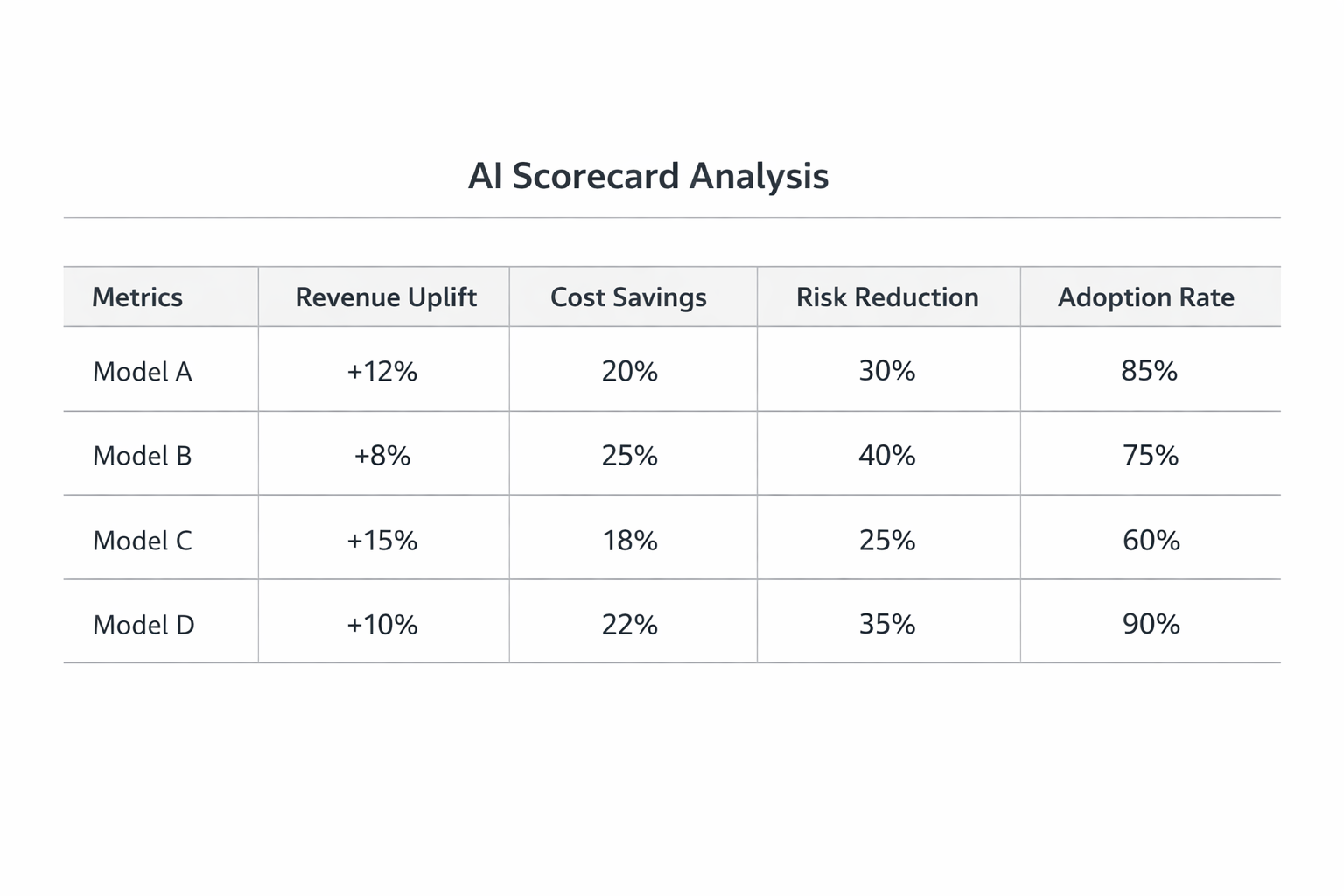
1. Why AI value is harder to measure than traditional software investments
Traditional software investments are usually easier to measure because the cause-and-effect chain is more direct. If you buy a billing platform, automate invoice routing, or add a new ERP module, the expected outputs are relatively clear: fewer manual touches, lower processing time, fewer errors, or faster close cycles. AI is different. It often changes decision-making, not just task execution. It may improve a recommendation, accelerate a draft, or augment a human workflow without fully replacing the workflow itself. That makes it harder to isolate the effect of AI from other changes happening at the same time. (mckinsey.com)
There is also a timing issue. AI benefits often start as leading indicators, such as adoption, workflow time saved, or improved employee confidence, before they show up as lagging indicators like margin improvement, cost reduction, or revenue growth. Deloitte’s 2025 research shows that a meaningful share of finance leaders early in the AI journey struggle to justify ROI, and many of those challenges take a year or more to resolve. McKinsey also found that while many organizations are experimenting with AI agents, most are still not scaling enterprise-wide impact. (deloitte.com)
Finally, AI introduces uncertainty in a way traditional software usually does not. Outputs can vary. Models drift. Policies change. Data quality can be inconsistent. Because of that, the value case has to include governance, trust, and risk management from the beginning, not as an afterthought. NIST’s AI Risk Management Framework was created specifically to help organizations manage AI risks across the lifecycle, reinforcing the idea that value and risk are inseparable in AI programs. (nist.gov)
2. The biggest mistake teams make: confusing activity metrics with business outcomes
One of the most common AI measurement mistakes is mistaking activity for impact. A dashboard may show thousands of prompts submitted, hundreds of users onboarded, or a high percentage of tasks “touched by AI.” Those numbers may look impressive, but they do not automatically mean the business is better off. In fact, teams can become trapped in a false sense of progress if they optimize for usage rather than outcomes. McKinsey’s research on value capture highlights the importance of tracking well-defined KPIs tied to adoption and ROI, not just internal excitement or deployment counts. (mckinsey.com)
This problem shows up in many forms. A customer support team might report that agents used AI on 90% of cases, yet handle time may not drop and customer satisfaction may stay flat. A finance team might celebrate that analysts generated more forecasts with AI, but if forecast accuracy does not improve or decisions do not speed up, the business value remains unclear. In these situations, activity metrics are only a proxy for usage, not evidence of value. (deloitte.com)
The better approach is to define the business outcome first and then identify the activity that should move it. If the goal is faster month-end close, measure close cycle days, journal entry rework, and the number of exceptions resolved before the deadline. If the goal is fewer support escalations, measure first-contact resolution, escalation rate, and customer effort scores. If the goal is better forecasting, measure forecast error, planner hours saved, and the rate at which forecasts change after new data arrives. In other words, activity matters only when it is visibly linked to a business result. (deloitte.com)
3. A better framework: track value across financial, operational, customer, workforce, and risk dimensions
A finance-friendly AI framework should not rely on a single ROI number. AI creates value in multiple dimensions, and the point of measurement is to understand the full picture. A more durable model tracks five categories: financial, operational, customer, workforce, and risk. This creates a balanced scorecard that can handle both short-term and long-term outcomes. Deloitte’s recent tech-value research emphasizes measuring value beyond narrow ROI, while NIST’s framework reminds organizations that trustworthiness and risk must be built into evaluation. (deloitte.com)
Financial value includes hard-dollar savings, revenue lift, margin improvement, working-capital gains, and avoided costs. For example, AI might reduce labor hours in accounts payable, increase cross-sell conversion in service, or improve pricing discipline. Operational value includes cycle-time reduction, fewer errors, higher throughput, and better SLA performance. Customer value includes satisfaction, retention, response quality, and resolution speed. Workforce value includes employee productivity, time reallocated to higher-value work, lower burnout, and better talent retention. Risk value covers compliance, model safety, fraud prevention, error reduction, and governance resilience. (mckinsey.com)

The value of this framework is that it prevents overclaiming. An AI use case can be a financial win even if it does not immediately increase revenue, because it may reduce risk or free up capacity. Likewise, a customer-facing AI tool can be valuable even if its direct revenue impact is indirect, because it improves experience and reduces churn. Deloitte’s 2025 finance research also suggests that trust, collaboration, and broader organizational outcomes matter in assessing AI’s return. That is exactly why a single, simplistic ROI ratio is usually too narrow. (deloitte.com)
4. What the latest research says about AI adoption, ROI delays, and executive skepticism
The latest research paints a consistent picture: AI adoption is widespread, but scaled value is still lagging. McKinsey’s 2025 global survey found that nearly all respondents say their organizations are using AI, but most are still early in scaling AI across the enterprise, and only 39% reported enterprise-level EBIT impact. McKinsey also found that 62% of respondents said their organizations are at least experimenting with AI agents, yet the transition from pilots to scaled impact remains a work in progress. (mckinsey.com)
Deloitte’s finance research tells a similar story from a CFO’s perspective. It found that 30% of finance leaders in the early stages of AI adoption struggle with justifying ROI, compared with 21% of those further along. Deloitte also reported that 70% of those struggling with ROI need at least a year to properly resolve the issue. That is a striking reminder that AI value realization is often slower than leaders expect. (deloitte.com)
IBM’s 2025 CEO study adds another layer of skepticism. It found that only 25% of AI initiatives had delivered expected ROI over the last few years, and only 16% had scaled enterprise-wide. At the same time, 65% of CEOs said their organizations are leaning into AI use cases based on ROI, and 68% said they have clear metrics to measure innovation ROI effectively. In other words, executives are not abandoning AI; they are becoming more disciplined about how they evaluate it. (newsroom.ibm.com)
The takeaway for finance leaders is that skepticism is healthy. It is not a sign to slow down indiscriminately. It is a sign to measure better. If the market is still struggling to distinguish pilot success from enterprise value, then the finance function can create an edge by insisting on stronger baselines, clearer assumptions, and stage-based measurement. (mckinsey.com)
5. How to define the right baseline before launching any AI initiative
A trustworthy AI ROI calculation begins before the project starts. The baseline is the reference point that tells you what would have happened without AI. Without a strong baseline, any performance improvement can be claimed as AI-driven, even when the real cause was seasonality, staffing changes, policy updates, or unrelated process improvements. That is why baseline design is one of the most important finance tasks in AI governance. (deloitte.com)
A good baseline should include both the current-state process and its natural variability. For example, if a support function averages a 6-minute handle time, finance should know the range, the volume mix, the escalation rate, and the fraction of work handled by new vs. experienced agents. If a forecasting team typically misses by 8%, that number should be broken down by product, region, or season so the AI pilot can be compared fairly. The more granular the baseline, the easier it becomes to prove whether AI improved the workflow or just shifted the mix. (deloitte.com)
Baseline definition should also include cost structure. Many AI pilots underestimate the starting cost because they ignore time spent by business experts, data engineering, integration work, legal review, and change management. Finance leaders should ask: What is the current labor cost? What is the current error cost? What is the current cycle-time cost? What is the current risk exposure? Only then can AI savings or gains be measured credibly. NIST’s AI RMF is useful here because it frames AI evaluation as part of a broader lifecycle of design, deployment, and ongoing monitoring, rather than as a one-time launch event. (nist.gov)
6. Use-case examples: finance, customer support, forecasting, and internal operations
AI ROI becomes clearer when viewed through specific use cases rather than abstract promises. In finance operations, AI can help automate invoice coding, reconcile exceptions, draft variance explanations, and speed up close support. The measurable outcomes are not the number of prompts generated; they are the reduction in manual touches, days to close, error rates, and hours spent by senior analysts on repetitive work. Deloitte’s finance research suggests that leaders are increasingly looking at AI not just as automation, but as a way to bridge skill gaps and reshape the function. (deloitte.com)
In customer support, AI can assist with answer retrieval, case summarization, and triage. Finance teams should measure containment rate, first-contact resolution, escalation rate, average handle time, and customer satisfaction. A successful use case may not always cut headcount immediately; it may instead absorb growing ticket volume without adding staff. That is still value, but it should be recognized as capacity creation rather than overstated as direct cash savings. (mckinsey.com)
In forecasting, AI can improve demand prediction, scenario planning, and anomaly detection. The most useful metrics are forecast accuracy, forecast refresh speed, decision latency, and the financial impact of reduced overstock, lower write-offs, or better resource allocation. This is especially important because improved forecasting often creates indirect value: better inventory management, more efficient working capital, and fewer emergency decisions. (deloitte.com)
In internal operations, AI can support HR, IT, procurement, legal intake, policy search, and knowledge management. Here the value often comes from shorter response times, fewer tickets, faster onboarding, and better employee self-service. IBM’s and McKinsey’s recent research both suggest that organizations are increasingly moving toward enterprise-wide AI workflows, but that the step from experimentation to durable performance requires more than tool deployment. It requires process redesign and measurement discipline. (newsroom.ibm.com)
7. The hidden costs of AI: integration, governance, change management, and model maintenance
One reason AI ROI is frequently overstated is that the visible cost of the tool is only a fraction of the total cost. The hidden costs begin with integration. AI systems rarely work in isolation; they must connect to identity systems, data sources, ticketing tools, finance platforms, CRM systems, or document repositories. That integration work can take longer than the AI prototype itself. Deloitte’s technology value research notes the importance of a program management approach that spans business, finance, and tech, which is a clue that AI economics are organizational, not just technical. (deloitte.com)
Governance is another major cost. Organizations need policies for access, data use, approval thresholds, human review, auditability, and acceptable use. NIST’s AI RMF and its generative AI profile exist because AI introduces new risks across reliability, transparency, privacy, and security. Those safeguards are necessary, but they are not free. They should be budgeted and monitored as part of the total cost of ownership. (nist.gov)
Change management is often the most underestimated expense of all. If employees do not trust the tool, do not understand where it fits in the workflow, or do not feel safe using it, adoption can stall even when the technology works. McKinsey’s value-capture research points to the importance of senior leadership engagement, role-based training, regular communications, incentives, and clearly defined roadmaps. Those are not “soft” extras; they are core enablers of ROI. (mckinsey.com)
Finally, model maintenance matters. AI systems degrade as data shifts, regulations change, or business processes evolve. That means ongoing tuning, monitoring, evaluation, and sometimes retraining. If finance leaders only model one-time implementation costs and ignore ongoing upkeep, the payback period will be unrealistically optimistic. A credible ROI model should include annual operating cost, support cost, governance cost, and refresh cost alongside the original build cost. (nist.gov)
8. Building a CFO-friendly dashboard: leading indicators, lagging indicators, and review cadence
A CFO-friendly AI dashboard should do three things: show progress, support intervention, and prove value. That means it needs both leading indicators and lagging indicators. Leading indicators tell you whether the initiative is on track; lagging indicators tell you whether it has created measurable business results. If you only track lagging indicators, you may discover problems too late. If you only track leading indicators, you may celebrate activity that never turns into value. (mckinsey.com)
A practical dashboard might include leading indicators such as active users, workflow penetration, completion rate, exception rate, review time, adoption by role, human override rate, and model confidence thresholds. It might also include lagging indicators such as cost per transaction, close cycle days, forecast error, customer satisfaction, revenue per agent, error rework, and avoided risk events. Finance leaders should ask each quarter: Which metrics moved because of the AI intervention? Which metrics moved for other reasons? Which metrics are still too early to judge? (deloitte.com)
The review cadence should match the maturity of the use case. Early pilots may need weekly or biweekly reviews focused on adoption, workflow friction, and model issues. Scaling initiatives may move to monthly business reviews, with quarterly value realization reviews led by finance. The goal is not to create a static report; it is to create a management rhythm. IBM and Deloitte both emphasize clearer metrics and stronger leadership alignment, which suggests that dashboards should be decision tools, not presentation decks. (newsroom.ibm.com)
9. How to compare AI projects fairly: pilot vs. scale, gen AI vs. agentic AI, and short-term vs. long-term value
Not all AI projects should be judged by the same yardstick. A pilot is supposed to prove feasibility and uncover workflow fit. A scaled deployment is supposed to prove repeatability and enterprise value. Comparing a pilot to a mature rollout is unfair and misleading. McKinsey’s 2025 survey shows that many organizations are still in early-stage experimentation, which means a lot of “ROI debates” are really stage-mismatch debates. (mckinsey.com)
The same issue applies to gen AI versus agentic AI. Gen AI tools often help with drafting, summarization, retrieval, and analysis support. Agentic systems aim to execute more multi-step work and can potentially reshape workflows more deeply. McKinsey reported that 23% of respondents were already scaling an agentic AI system somewhere in their enterprise and 39% were experimenting with agents. That means comparison should reflect the complexity of the use case, the required controls, and the expected payback horizon. (mckinsey.com)
Finance leaders should also separate short-term value from long-term value. Short-term value may include productivity gains, reduced cycle time, or cost avoidance. Long-term value may include new products, better customer retention, improved decision quality, or strategic flexibility. IBM’s CEO survey is useful here because it showed executives expect positive ROI from scaled AI efficiency and cost savings by 2027, and also from scaled AI growth and expansion. That is a reminder that some AI value takes longer to appear and should not be evaluated on a quarterly-only basis. (newsroom.ibm.com)
A fair comparison framework should therefore ask: What stage is the project in? What type of AI is it? What type of value is expected? What time horizon is reasonable? Once those four questions are answered, finance teams can compare projects more honestly and allocate capital more intelligently. (deloitte.com)
10. A practical playbook for turning AI measurement into a decision-making system
The most useful AI measurement system is not a spreadsheet. It is a decision-making system. That means every metric should have a purpose: approve, scale, pause, redesign, or stop. Finance leaders can build this system in five steps. First, define the business objective in plain language. Second, establish the baseline and assumptions before launch. Third, assign metrics across financial, operational, customer, workforce, and risk dimensions. Fourth, set the review cadence and ownership model. Fifth, define decision thresholds in advance so the team knows what good, bad, and inconclusive results look like. (deloitte.com)
A good playbook also needs portfolio thinking. Some AI projects should be quick wins with a short payback period. Others should be strategic bets with a longer horizon. The point is not to force every use case into the same financial mold. The point is to manage the portfolio based on expected value, risk, and maturity. Deloitte’s recent work suggests organizations should measure value beyond ROI alone, while IBM’s study shows that clear metrics and enterprise-scale discipline are now central to AI success. (deloitte.com)
Most importantly, finance leaders should create a common language with business and technology teams. Terms like “productivity,” “automation,” “value,” and “ROI” are often used loosely. The more disciplined the definitions, the fewer arguments about whether AI is working. NIST’s framework can support that discipline by emphasizing trustworthy, risk-aware evaluation across the AI lifecycle. In practice, this means finance becomes not just the scorekeeper, but the operating system for AI value realization. (nist.gov)
Conclusion
AI ROI is hardest to trust when organizations confuse motion with progress. Finance leaders can raise the quality of the conversation by insisting on baselines, multi-dimensional value tracking, hidden-cost accounting, and stage-appropriate comparisons. The latest research is clear: adoption is broad, but scaled value is still uneven, ROI often takes time, and executive skepticism is justified. That is not a reason to avoid AI. It is a reason to measure it like a serious investment. (mckinsey.com)
The best AI programs will not be the ones with the flashiest demos or the highest usage counts. They will be the ones that can show business outcomes, defend their assumptions, and survive finance review. When AI measurement becomes a management discipline, it stops being a hype exercise and starts becoming a durable source of enterprise value. (deloitte.com)
References
McKinsey: The state of AI in 2025: Agents, innovation, and transformation
McKinsey: The state of AI: How organizations are rewiring to capture value
NIST: Artificial Intelligence Risk Management Framework (AI RMF 1.0)
NIST: Artificial Intelligence Risk Management Framework: Generative Artificial Intelligence Profile
IBM Newsroom: IBM Study — CEOs Double Down on AI While Navigating Enterprise Hurdles