
AI in HR in 2026: What Leaders Are Doing Beyond Recruiting
August 14, 2026
Artificial intelligence in HR has moved far beyond résumé screening and chatbot experiments. In 2026, the most forward-looking HR teams are treating AI as an operating-model change: a way to redesign service delivery, manager support, learning, internal mobility, policy administration, and employee experience. The shift is visible in the data. SHRM’s 2026 State of AI in HR report found AI use is most common in recruiting, HR technology, learning and development, and employee experience, while also showing that many organizations still struggle to measure impact or move from pilots to scaled adoption. Deloitte’s 2025 human capital research similarly points to a workplace where AI is reshaping manager roles, worker expectations, and the employee value proposition, not just automating tasks. (shrm.org)
At the same time, the legal and regulatory bar has risen. The EU AI Act classifies many employment-related AI systems as high-risk, including tools used for recruitment, selection, task allocation, and monitoring or evaluation of workers. In the United States, the EEOC has made clear that employment laws still apply when AI is used in hiring or worker assessment, and the FTC has likewise emphasized transparency and accountability in AI deployments. That means HR leaders in 2026 are no longer asking only, “Can we use AI here?” They are asking, “How do we govern it, explain it, measure it, and make it trustworthy enough for managers and employees to actually use?” (eur-lex.europa.eu)

1. Why the conversation has shifted: AI in HR is now about operating model change, not just tool adoption
The biggest change in 2026 is not that HR teams are using more AI tools; it is that the conversation has moved from point solutions to operating-model redesign. Earlier waves of HR technology often focused on digitizing a process: a recruiting workflow, a ticketing queue, a learning library, or a performance form. AI changes the shape of the work itself. Instead of merely speeding up one step, it can draft, recommend, summarize, prioritize, route, and personalize across the entire employee lifecycle. That creates a different management challenge: leaders must decide what should be automated, what should stay human, and where AI should support decisions rather than make them. Deloitte’s human capital research frames this as a tension between short-term efficiency and long-term value, especially as AI changes the role of managers and the expectations workers have of employers. (deloitte.com)
This is why “tool adoption” is no longer enough. A company can buy a recruiting copilot or an HR service chatbot and still fail to improve employee experience if the underlying workflow is fragmented. If employees must still navigate multiple portals, inconsistent policies, and approval delays, AI will only automate friction faster. The more mature HR programs are asking structural questions: Which interactions should be self-service? Which decisions require human review? Which data sources are trusted enough to inform recommendations? And where do managers need a new workflow because AI has changed the volume, pace, or complexity of decisions? SHRM’s 2026 findings reflect this broader shift by noting that organizations are pairing AI use with policy, compliance, and organizational change, not simply layering on new software. (shrm.org)
The operating-model lens also explains why HR’s role is expanding. HR is no longer only a process owner; it is becoming a designer of human-plus-machine collaboration. That means partnering with IT, legal, security, procurement, and business leaders to define guardrails and accountability. It also means managing expectations. AI is often sold as a productivity miracle, but in practice it works best when the organization redesigns roles, trains managers, updates policies, and clarifies accountability. In 2026, the leaders seeing real gains are the ones treating AI as organizational change, not software procurement. (deloitte.com)
2. The most common HR use cases in 2026: recruiting, HR tech, learning, employee experience, and manager support
SHRM’s 2026 State of AI in HR report gives a clear snapshot of where AI is showing up most often. The most common practice areas are recruiting, HR technology, learning and development, and employee experience. The report also notes a growing set of more advanced applications, including content generation, decision support, candidate-job matching, and personalized learning recommendations. In other words, HR AI is no longer limited to one front-end use case; it is becoming embedded across multiple HR workflows. (shrm.org)
Recruiting remains the most visible use case because the payoff is easy to see: faster screening, better matching, and more scalable candidate communication. HR technology is another major category because AI can improve the employee and manager interface to systems of record and service delivery. Instead of forcing users to search through policy pages or submit tickets for routine questions, AI assistants can help surface the right information or route requests more efficiently. Learning and development is also a major area of adoption, especially where organizations want personalized recommendations, adaptive practice, or AI-generated learning content. LinkedIn’s 2025 Workplace Learning Report highlights growing interest in AI-enabled and personalized learning as organizations try to keep pace with changing skill needs. (shrm.org)
Employee experience is becoming just as important as recruiting because HR teams are realizing that the moment of hire is not the only place where friction matters. Benefits questions, policy explanations, onboarding support, career navigation, and internal mobility all shape how employees feel about the company. AI is particularly useful where the volume of repetitive questions is high and the underlying policies are complex. That is also why manager support is emerging as a major theme. Deloitte’s research suggests many managers are underprepared for the people-manager parts of their role, and organizations are looking at technology as a way to help managers coach, communicate, and make decisions more confidently. (deloitte.com)
A useful way to think about 2026 is this: the most common use cases are not necessarily the most strategic ones, but they are often the easiest entry points. Recruiting, learning, service delivery, and manager support all have enough repetition and enough data to make AI practical. The challenge is not finding use cases. It is choosing the right ones, designing them well, and making sure they solve a real pain point instead of adding another layer of complexity. (shrm.org)
3. Where AI is delivering real value: faster screening, better matching, personalized learning, and quicker service responses
The clearest value from AI in HR tends to come where work is repetitive, high-volume, and information-heavy. Recruiting is the obvious example. AI can help screen applications faster, surface better matches between candidate profiles and role requirements, and support recruiters with drafting, summarization, and scheduling. The value is not just speed; it is consistency. When used carefully, AI can reduce manual sorting work and help recruiters spend more time on relationship-building, interviews, and decision quality. SHRM reports that candidate-job matching and AI-generated quizzes or scenarios are among the more advanced use cases organizations are adopting. (shrm.org)
Personalized learning is another area where AI can create visible improvements. LinkedIn’s 2025 Workplace Learning Report describes AI as a way to deliver dynamic, on-demand, and personalized learning experiences that help organizations keep up with shifting skill needs. Instead of assigning the same learning module to everyone, AI can help recommend content based on role, skill gaps, or career goals. That makes learning feel more relevant and can increase engagement, especially when employees want practical guidance rather than generic course catalogs. (business.linkedin.com)
Service response time is also a major win. Many HR teams still spend a large share of their time answering routine questions about pay, leave, benefits, policy interpretation, and onboarding steps. AI assistants can shorten response times by giving employees immediate answers, guiding them through forms, or routing exceptions to the right human. That does not eliminate HR service work; it reduces the amount of low-value administrative effort so teams can focus on more complex cases. The most effective deployments pair automation with human escalation paths, so the employee gets quick help without getting trapped in a bot loop. (shrm.org)
The key lesson is that AI creates value when it improves both throughput and experience. Faster screening matters if it also improves match quality. Personalized learning matters if it also helps employees progress. Faster service responses matter if they reduce frustration, not just ticket backlog. The strongest programs are careful to measure both operational impact and human outcomes, because the real goal is not simply efficiency. It is better work. (shrm.org)
4. The hidden bottleneck: why many AI pilots stall at the manager and employee level
One of the biggest reasons AI pilots stall is that the technology may work, but the people who need to use it do not fully trust it, understand it, or feel equipped to incorporate it into daily work. HR leaders often approve a pilot because it promises speed, but managers and employees experience it as another change layered onto already crowded workflows. Deloitte’s research shows that many managers feel underprepared for the people-management side of their role, and that organizations have been slow to provide technology support that makes those responsibilities easier. That is a warning sign for AI adoption: if managers are not supported, AI will not scale smoothly through the organization. (deloitte.com)
The issue is not just skills. It is also fit. A tool can look impressive in a demo and still fail in the real world because it does not align with how managers make decisions or how employees want to interact with HR. For example, a manager may resist an AI recommendation if it arrives without context, if it conflicts with their judgment, or if they do not know how the model reached its answer. Similarly, employees may ignore an AI assistant if it gives generic responses, uses confusing language, or cannot handle edge cases. SHRM’s 2026 report suggests that adoption is uneven across job levels, with directors and above adopting earlier than managers and individual contributors. That pattern supports a simple conclusion: the bottleneck is often the middle layer of the organization. (shrm.org)
There is also a change-management problem. AI pilots frequently start in HR or IT, where enthusiasm is high, but they fail to include the users who will live with the consequences. If managers are not involved in design, training, and feedback loops, the solution may technically function but practically stall. If employees do not understand what data is being used, why a recommendation appears, or when a human will intervene, trust erodes quickly. And once trust erodes, adoption drops. That is why the best programs invest in manager enablement and employee communication as seriously as they invest in the model itself. (shrm.org)
In short, the hidden bottleneck is not compute power or vendor capability. It is adoption capacity. Organizations that want AI to stick must design for the people who will use it, override it, explain it, and benefit from it. Without that, the pilot stays a pilot. (deloitte.com)
5. Building trust first: transparency, explainability, and clear boundaries for automated decisions
Trust is now a core design requirement for HR AI. If employees suspect that AI is making opaque or unfair decisions about them, they will not engage with the system in good faith. That is especially true in HR, where the stakes are personal: jobs, pay, promotions, schedules, access to training, and career progression. The EU AI Act recognizes this by treating employment-related AI as high-risk, which signals the need for stronger controls, documentation, and oversight. In the U.S., the EEOC has likewise emphasized that antidiscrimination laws apply when AI is used in hiring, screening, or other employment decisions. (eur-lex.europa.eu)
Transparency is the starting point. People should know when they are interacting with AI, what the AI is used for, and what it is not used for. If an AI assistant answers benefits questions, employees should know that it is not the final authority for legal or eligibility decisions. If a recruiting system ranks applicants, candidates and recruiters should understand the purpose of the ranking and whether a human reviews it. The FTC’s AI compliance approach reinforces a broader principle: organizations should be accountable for how AI is deployed and should avoid making claims they cannot substantiate. (ftc.gov)
Explainability matters too, but it should be practical rather than technical. Most employees do not need a machine-learning lecture. They need a plain-language explanation of what factors were considered, how the recommendation should be used, and when a human can override it. In HR, explainability is about fairness and usability. If a manager sees a candidate recommendation, the system should be able to show why that person surfaced. If a worker gets a benefits answer, the system should cite the policy source or direct them to the right human expert. Clarity reduces fear and makes the system easier to use correctly. (eur-lex.europa.eu)
Clear boundaries are just as important. Not everything should be automated. High-stakes decisions, sensitive employee issues, accommodations, disciplinary actions, and exceptions typically require human judgment. The goal is not to remove humans from HR; it is to define where AI can assist and where human oversight is mandatory. Organizations that write this boundary into policy and communicate it openly are more likely to build durable trust. (eeoc.gov)
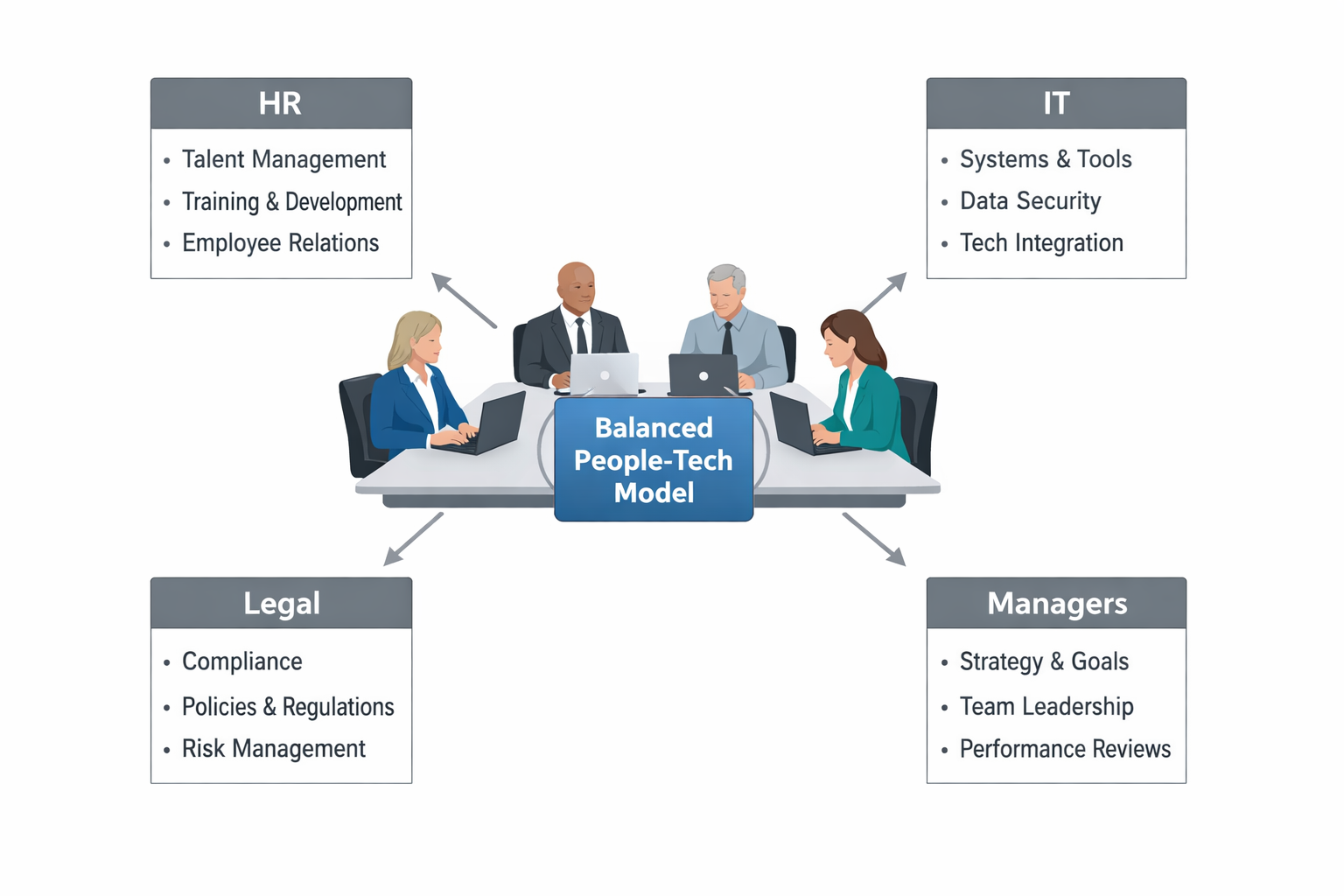
6. Governance that works in practice: policy, human oversight, auditability, and cross-functional ownership
Good governance is the difference between an AI experiment and an AI program. In HR, governance has to be operational, not ceremonial. It should answer who approves use cases, which data can be used, what level of human review is required, how issues are escalated, and how the organization will monitor outcomes over time. SHRM’s 2026 report suggests that organizations are increasingly setting policy and compliance steps alongside AI adoption, which reflects the reality that governance can no longer be an afterthought. (shrm.org)
Policy is the first layer. A practical HR AI policy should define approved use cases, prohibited uses, data handling standards, vendor review requirements, and required employee disclosures. It should also explain whether staff can use public AI tools for HR work, what kinds of information are off limits, and what happens when a model makes a poor recommendation. In the U.S., this policy layer needs to align with antidiscrimination, privacy, and consumer protection obligations. In Europe, it needs to align with the AI Act’s risk-based framework and the obligations tied to high-risk systems. (eur-lex.europa.eu)
Human oversight is the second layer. That means a named person or role is responsible for reviewing high-impact outputs, handling exceptions, and intervening when the system behaves unexpectedly. Oversight should not be symbolic. It should be built into the workflow so that decisions can be paused, reviewed, and corrected. This is especially important in recruitment, promotions, performance-related workflows, and worker monitoring. The EU AI Act explicitly flags these employment contexts as high-risk, underscoring the need for active oversight and documentation. (eur-lex.europa.eu)
Auditability is the third layer. Organizations should be able to answer basic questions after the fact: What model or vendor was used? What data informed the output? Who reviewed it? Was the recommendation accepted, changed, or rejected? Without audit logs, HR cannot investigate complaints, test for bias, or prove compliance. Cross-functional ownership is the final layer because no single function can govern HR AI alone. HR, legal, IT, security, procurement, privacy, and business leadership all need a seat at the table. AI governance works best when it is embedded in existing decision structures rather than bolted on as a separate committee with no authority. (ftc.gov)
7. The legal and regulatory reality: why HR AI programs now need jurisdiction-by-jurisdiction review
For global employers, one of the hardest truths in 2026 is that there is no single HR AI compliance framework that fits every country or even every U.S. state. The EU AI Act treats many employment-related AI systems as high-risk and sets obligations tied to that classification. The regulation is explicit that systems used in recruitment, selection, task allocation, monitoring, evaluation, promotion, and termination can fall into that category. Meanwhile, in the U.S., the EEOC continues to enforce antidiscrimination law in hiring and worker assessment, and the FTC has made clear there is no “AI exemption” from consumer protection or fairness standards. (eur-lex.europa.eu)
This means HR AI programs need jurisdiction-by-jurisdiction review because the same tool may create different obligations depending on where it is used and who it affects. For example, an AI-assisted hiring workflow may raise one set of requirements in the EU, another set for U.S. equal employment compliance, and additional obligations if it touches state-level AI rules or contractor requirements. The Colorado AI Act is another sign of how quickly the regulatory landscape is evolving at the state level. Colorado’s AI-related rulemaking and recent legislative activity show that employers cannot assume the U.S. remains static or uniform. (leg.colorado.gov)
The practical implication is that global HR teams need a review process, not a one-time legal memo. That process should map each AI use case to the jurisdictions where it will operate, the categories of employee data it uses, the decision it influences, and the applicable laws or guidance. It should also include vendor diligence and documentation retention. If a system is used in hiring, compensation, promotion, scheduling, or employee monitoring, legal review should be more stringent than for low-risk administrative support. (eur-lex.europa.eu)
The broader lesson is simple: HR AI is no longer a purely internal technology choice. It is a regulated operational decision. Leaders who treat compliance as part of the design process will move faster than those who bolt it on later. (eur-lex.europa.eu)
8. A better employee experience model: using AI to reduce friction in onboarding, benefits, internal mobility, and support
The most employee-friendly uses of AI in HR are often the ones that remove friction from everyday experiences. Onboarding is a good example. New hires usually need answers about paperwork, systems access, team norms, benefits, schedules, and where to find help. AI can guide them through these steps, surface the right resources, and reduce the time it takes to become productive. When done well, this makes onboarding feel more human because fewer people get stuck waiting for basic information. (shrm.org)
Benefits support is another strong use case. Employees rarely need a full policy manual; they need a clear answer to a specific question at the moment they have it. AI can help interpret plan options, explain deadlines, direct people to the correct forms, and route complex cases to human specialists. This is especially useful during open enrollment or life events, when HR teams face spikes in questions. The key is to make sure the AI is grounded in approved content and that it can escalate when the issue is sensitive or individualized. (ftc.gov)
Internal mobility may be the most strategically important employee-experience use case of all. If AI can help employees understand role requirements, surface adjacent opportunities, recommend learning pathways, and connect skills to available jobs, it can improve both retention and workforce agility. LinkedIn’s learning research connects career development with stronger business confidence and talent outcomes, reinforcing the idea that employee growth and workforce planning should be linked. AI is useful here not because it replaces human career conversations, but because it makes them more informed and more accessible. (business.linkedin.com)
Support services also benefit. Many employees do not want to submit a ticket for every question, but they do want a quick, reliable answer. AI can become the front door for HR service, provided that employees know when the answer is informational and when a human needs to step in. The best employee-experience model is not “AI instead of HR.” It is “AI that makes HR easier to reach, easier to understand, and faster to use.” (shrm.org)
9. Metrics that matter: how to measure AI success in HR beyond time saved
One of the most striking findings in SHRM’s 2026 report is that many HR teams are not formally measuring the success of their AI investments. The report notes that a large share of professionals rely on broad indicators like productivity, cost savings, improved decision-making, and employee satisfaction, while many do not use a dedicated ROI metric at all. That matters because time saved is not the same as value created. An AI tool can shorten a task and still fail if it harms trust, creates rework, or produces low-quality decisions. (shrm.org)
A better measurement model starts with the business outcome. In recruiting, success might include time-to-fill, quality-of-hire, candidate drop-off, recruiter capacity, and fairness indicators. In learning, it might include course completion, skill progression, manager confidence, internal mobility, or performance improvement. In employee experience and service delivery, useful metrics include first-contact resolution, response time, ticket deflection, employee satisfaction, and escalation rates. In manager support, leaders should look at decision confidence, adherence to policy, reduced administrative burden, and employee perceptions of managerial effectiveness. (shrm.org)
Equally important are risk and trust metrics. If an AI tool speeds up hiring but increases adverse impact or generates more complaints, that is not success. If an HR assistant answers questions faster but gives wrong information, that creates hidden cost. Leaders should track override rates, error rates, policy exceptions, audit findings, and user trust. These are not “soft” measures; they are indicators of whether the system is fit for sustained use. The EU and U.S. regulatory environment makes this even more important because organizations must be able to show that they are monitoring outputs and managing risks responsibly. (eur-lex.europa.eu)
The smartest HR teams are building scorecards with both operational and human metrics. That gives them a more honest view of value and helps them decide whether to expand, redesign, or stop a use case. In 2026, the question is not whether AI saves time. It is whether it improves outcomes in a way that is measurable, defensible, and worth scaling. (shrm.org)
10. A practical roadmap for HR leaders: start small, design for adoption, scale responsibly
A practical HR AI roadmap in 2026 starts with a narrow problem and a clear owner. The best early use cases tend to be high-volume, repetitive, and low-to-medium risk: employee support, onboarding guidance, learning recommendations, recruiter assistance, or manager coaching prompts. These are areas where AI can show value quickly without immediately touching the highest-stakes decisions. SHRM’s adoption data and Deloitte’s workplace research both suggest that organizations are moving most confidently where the use case is tangible and the workflow can be redesigned around it. (shrm.org)
The second step is to design for adoption. That means involving end users early, writing plain-language guidance, defining escalation paths, and training managers on how to use the tool responsibly. It also means being honest about limitations. If the AI is good at summarizing policy but not interpreting edge cases, say so. If the recommendation should be reviewed by a person, make that explicit. Adoption improves when people understand what the tool does and what it does not do. (ftc.gov)
The third step is governance by design. Before scaling, HR leaders should confirm the policy, human oversight, audit logs, vendor terms, and legal review are in place. For global organizations, that review should be jurisdiction-specific, especially where employment-related AI may be considered high-risk or otherwise regulated. The goal is to avoid launching something that later needs to be shut down or heavily reworked. (eur-lex.europa.eu)
The final step is to scale only after the pilot proves both value and trust. That means the tool improved a meaningful HR metric, users actually adopted it, and the organization can explain and defend its use. Scaling responsibly may feel slower than pushing everything at once, but it is ultimately faster because it avoids the cycle of pilot, backlash, and retreat. In 2026, the winning formula is simple: start small, design for people, govern tightly, measure broadly, and expand only when the system proves it deserves to grow. (shrm.org)
Conclusion
AI in HR in 2026 is no longer mainly about recruiting automation. It is about changing how HR operates, how managers make decisions, and how employees experience the workplace. The strongest programs are using AI to improve hiring, learning, service delivery, onboarding, internal mobility, and manager support. They are also recognizing that value only lasts when trust, governance, and legal compliance are built in from the start. (shrm.org)
The key takeaways are straightforward: AI should reduce friction, not add it; human oversight remains essential in high-impact decisions; measurement must go beyond time saved; and global HR programs now need jurisdiction-specific review. Leaders who treat AI as an operating-model shift will be best positioned to capture its benefits responsibly. Leaders who treat it as a standalone tool risk ending up with impressive pilots and disappointing adoption. (shrm.org)