
AI-First MVP Development: How Teams Can Validate Faster Without Cutting Corners
July 11, 2026
Building a new product has always involved uncertainty, but today that uncertainty arrives with more pressure, more competition, and less patience. Users expect useful software quickly. Investors, stakeholders, and internal teams want evidence that an idea is worth scaling. In that environment, the minimum viable product, or MVP, is no longer just a lean startup buzzword. It’s a survival tool.
The challenge is that “move fast” often gets misunderstood as “skip the hard thinking.” That leads teams to ship vague products, overbuild features, or confuse activity with validation. The better approach is to use AI to compress the discovery and delivery cycle without compressing judgment. AI can help teams turn assumptions into testable hypotheses, analyze feedback faster, generate interface ideas, and support more structured experimentation. OpenAI’s Structured Outputs, for example, is designed to make model-generated outputs conform to developer-supplied schemas, which is useful when teams need AI-assisted workflows to stay predictable and machine-readable rather than messy and ad hoc. (openai.com)
At the same time, the core logic of MVPs remains unchanged: build the smallest thing that can prove value, learn from real users, and decide what to do next. Atlassian’s product guidance emphasizes that MVPs are the simplest version of a product used to validate ideas and gather feedback, while product discovery and prioritization practices help teams focus on the right problems before committing to full-scale development. (atlassian.com)

1. Why MVPs matter more now than ever: the pressure to validate ideas quickly in crowded markets
MVPs matter more now because the cost of being wrong is higher and the window for learning is shorter. Markets are crowded, competitors can copy features quickly, and user attention is fragmented. A team that spends months building a polished product before testing demand risks discovering too late that the problem was not painful enough, the audience was too small, or the proposed solution missed the mark. Atlassian describes an MVP as the simplest version of a product that helps teams validate ideas and gather feedback with minimal effort, which is exactly why it is so valuable in high-speed markets. (atlassian.com)
The pressure to validate quickly is not just about speed; it is about reducing uncertainty. An MVP creates a controlled way to answer the biggest questions early: Do users actually care? Will they sign up, pay, return, or recommend? What matters most to them? Without that evidence, teams often rely on opinions, internal excitement, or feature checklists that feel productive but don’t prove market need. ProductPlan notes that customer validation is a core phase in taking a product from concept to market and that MVPs help attract early adopters while validating assumptions and hypotheses. (productplan.com)
In crowded markets, speed must be paired with precision. Launching something quickly is only useful if the team knows what it is trying to learn. That means framing the MVP as a learning machine, not a tiny version of the final product. The best teams define the riskiest assumptions first, then design the MVP to test those assumptions with the fewest possible dependencies. This is where many projects fail: they confuse “minimal” with “underdeveloped,” or “viable” with “feature-rich.” A strong MVP is neither. It is a focused experiment with a real user value proposition.
The practical implication is clear: every week saved before launch matters, but only if the week saved leads to clearer learning. In today’s environment, an MVP is not about rushing to market for its own sake. It is about shortening the distance between an idea and a credible signal.
2. How AI is reshaping product discovery: turning assumptions into testable hypotheses faster
AI changes product discovery by reducing the friction between a vague idea and a testable plan. Instead of spending days manually synthesizing notes, drafting user stories, or brainstorming edge cases, teams can use AI to accelerate the first pass. That does not mean AI decides the product. It means AI helps the team get to sharper questions faster. OpenAI’s documentation on Structured Outputs and function calling shows how models can be used to produce structured, schema-aligned outputs for workflows such as extracting data, generating interfaces, and supporting multi-step tasks. (openai.com)
This matters because product discovery is often bottlenecked by ambiguity. A founder may say, “We need a better onboarding flow,” but that statement is still a hunch. AI can help transform that into hypotheses such as: “If we reduce signup fields from eight to three, completion will increase,” or “If we surface the primary value proposition earlier, activation will improve.” Those hypotheses are testable. Once a team has them, it can design experiments, analyze responses, and prioritize more rationally.
AI is also helpful in digesting qualitative inputs at scale. Interview transcripts, support tickets, sales notes, and survey answers can be summarized into themes faster than a human team could do manually. The important caveat is that AI should support synthesis, not replace it. The most useful discovery outputs still require people to interpret context, detect nuance, and understand what users are actually trying to achieve. In other words, AI can speed up the process of making sense of messy information, but it cannot reliably tell you which customer pain is strategically important.
A good AI-supported discovery process usually includes:
faster summarization of customer interviews,
clustering repeated pain points,
drafting prototype copy and flows,
generating experiment ideas,
and translating qualitative findings into explicit hypotheses.
Atlassian’s product discovery guidance emphasizes continuous evaluation of data, collaboration, and prioritization methods such as RICE or opportunity-solution trees. AI fits well into that system because it helps teams process more inputs without becoming slower or more reactive. (atlassian.com)
The biggest shift is cultural: teams no longer need to treat discovery as a slow, mostly manual phase. With AI, discovery can become a rapid loop of “sense, hypothesize, test, refine.” That is a major advantage, as long as humans remain responsible for deciding what the findings mean.
3. The modern MVP stack: combining AI, no-code, and modular engineering for rapid delivery
The modern MVP stack is less about choosing one perfect tool and more about combining the right layers for speed and flexibility. AI helps with research, writing, synthesis, and workflow automation. No-code tools help teams assemble interfaces and simple workflows without heavy engineering. Modular engineering ensures that what gets built can evolve without being thrown away later. Together, these approaches let teams validate faster while preserving a path to scale.
This stack works best when each layer has a clear job. AI should accelerate ideation, analysis, and task automation. No-code should handle fast prototyping, landing pages, simple dashboards, forms, and internal tools. Modular engineering should create the parts that are likely to survive beyond the MVP: authentication, billing logic, core data models, API boundaries, and reusable services. OpenAI’s guidance on structured outputs and function calling is especially relevant here because it supports more reliable AI-powered workflows when applications need predictable data exchange rather than free-form text. (openai.com)
This approach helps teams avoid the classic MVP trap: building everything custom too early. A lot of product teams assume that a real MVP must be fully hand-coded. In practice, that often slows learning and increases waste. If the goal is to prove demand, there is no prize for rewriting a prototype in the most expensive way possible. The goal is to find the fastest credible path to user evidence.
A modern stack can look like this:
AI for interview synthesis, copy drafts, and experiment suggestions
No-code or low-code for prototype experiences
Lightweight backend services for critical logic
Modular APIs for future extensibility
Analytics and event tracking built in from day one
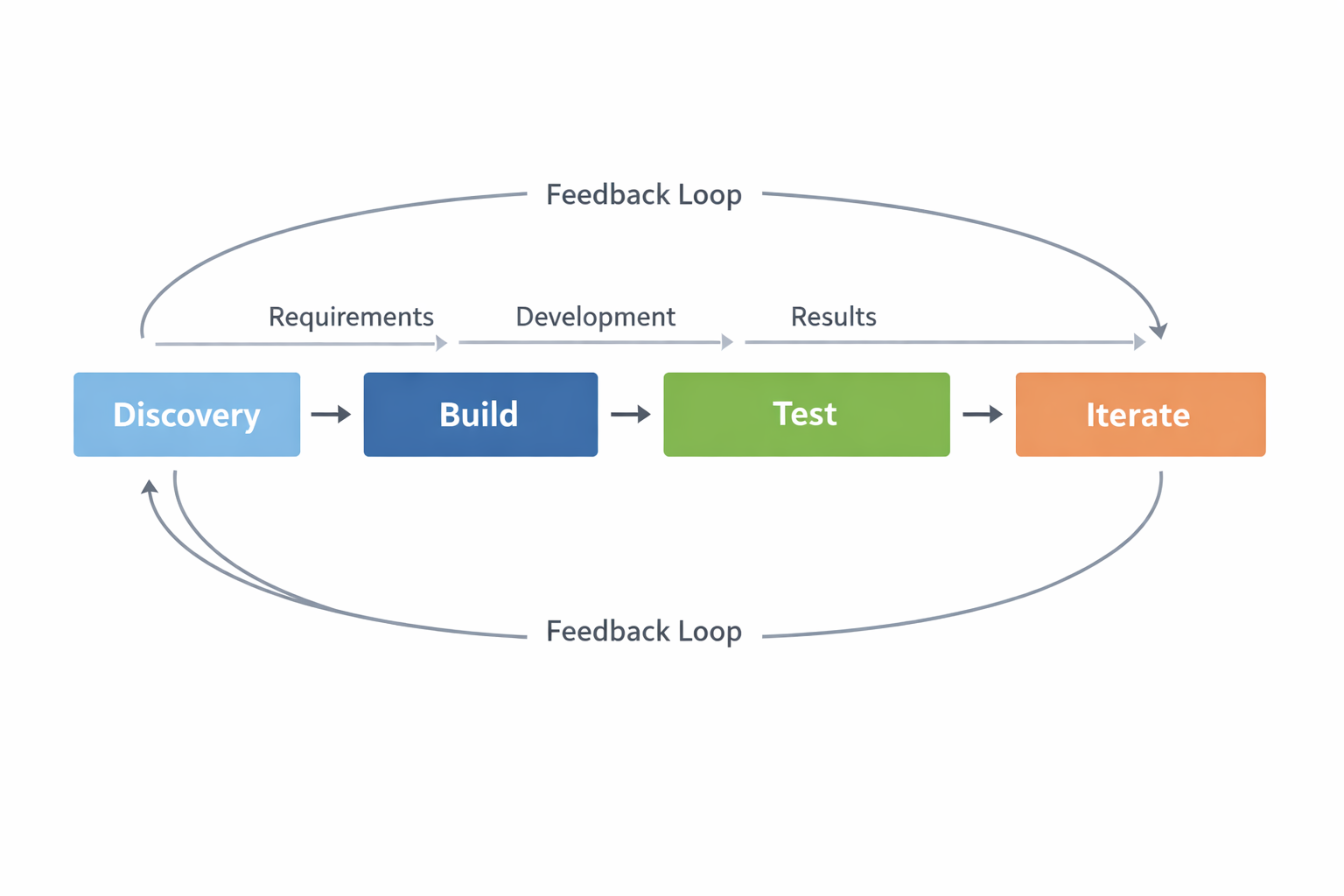
This blend also supports team efficiency. Designers can test flows without waiting on engineering. Product managers can refine hypotheses faster. Engineers can focus on the pieces that matter most. The result is not “less serious” software; it is more strategically layered software. Atlassian’s product and discovery resources reinforce the value of visibility, collaboration, and prioritization, which are essential when multiple tools are used together. (atlassian.com)
The strongest MVP stacks are designed with transition in mind. They are fast enough to launch quickly, but not so fragile that the team must restart from zero if the idea gains traction.
4. What a strong discovery phase should uncover before any code is written
A strong discovery phase should answer four questions before code begins: who the user is, what problem they are solving, why current options are insufficient, and what proof would convince the team the idea is worth pursuing. If those questions are still fuzzy, building is premature. Atlassian’s discovery guidance emphasizes capturing and prioritizing ideas, while customer validation resources underscore the role of hypotheses and early-adopter feedback in shaping what gets built next. (atlassian.com)
Discovery should uncover the underlying job-to-be-done, not just a requested feature. Users often describe solutions, but the team needs to identify the real friction. For example, someone may ask for “better reporting,” but the actual need may be “I need to know whether my campaign is working without spending an hour exporting spreadsheets.” That distinction changes the product direction entirely. A good discovery process captures these deeper motivations through interviews, observation, and pattern analysis.
Before writing code, teams should aim to uncover:
the primary user segment,
the core pain or opportunity,
the current workaround,
the moment when the problem becomes urgent,
the expected value of solving it,
and the smallest signal that would indicate product-market fit is possible.
AI can help here by accelerating synthesis, but it should not replace direct customer contact. Discovery is strongest when AI helps organize information after the team has gathered it from real humans. That human evidence is what grounds the MVP in reality.
The discovery phase should also reveal what not to build. This is critical because early product teams often waste time on edge cases, secondary user types, or “nice-to-have” features that do nothing to validate the core value proposition. A disciplined discovery phase creates boundaries. It tells the team which assumptions are worth testing now and which can wait.
If discovery is done well, the MVP becomes much easier to scope. Instead of asking, “What can we fit in version one?” the team asks, “What is the smallest experience that would expose the truth about this opportunity?” That is a much better question.
5. Prioritization that protects speed: choosing the smallest product that can prove value
Prioritization is where speed is protected or destroyed. A fast team is not one that says yes to everything quickly. It is one that says no to most things based on a clear standard. The standard for an MVP should be simple: choose the smallest product that can prove value. Atlassian’s prioritization guidance stresses using data and insights to prioritize, rather than gut feel or loud opinions, and its growth product management material warns against scopes that are too small to produce meaningful learning. (atlassian.com)
This creates an important balance. On one hand, the team must stay minimal. On the other hand, the MVP must be big enough to produce a valid signal. If it is too thin, the team may get a false negative and wrongly conclude there is no demand. Atlassian explicitly notes that too small a scope can doom a promising experiment to failure by creating misleading results. (atlassian.com)
A good prioritization method considers both user value and learning value. That means asking:
Which feature or flow is essential to the core promise?
Which assumption is most dangerous if wrong?
Which part of the experience will users actually notice?
What can be postponed without harming the test?
This approach often leads to uncomfortable cuts, but those cuts are what make the MVP useful. A product can be small and still meaningful. In fact, the smaller the team can make the surface area of uncertainty, the easier it becomes to learn.
Prioritization also benefits from AI support. AI can help compare options, summarize feedback, and surface repeated pain points. But the decision itself should stay human. Product judgment involves strategy, timing, and tradeoffs that models cannot own. The team must decide not only what is easiest to build, but what will produce the clearest evidence about future direction.
A well-prioritized MVP usually includes one core promise, one target audience, one primary action, and one measure of success. Everything else is optional. That kind of discipline protects speed more effectively than any project management trick.
6. Human judgment still wins: where founders and product teams must not automate blindly
AI can accelerate many parts of MVP development, but it should not be trusted blindly in places where context, ethics, or strategy matter most. Founders and product teams still need to make the final calls on market fit, positioning, user empathy, and acceptable tradeoffs. AI is extremely useful for draft work, pattern detection, and workflow automation. It is much less reliable when the question is “What should we build?” rather than “How can we help with the work?”
OpenAI’s own documentation is a useful reminder here. Structured Outputs improves reliability by constraining model responses to developer-supplied schemas, but it does not eliminate all kinds of mistakes. The guidance also notes that developers should split tasks into simpler subtasks or provide examples when mistakes occur. That is a strong signal that human oversight is still necessary for meaningful product decisions. (openai.com)
There are several areas where blind automation is risky:
interpreting emotional or behavioral nuance in customer research,
choosing product strategy based on shallow pattern matching,
generating copy that misrepresents the value proposition,
deciding eligibility, pricing, or access rules without review,
and approving outputs that could create legal, trust, or brand issues.
Human judgment is also essential when the signal is ambiguous. An MVP launch may produce mixed data: strong curiosity, weak retention, positive feedback but low conversion, or high activation but limited repeat use. AI can summarize the numbers, but it cannot fully explain the market reality behind them. That explanation requires people who understand the business context and can ask the next right question.
The healthiest mindset is not “AI versus humans” but “AI with humans in the loop.” Use AI to reduce toil, not accountability. Let it help the team move faster, but keep the decisions that shape the product’s direction in human hands.
This is especially important for early-stage teams, where small mistakes can compound. An inaccurate assumption in an MVP can lead to wasted weeks or misallocated budget. Human review provides a critical safety net. In practice, the teams that win are often not the ones using the most automation; they are the ones using automation with the most discipline.
7. Building for iteration, not perfection: designing feedback loops into the first release
A good MVP is designed to teach, not to impress. That means building feedback loops into the first release so the team can learn what to change next. If a launch cannot produce meaningful user behavior data, direct feedback, or iteration opportunities, then it is not truly viable. Atlassian’s MVP guidance emphasizes building, testing, refining, and growing step-by-step, which is the right mindset for an iterative product cycle. (atlassian.com)
Iteration starts with instrumentation. The team should know what users do, where they drop off, and what actions matter most. Even simple MVPs need event tracking, qualitative feedback channels, and a process for reviewing insights quickly after launch. Without this, teams end up guessing whether the product is improving or merely changing.
Feedback loops can include:
in-app surveys or short post-task prompts,
interview follow-ups with early users,
usage analytics on the core action,
support conversations as product signals,
and weekly review sessions where product, design, and engineering evaluate learning.
The key is to make iteration part of the initial design, not a later add-on. If the team waits until after launch to think about feedback, it may not have the right data architecture or user contact plan. In an AI-first workflow, AI can help summarize feedback faster, cluster recurring issues, and draft proposed changes. But the team still needs to decide which issues represent a meaningful pattern and which are one-off noise.
Iteration also requires psychological discipline. Early teams often fall in love with their first release and resist making changes. That is a mistake. The first version is supposed to be incomplete in useful ways. Its job is to surface truth. If a team treats it like a finished product, it may overreact to superficial praise or ignore valuable criticism.
A release built for iteration should ask users to do one meaningful thing, measure that action clearly, and make it easy for the team to respond. That is how an MVP becomes a compounding learning system rather than a one-time launch.
8. Common mistakes that slow MVPs down: overbuilding, vague scope, and weak validation signals
The most common MVP mistakes are usually not technical; they are strategic. Overbuilding, vague scope, and weak validation signals can slow a team down more than any engineering challenge. Atlassian’s guidance on growth product management warns that scope can be too small to learn from, but the opposite problem is just as common: teams build too much and end up validating nothing because the product took too long to ship. (atlassian.com)
Overbuilding happens when teams confuse confidence with completeness. They add features to make the product feel “real” before knowing whether users care. This creates delays, more dependencies, and more room for hidden complexity. It also makes it harder to tell which part of the product is actually producing value.
Vague scope is equally dangerous. If the team cannot clearly define the user, the use case, and the success metric, the project drifts. Everyone may agree that the idea is good, but nobody can say what the MVP is trying to prove. That usually leads to endless discussion and shifting priorities.
Weak validation signals are the silent killer. Launching to “a lot of interest” is not the same as validation. Page visits, signups, likes, and compliments are all useful, but only if they map to the behavior the business actually needs. The right signal might be activation, repeat usage, paid conversion, referrals, or time-to-value. Without a pre-agreed signal, teams can rationalize almost any result.
The most damaging mistakes tend to come in combinations:
overbuilt product + unclear target user,
fast launch + no measurement plan,
good feedback + wrong metric,
or strong curiosity + no retention.
The cure is discipline. Define the riskiest assumption, scope the smallest meaningful test, and choose metrics that reflect actual value creation. AI can help reduce the busywork around all of this, but it cannot rescue a product strategy that was vague from the start.
If a team wants to move quickly without cutting corners, the goal is not simply to “ship sooner.” The goal is to ship less, learn more, and decide better.
9. A practical launch framework: from concept to first users with lower risk and clearer learning
A practical AI-first MVP launch framework should feel like a series of disciplined handoffs, not a giant leap. The sequence matters because each step reduces uncertainty before the next commitment is made. Atlassian’s resources on discovery, prioritization, and MVPs support this stepwise approach: capture ideas, validate assumptions, prioritize the right problem, build the smallest useful version, and then learn from real users. (atlassian.com)
A simple framework looks like this:
Define the problem
Turn assumptions into hypotheses
Run discovery
Choose the smallest meaningful test
Build with the lightest viable stack
Launch to a small, real audience
Review, iterate, or stop
This framework lowers risk because it makes each step reversible for as long as possible. Teams do not commit to a large build until the evidence supports it. They do not rely on intuition alone, and they do not wait for perfection. Instead, they create a system for making good decisions faster.
The advantage of AI in this framework is not that it replaces the steps. It makes each one faster and more scalable. It helps summarize, draft, compare, and automate. But the framework itself remains grounded in product discipline.
10. What to measure after launch: traction, retention, and the next decision point
After launch, the most important question is not “Did users like it?” It is “Did the product create enough value to justify the next step?” That requires measuring traction, retention, and the decision point that follows. If the launch generated interest but no sustained behavior, the team may need to reposition or narrow the target audience. If it created repeated use and clear value, the team may be ready to scale.
At a minimum, teams should measure:
Traction: Are people discovering and trying the product?
Activation: Do they reach the core value quickly?
Retention: Do they come back?
Conversion: Do they pay, upgrade, or commit?
Referral or advocacy: Do they recommend it?
These metrics matter because they reveal whether the MVP solved a real problem well enough to earn more attention. Atlassian’s MVP guidance emphasizes learning from real-world testing and iteration, and product discovery materials reinforce the idea that teams should continuously evaluate data and adjust priorities based on evidence. (atlassian.com)
Retention deserves special attention. Many MVPs generate excitement on day one but fail to create repeat behavior. That usually means the product addressed curiosity more than necessity. Traction tells you whether the message is working; retention tells you whether the product itself is working.
The next decision point should be explicit. After the first launch cycle, the team should decide one of three paths:
Scale: signals are strong enough to invest more.
Iterate: the core idea has promise, but the experience needs refinement.
Stop or pivot: the evidence does not support continuing as-is.
AI can help with this analysis by synthesizing feedback and tracking usage patterns, but the decision should be anchored in a clear product thesis. Otherwise, teams drift into endless tweaking without learning.
The best MVP programs are not just about launching faster. They are about making the next decision with more confidence. That is what turns an experiment into a business.
Conclusion
AI-first MVP development is not about replacing product thinking with automation. It is about using AI to remove friction from the parts of development that slow teams down: discovery, synthesis, prioritization, and iteration. The teams that benefit most are the ones that stay disciplined about scope, use real user evidence, and keep humans responsible for the decisions that matter most.
The core lesson is simple: validate faster, but do not cut corners. Use AI to sharpen hypotheses, no-code to move quickly, and modular engineering to avoid dead ends. Invest in discovery before building, prioritize the smallest meaningful test, and design the launch so it can teach you something useful. Then measure traction and retention with enough honesty to make the next decision well.
In crowded markets, speed matters. But speed without learning is just motion. The strongest MVPs are the ones that turn motion into insight.